Showing posts with label Hal Leonard. Show all posts

Sunday, August 10, 2025

Vinyl Madness 2025: Part 1...

...because I’m certain of a Part 2 within another few weeks.


As befits this 75th anniversary year of Peanuts — October 2 is the actual diamond anniversary date — all manner of folks have jumped on the bandwagon: everything from clothes and plush, to toys, electronics and even art installations.


Needless to say, that list includes the two record labels dedicated to Guaraldi.


Vinyl variants of A Charlie Brown Christmas have been an annual tradition since 2014, but this year Craft Recordings — in partnership with numerous retailers — has pulled out all the stops.


But before discussing those, let’s first focus on the holiday that too frequently feels forgotten, between Halloween and Christmas.


Lee Mendelson Film Productions will issue a pair of
Charlie Brown Thanksgiving variants: a picture disc, exclusive to Barnes & Noble (different from their 2024 picture disc); and a "yellow jelly bean" disc, exclusive to Record Store Day.

The Barnes & Noble album can be ordered here.


Information on Record Store Day’s participating brick-and-mortar outlets is here.


Both albums will be released on September 26.


********


Moving on to A Charlie Brown Christmas...


To paraphrase Bette Davis from 1950’s All About Eve, "Fasten your seat belts; it’s going to be a bumpy ride!”


We’re anticipating nine vinyl variants. They’re all discussed in Craft’s official press release.


The snazziest is this zoetrope disc from Craft, scheduled for release on September 26:


It can be pre-ordered here, and do check out this nifty promotional video. (It also can be purchased at Amazon and your local brick-and-mortar record store, among other outlets.)


The most unusual release will be this 4-inch “tiny vinyl” from Target, with only one song on each side: “Linus & Lucy” and “Christmas Time Is Here.” It’ll be released on October 31, and can be pre-ordered here.


Craft also is releasing a standard black vinyl disc in a holographic foil jacket; Walmart is releasing a red and gold vinyl in a similar holographic foil jacket. Both will be available August 29. The Craft LP can be ordered here (and is available elsewhere, as well); the Walmart album can be ordered here.


Best Buy will issue a bright neon green vinyl disc in a holographic foil jacket; Craft also will feature a glitter-colored vinyl in a holographic foil jacket. Both also will be available August 29. Pre-order the Best Buy album here, and the Craft album here (and this one is exclusive to Craft).


Barnes & Noble will feature a truly nifty two-sided picture disc, available September 26 (and, again, it's different from previously released picture discs); Target’s second offering will be a tree-green disc in a holographic foil jacket, available October 10. Pre-order the Barnes & Noble disc here; and the Target album here.


Finally, Urban Outfitters will offer a “blizzard swirl” album in a holographic foil jacket; it's expected on October 17, and can be ordered here.


Folks interested in “one stop shopping” will find links for most of the above here, along with mention of numerous other iterations.


Craft hasn’t yet released details about its plans for It’s the Great Pumpkin, Charlie Brown — which is ironic, since Halloween comes before the other two holidays! — although I am aware of a “ghost white” pumpkin-shaped vinyl, exclusive to Target, which can be ordered here. I'll include that when I got full information about Halloween releases, which should follow shortly in the promised Part 2.


********


On an entirely different note (no pun intended)...

Folks with keyboard talents, and a desire to emulate Dr. Funk, will be pleased by the pending arrival of this new songbook from Hal Leonard: Music from Peanuts Holiday Specials


Sean and Jason Mendelson worked with the publisher, to select the best tracks from the more recently released TV special scores.


The complete song list:


• Charlie Brown Theme

• Charlie Brown's Wake-Up

• Charlie's Blues

• Christmas Is Coming

• Christmas Time Is Here

• Easter Theme

• Graveyard Theme

• The Great Pumpkin Waltz

• Heartburn Waltz

• Linus And Lucy

• Linus And Lucy - Easter Beagle Edition

• Little Birdie

• Marcie's Song (Kitchen Music)

• Never Again

• Paw Pet Overture

• Peppermint Patty

• Red Baron

• Skating

• Thanksgiving Theme

• Woodstock's Dream


Although some of the above have appeared in previous songbook collections, roughly half have been transcribed for the first time. The book can be preordered here.


Time to flex those fingers! 


********


And, one final note: I spent an enjoyable half-hour discussing Guaraldi on the most recent edition of Davisville, the local public affairs radio show hosted by longtime journalist Bill Buchanan. He has been very generous about granting me air time to discuss my biography, and other Guaraldi-related matters. You can listen to the show here.

Wednesday, April 30, 2025

From album to manuscript page

I’ve played piano since childhood, although I never rose beyond the level necessary to perform for local community theater productions. Even so, I’ve continued to dabble, and of course have purchased every Guaraldi songbook or sheet music single that came to my attention.

I started young. In the late '60s and early ’70s, Pointer Publications, a division of what then was Hal Leonard/Pointer Publications, put out a series of easy piano books — the Peanuts Keyboard Fun series — which were adapted from the early TV specials. The books typically contained 32 pages, and the two center pages featured full-color illustrations from the show in question. The musical contents tended to cross over from book to book; in other words, if you had two books, they’d have some of the same songs, and some unique to each book.


The books were $2.95 each, and included the following volumes:


 • A Charlie Brown Christmas

 • Charlie Brown's All Stars

 • It’s the Great Pumpkin, Charlie Brown

 • You’re in Love, Charlie Brown

 • He’s Your Dog, Charlie Brown

 • It Was a Short Summer, Charlie Brown


My library has grown substantially since then, and recent years have been a true Renaissance. As a sidebar to all the recent Peanuts soundtrack albums released by Lee Mendelson Film Productions, Sean and Jason Mendelson also worked with Hal Leonard LLC, a music publishing and distribution company that dates back to 1947, to publish many cues and songs never before released in sheet music format, as I covered in an earlier post.


I recently realized, as a result of my ongoing collaborations with Sean and Jason, that I had an “in” to answer a question that has long intrigued me:


How does a song get transcribed? What’s the process?


Sean put me in touch with Ben Culli, Hal Leonard’s Vice President of Editorial and Production, who turned me over to keyboard publications editor Mark Carlstein. He and I had a delightful chat a few weeks ago, and all my questions were answered.


The first one was obvious: Are transcribers musicians themselves?


“Yes,” Mark replied, “that’s absolutely imperative.”


So ... when starting work on a new tune, Mark — a pianist himself — handles the initial steps.


“The first thing is to get a good recording that’s indicative of the song. If I’m looking at Bill Evans, he might have recorded a given tune half a dozen times, and I’d want one that best represents him playing that music.”


Next: “catalogue” the tune.


“Every song has a road map. In the same way you’d follow a route, to get from A to B, a given song will last a certain number of bars, in a certain time signature, and in a certain key signature. Some sections may repeat, or not; typically in jazz, you don’t have exact repeated sections, as often is the case in pop music.


“I then send the representative tune to one of our transcribers, along with my road map; they listen to it, and write down everything they hear. All the parts are important. If words are part of the song, those words also must be transcribed. All of the melody’s rhythms must be notated precisely.


“What you look at, when you sit down to play something from a songbook, is a finished document that the transcriber built from the ground up.”


In the case of a Guaraldi trio composition, the transcriber pays attention to both the keyboard work, and the bass, to pick up the latter’s supplementary notes. 


“The trio musicians will be playing the same harmonies and chords, but not necessarily the same notes. (We always ignore the drums, because that’s a non-tonal portion of the recording.)”


Vocalists, often backed by larger ensembles, are trickier.


“Take a Taylor Swift recording. It’ll have a bass line, a guitar player, a piano player, perhaps another keyboard player, perhaps a secondary guitar player, the vocals and the words. All of that must be distilled into something that can be played — say, in the case of a pianist — by one person with two hands. As a result, a lot of compromises are involved, and it’s necessary to focus on the essence of the song. 


“How much of what the bass player does should be included? Some of it can’t be played by a pianist, and it’ll never be in the same octave, because what the bassist plays sounds too low on a piano keyboard; the two hands must be kept closer together. 


“You also can’t play a busy guitar part at the same time you’re playing the melody and bass line.


“Everything can’t be included, and that’s the biggest challenge for our transcribers who handle vocals, because we always include the melody in the right hand, and everything else must be inserted around that. Our transcribers therefore start first and foremost with the melody, because it’s imperative that it be presented in a way that can be played by that one person with two hands.”


Are vocal pieces easier than instrumentals?


“Yes, because you’re looking primarily at the melody and bass line; far fewer parts must be coordinated into a single playable score. 


“Alternatively, right now I’m working with one of our best transcribers on a jazz piano Omnibook, which includes classic recordings by Herbie Hancock, Oscar Peterson and everybody else you’d immediately recognize. But few of the pieces are solo piano; most involve at least bass and drums, and perhaps one or two horns. In such cases, you can’t include every single thing that every instrument plays, but all of the piano stuff is transcribed precisely — everything exactly as was played by that particular artist, on that particular recording — and the other instruments go onto other staves. One pianist can’t possibly play everything, but an Omnibook like this serves as a reference of sorts.”


What determines the necessary skill level required to play the result?


“That gets into arrangements. ‘Exact transcription’ means note for note, and the result can be quite complex and extremely difficult to play, because we’re talking about musicians who have extraordinary skills. If you’ve tried to play anything by Oscar Peterson, you know right away; it’s next to impossible. But something like the Omnibook isn’t what Hal Leonard does most. The bulk of what Hal Leonard does, is to take songs that people know, and to present them in different ways: different grade and skill levels. 

“Looking at just piano, we have at least a dozen different skill series, and of course we also have stuff for clarinet, violin and all sorts of other instruments. So, one person might do the initial transcription, and then several other people will handle the various arrangements.”


Why are some transcriptions in a key that differs from the original performance?


“We try to present things with no more than four sharps, or four flats. When we transcribe and arrange what we call ‘sheet music’ for the consumer, 1) the melody must be in the piano, so it can be played; and 2) it can only be reasonably difficult, at worst. 


“We’re super-conscious of keeping things at an average consumer’s ability level, so that almost anybody can pick up that sheet music and make use of it, and enjoy it. Part of that involves avoiding complicated key signatures.


“A lot of jazz and pop musicians like keys that have five and six flats, because it works well under their hands, like certain sharp keys work better for guitar players. 


“But the rest of us,” Mark added, with a chuckle, “don’t like seven sharps or seven flats.”


Indeed, some books are deliberately signature-simple.


“One of our most popular series is My First Fake Book, and every song is in the key of C major. We make it easy for the consumer, and of course you can transpose a song into any key you want.”


During my childhood, almost everybody I knew had a piano in their home, as also was the case in ours. These days, though, one sees very few pianos in homes. Has that affected sales of songbooks and sheet music singles?


“No, because all sorts of electronic keyboards are available these days; they’re less expensive and portable. The nature of the product has changed, because so much is available online; a lot of people download sheet music, as opposed to walking into a store and pulling something off a rack.”


Mark laughed at my next comment: One of my ongoing pet peeves has been the annoyance of square-bound songbooks. I’ve long felt that every songbook should be spiral-bound ... but I guessed (accurately) that must be too expensive.


“As far as I’m concerned, having the book stay open, while on the music rack, is the most important thing. So for Hal Leonard’s jazz piano solos series, at 96 pages, we switched the binding to what we call ‘lay-flat binding,’ so you can open the book anywhere, and it stays open and doesn’t split the spine.

“As it happens, the Guaraldi volume in that series is one of my favorites.”


That book is pictured at left; check it out here. Click on "closer look," below the photo, to see sample pages from "A Day in the Life of a Fool (Manha de Carnival)," "Great Pumpkin Waltz" and "Skating."


In the case of the Guaraldi cues and themes recently released in The Peanuts Piano Collection, Ben then explained that one final step was involved: “Sean reviewed the transcriptions prior to release, and offered a few very small suggestions and tweaks.”


And there you have it.


Many thanks to Mark and Ben, for fully satisfying my curiosity.

Tuesday, June 11, 2024

Bits & bobs: late spring 2024

The colored vinyl craze shows no sign of letting up.

When the soundtrack for A Charlie Brown Thanksgiving debuted last October, fans of solid media had a choice of formats: CD, plain black vinyl, Record Store Day's jelly bean green vinyl, and Target's cranberry vinyl.

Bet you thought that would be it, right?

Nope.

Those vinyl color variants blew out so quickly, many folks never even saw one in person, let alone were able to purchase one. Well, you'll have another chance. This coming October 18, participating Record Store Day outlets will unveil yet another vinyl variant: jelly bean purple! Details are here.

If you're late to the party, or need a reminder about the album details, check out this earlier post.

Honestly, my LP shelves are sagging...!

********

Back in early 2022, I ran a post about how the folks at Lee Mendelson Film Productions, in collaboration with Hal Leonard Publishing, had made (initally) 18 of Guaraldi's less well-known Peanuts themes and cues available via downloadable sheet music folios. 

Quite a few more subsequently were released, as you can discover by doing a search at Sheet Music Direct for "Vince Guaraldi." (It helps to narrow the search by sub-selecting "Piano Solo.")

Folks who prefer old-fashioned songbooks (and I'm one of them) will be pleased to learn that Hal Leonard has published 20 of these themes and cues in a book titled The Peanuts Piano Collection. It isn't new -- having been issued in May 2022 -- but I never got around to mentioning it ... until now.

********

The new content in the just-published second edition of my Guaraldi biography includes an appendix that lists the use of Guaraldi's music in popular culture ... which is to say, TV shows and movies. I tried to make it authoritative as of publication date, but (of course!) this is the sort of data that quickly becomes incomplete.

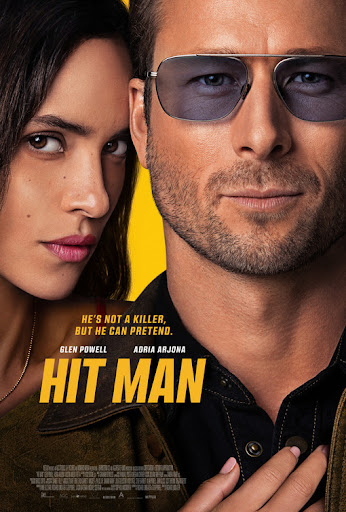
Case in point: director Richard Linklater's audacious new film Hit Man, which had a brief theatrical release beginning May 24, and then debuted on Netflix on June 7. The film's charms are many, and I can't recommend it enthusiastically enough; check out my full-length review. (For those unaware, I wear many hats; I've also been a film critic since ...  well, way back in the day.)

The story is set in New Orleans, and the soundtrack is laden with songs by longtime local stalwarts such as Jelly Roll Morton and Dr. John, along with rising newcomers Rob49 and Tuba Skinny. You'll also hear a very familiar tune twice during the film, most memorably during the end credits: Allen Toussaint's gorgeous cover of "Cast Your Fate to the Wind."

Now, I'd like to think that my recommendation — and the involvement of Linklater and stars Glen Powell and Adria Arjona — would be sufficient motivation ... but if you're still wavering, how can you miss this opportunity to hear Guaraldi's signature tune in such a setting? 

Friday, February 18, 2022

Bits & bobs

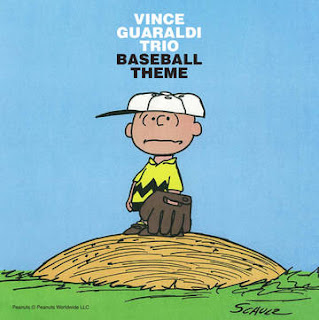
Followers of this blog will recall that the various special releases promised for last year's Record Store Day — on Saturday, June 12 — included Guaraldi's “Baseball Theme,” pressed for the very first time as a stand-alone, 7-inch single. Alas, supply-chain issues and the ongoing vinyl shortage resulted in numerous titles being postponed or canceled; the Guaraldi single was one of the casualties.

Good news, folks: It now has been promised for Record Store Day 2022: Saturday, April 23. Mark your calendar!

By way of a reminder, the A-side features 1964's original soundtrack version of the song, while the B-side is an alternative studio take never before available on vinyl (although it is included on the album's 2014 CD re-release). 

“Baseball Theme” was one of many tunes Guaraldi wrote for the never-released 1964 documentary, A Boy Named Charlie Brown: to be used in a sequence devoted to Charlie Brown’s ill-fated efforts on the ball field. Guaraldi deftly leads his trio through the up-tempo instrumental track, accompanied by bassist Monty Budwig and drummer Colin Bailey. 

The limited-edition single is pressed on white vinyl and housed in a colorful jacket, featuring whimsical, baseball-themed images of Charlie Brown and Snoopy. Visit recordstoreday.com for a list of participating indie retailers. 

********

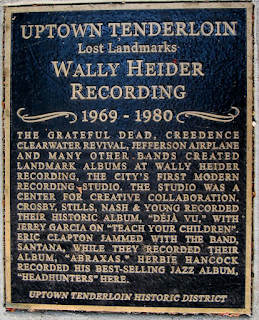
The San Francisco Chronicle recently published an excellent article concerning an honor bestowed to the famous Hyde Street Studios: a bronze plaque recognizing it as a legacy business in San Francisco, for its contributions to the history and identity of the neighborhood, and to the pantheon of pop music.

Way back in the day, when it was known as the Wally Heider Studios (and following his breakup with Fantasy), Guaraldi recorded many of his scores for Peanuts specials within its walls, starting with You're Not Elected, Charlie Brown, and concluding — on February 6, the day he later died — with It's Arbor Day, Charlie Brown

On February 6, 1974, Guaraldi and his trio were in that studio to record a live concert broadcast by KPFA and KPFB, much later released as the CD Live on the Air.

Guaraldi also spent several studio sessions, over the course of his final few years, recording tracks for a never-completed album: among them "Autumn Leaves," "Billie's Bounce," "No. 1 Snoopy Place," "Special Song" and "Your Song."

********

This isn't fresh news, but it was new to me.

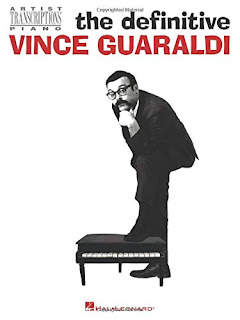
Back in 2009, Fantasy released the two-disc Definitive Vince Guaraldi, which is a marvelous 31-song collection of Guaraldi's best work for that label, from early tunes such as "Calling Dr. Funk" to later Peanuts efforts, such as the title theme to A Charlie Brown Thanksgiving. The package also included two previously unreleased tracks: "Blues for Peanuts" and an alternate take of "Autumn Leaves."

I somehow missed the fact that, in July 2019, Hal Leonard released a massive 216-page book in its "Artist Transcription" series, devoted to the music in this two-disc set, and bearing the same title.

It contains all 31 songs.

Let me assure you, these are not trivial arrangements; as promised by the series, they are "authentic, note-for-note transcriptions." Many of them — I'm looking at "On Green Dolphin Street" and "Manha de Carnaval" — are impressively dense; you'll need serious piano chops to play these puppies.

(But everybody loves a challenge, right?)

This is, without question, the most impressive Guaraldi song book released thus far. Better work on those finger exercises!

Sunday, January 16, 2022

New projects

Pandemic-enforced isolation has a few benefits, such as encouraging folks to finally tackle massive, long-postponed projects of one sort or another. I mean, really; what else were we able to do with our time?

The folks over at Lee Mendelson Film Productions spent the past year and change digging through their music archives, which prompted some happy discoveries: wonderful Guaraldi artifacts, some of which may have been thought lost; additional details will follow, as plans for mainstream release can be finalized.

One of their many goals has been to enhance Guaraldi's sheet music library, by releasing more fulsome expressions of his genius Peanuts work. They've started with 18 of Guaraldi's less well-known themes and cues, which now are available via Hal Leonard Publishing as online folios. They aren't simple, "E-Z play" arrangements for all ages; these are solid transcriptions that'll require at least some keyboard chops.

Click each title to be taken to the relevant SheetMusicDirect page.


"Little Red-Haired Girl" (a preferable title for a cue originally called "Trio Ad Lib" when used in You're in Love, Charlie Brown)


Have fun! More will follow, as long as this initial set generates sufficient interest. 

********

Across the border in Canada, the Community Foundation of Nova Scotia has unveiled the Jerry Granelli Legacy Fund, in recognition of the jazz drummer — and long-ago Guaraldi sideman — who passed last year.
The fund is dedicated to carrying on Granelli's unique approach to teaching, and to the nurturing of the improvising arts community he created in Nova Scotia, which was his home for many years, and where — in addition to his live performances — he worked as an educator and community builder.

His unique teaching approach is embodied in the Creative Music Workshop, established in 1996 with fellow Halifax musicians Don Palmer (sax) and Skip Beckwith (bass).

The Workshop has been run in collaboration with the Atlantic/Halifax Jazz Festival since its inception. Today it is an eight-day intensive program grounding participants of all ages, skill levels, and artistic disciplines in the fundamentals and practice of improvisation in music and life. 

This is a lovely honor ... and it makes me want to visit Nova Scotia!

(When such travel once again is safe and practical, of course...)