Showing posts with label Jimbo's Bop City. Show all posts

Friday, June 4, 2021

Playboy visits San Franciso ... back in the day

This post has very little to do with Guaraldi himself, but it does concern his San Francisco environment, and specifically many of the jazz clubs where he performed.

During the first decade and change after its debut issue in December 1953, Playboy magazine ran an occasional “On the Town” feature designed as a “cosmopolitan’s guide” to national and international cities — Paris, Tokyo, New York, London and others — that were becoming accessible to the publication’s upwardly mobile male subscribers, thanks to the rapidly expanding network of airline travel. The June 1958 issue was highlighted by a lengthy focus on San Francisco: where (and how) to lodge, dine, drink and be entertained. 


Since Hugh Hefner was an avid fan of mainstream and progressive jazz, the exhaustive article included a generous coverage of Baghdad-by-the-Bay’s then boisterous nighttime jazz scene. (The action probably was richer and more extensive right then, than at any other point in time; many of the clubs cited would close, change hands or go bankrupt within the next few years.)


Although the article makes fascinating reading as a time capsule, one must, ah, tolerate the wincingly archaic “dating tips” sprinkled throughout, such as…


[San Francisco] is a place of beautiful women, characterized (more than in any other city) by independence, good jobs, a friendly love of pleasure, hideaway apartments of their own, unpretentious poise, and an utterly charming knowledge of how to dress and behave, to please a man.


…and…


Your first stop, preferably just before sunset, should be the Mark Hopkins, up at the glass-enclosed Top o’ the Mark. Relax, have yourself a drink, take time to watch the sunset, and get the feel of the city here. Many a San Francisco visitor settles for the first girl he meets — only to rue it later, when finer prospects cross his path.


(Ouch!)


Further along, having offered suggestions for the best dining and dancing, we finally come to the late-evening options. I’ve extracted those with a strong — or even fleeting — connection to Guaraldi’s career, at that moment or soon to occur:


Thursday, March 7, 2013

Another view of the Annex

I continue to marvel at the manner in which the Internet allows access to — and contact with — other historians and fans who pursue the same subjects from slightly different angles. If the blogosphere is any indication, quite a few music buffs have become absorbed by the San Francisco scene from the 1950s through the '70s, and some are devoted enough to seek out and interview Those Who Were There, occasionally with radio broadcasts or podcasts in mind. I love to learn about such efforts; there's always the possibility of fresh nuggets to be mined, even from musicians I've interviewed (exhaustively!) myself. You never know when a familiar question, perhaps worded in a slightly different manner, might trigger a long-buried, previously unshared memory.

My colleague Corry Arnold — who writes the marvelous Grateful Dead blog, Lost Live Dead — called my attention to Jake Feinberg, an unabashed music fan on a mission to immerse himself in the aforementioned music scene to the best of his ability, at this decades-long remove. I appreciate Jake's enthusiasm and dedication; I also share his devotion to vinyl ... although I fear that's a battle we're destined to lose.

Jake has interviewed all sorts of musicians, with the resulting hour-length installments of KJLL's The Jake Feinberg Show archived at his website. (KJLL is an AM station out of South Tucson, Arizona.) The impressive roster includes several of Guaraldi's former sidemen, each of whom discusses Vince at least in passing, and in some cases in considerable detail.

I also enjoy the archive photos that Jake has managed to dig up, granting us a glimpse of what these cats looked like, back in the day.


Vince Lateano
Drummer Vince Lateano was interviewed on September 24, 2011. He mentions working with Guaraldi on some of the later Peanuts soundtracks, and also spending six to eight months — alongside bassist Seward McCain — as part of Guaraldi's regular trio at Butterfield's. 

Nothing new there, but I was intrigued to learn that Lateano recalled first hearing Guaraldi perform in the late 1950s, while the latter was a member of Cal Tjader's Quintet, alongside Al McKibbon (bass), Willie Bobo (drums and percussion) and Mongo Santamaria (congas). Lateano was in his mid-20s when he moved to San Francisco from Sacramento in the mid-'60s, so he would have been a teenager during that initial exposure to Guaraldi, perhaps during a jazz-laden night in the City.

(Wouldn't it have been nice to tag along!)


Jerry Granelli (foreground)
Drummer Jerry Granelli, interviewed on November 26, 2012, discusses his gig with Guaraldi at some length. Granelli gives Guaraldi credit for introducing him to the bossa nova and samba sound that inspired the jazz pianist so strongly in the late 1950s. Granelli also recalls how quickly guitarist Bola Sete was added to their trio, which included bassist Fred Marshall: "We rehearsed a couple of tunes with Bola," Granelli explains, "and then just started playing!"

Albums were knocked out quickly at Fantasy, Granelli recalls, because the studio time would be booked — and paid for — in three-hour blocks. That corresponds to what I've heard from many of Guaraldi's former sidemen, who explained that arrangements and solos would be perfected during the nightly club gigs; no surprise then, when it came time to make a record, that the tracks could be laid down in just a few takes.

Tuesday, January 1, 2013

A song by any other name...

The name always bothered me.

Guaraldi had an occasional tendency to recycle his own compositions, sometimes under new titles ... much to the hair-pulling frustration of discographers. "Ginza Samba," which popped up on 1958's The Cal Tjader/Stan Getz Sextet, is pretty much the same as plain ol' "Ginza," which debuted on 1956's Modern Music from San Francisco (Guaraldi's first album as a combo leader). "Air Music," a bouncy little track originally recorded for TV's A Charlie Brown Christmas — but not included on the soundtrack album — also is known as "Surfin' Snoopy," reflecting the tune's later use behind Snoopy's imaginative effort to hang paws on the end of his surfboard ... in a wading pool.


And then there's "Casaba," alternately known as "Jambo's."

"Casaba" opens 1964's Vince Guaraldi, Bola Sete & Friends, the first of the jazz pianist's three collaborative albums with the Brazilian guitarist. The eight-minute tune, which reflects Guaraldi's sense of compositional whimsy, boasts sparkling interplay between his single-note runs and Sete's graceful guitar work. The tune resurfaced on 1970's Alma-Ville, the third of Guaraldi's albums for Warner Bros., and the last LP he recorded during his lifetime. This time, however, it was retitled — rather oddly — as "Jambo's." Percussionist Rubens Bassini highlights this latter-day version of the tune, which evokes the same bossa nova atmosphere that Sete had given it six years earlier.

But that name ... who or what was Jambo's?

Jimbo's would have made much more sense, given all the happy hours Guaraldi spent at the after-hours San Francisco club that took its name — Jimbo's Bop City — from John "Jimbo" Edwards, the cool cat who ran the place from 1950 to '65. I learned quite a lot about that venue while researching my book, with most of the information coming from filmmaker Carol P. Chamberland's excellent 1998 documentary, The Legend of Bop City, and an extensive article she wrote for the fall 1996 issue of California History.

Surely Guaraldi would have honored Edwards with a song, and surely the so-called "Jambo's" must have been that song. But how to prove as much?

This sounded like a job for the U.S. Library of Congress, and its musical composition copyright deposits. And, indeed, it was.


Click here to see a larger image.
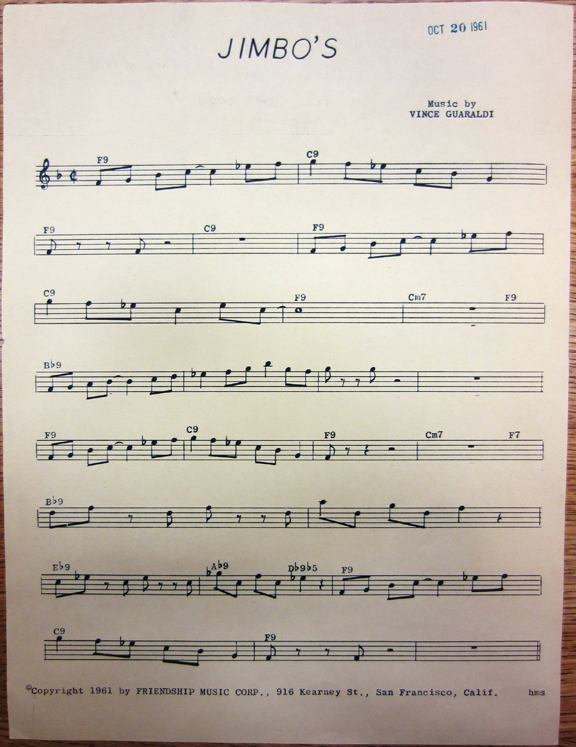
On October 20, 1961, Guaraldi filed a copyright claim for an original composition titled "Jimbo's." The copyright deposit — the page of music filed to identify the song — displays a melody line that can be recognized instantly as "Casaba"/"Jambo's."

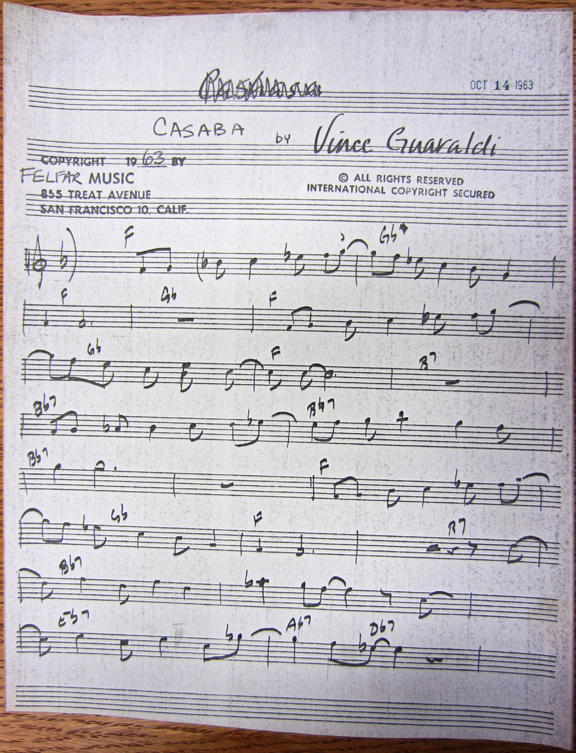
Two years later, almost to the day — on October 14, 1963 — Guaraldi filed a copyright claim for "Casaba." That page of music displays an identical melody line, allowing for minor variations on how long individual notes were to be held. "Casaba," then, was the title used when Guaraldi and Sete debuted the recorded version of the tune on their first collaborative LP.

Why, we wonder at this late remove, the change of heart, title-wise? And for that matter, why file a second copyright? What had changed, aside from the title?

The song's owner, that's what.

Prior to this most recent bit of research, I was under the impression that Guaraldi had issued only two songs — "Cast Your Fate to the Wind" and "Alma-Ville" — under the Friendship Music banner, the partnership he had formed with Trident club manager Frank Werber. An exhaustive examination of the Library of Congress' Guaraldi copyright registrations, however, reveals that Friendship also represented "Jimbo's" ... but not for long. By the time Guaraldi and Sete recorded their album, the song belonged to Felfar Music, one of the many shell entities that Fantasy Records' Sol and Max Weiss employed to conceal their control of the pianist's work. We'll never know why Guaraldi chose to re-title the song at that point, but he did.


Click here to see a larger image.
And he didn't immediately arrive at that new choice, either. The sheet music deposit for "Casaba" shows this to be a replacement title, written beneath a crossed-out "Cashasa." Cashasa — also spelled cachaca — is one of Brazil's most popular distilled spirits (390 million gallons consumed annually!), fermented from sugar cane juice and ripened to somewhere between 70 and 100 proof. The connection is obvious: Bola Sete, Brazil, bossa nova, cachaca. 

A casaba is a melon that hails from Turkey. Not much of a link there.

Why "Casaba," then, instead of "Cashasa"? Hey, we'll never know that answer, either.

Which brings us back to the title employed when Guaraldi re-recorded the tune on his final Warner Bros. album.

There is no Library of Congress copyright registration for "Jambo's," which suggests this might have been ... a typographical error on somebody's part. Guaraldi himself? The person responsible for the album liner notes and disc song titles? If the latter, you'd certainly think Guaraldi would have caught such a mistake, particularly since it seemed his intention, in 1970, to finally acknowledge Jimbo Edwards and his club.

My good research buddy Doug — who has assisted greatly with these copyright investigations — points to Guaraldi's occasionally tendency toward wordplay (as with "Coffee and Doe Nuts"), and suggests that perhaps the jazz pianist made a droll portmanteau word out of Jimbo's and jam (as in jazz jam), and arrived at "Jambo's." That's a much more romantic option than an unfortunate spelling mistake, but — as with Casaba and Cashasa — the truth remains lost to time.

But this much is certain: As originally composed and registered as "Jimbo's" in 1961, Guaraldi clearly intended this tune to honor John Edwards and Jimbo's Bop City ... which I long suspected and now can safely accept as fact.

************

Speaking of the album Alma-Ville...

I'm issuing a call to the Internet Group Mind: Let's see if anybody out there can help answer a few questions about this album.

1) Any thoughts of the significance of the title? (Both the LP title, and of course the song of the same name, which debuted back on 1962's Jazz Impressions of Black Orpheus.)

2) Who is the kid in the photo?

3) Where was the picture taken ... and what are those things behind and beneath him?

Enquiring minds want to know...