Showing posts with label Cal Tjader. Show all posts

Thursday, April 21, 2022

More great stuff from the magazine archives!


My previous post concerned the exciting discovery of a searchable online archive for Record World, during its time one of the three primary U.S. weekly music industry trade publications.


In my delight over focusing on Record World entries related to Guaraldi, I initially neglected to investigate more about the host site: worldradiohistory.com


Oh. My. Goodness.


Record World is just one of dozens of magazines and journals offered with similarly searchable archives; you’ll find the list here.


Alternatively, clicking on the “Music Magazines” button, along the top row, will open a sub-menu allowing quick access to a given magazine’s entire archive.


The depth and scope of this site are simply jaw-dropping.


It remains a work in progress; some archives aren’t complete, and occasional issues have missing pages. But it’s still astonishing.


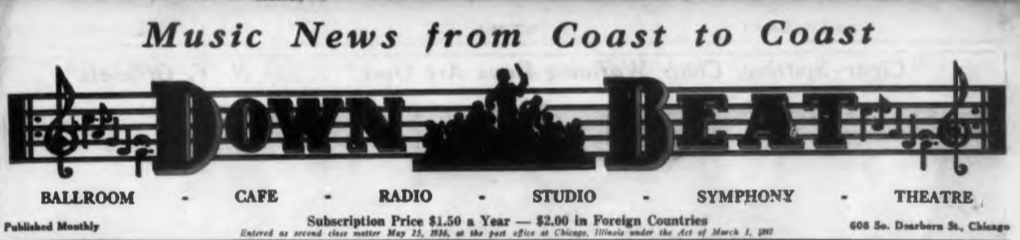
Having thoroughly examined Record World, I subsequently turned my attention to Billboard, Cash Box and Down Beat (as it was known, in the early days). 


Billboard began publishing in 1894. The entries are spotty until 1936, after which each year is pretty much complete. (Most crucially, it’s much easier — and more reliable — to search here, than in the Google Books Billboard archives, which return only some hits for a given search term.)


Cash Box ran from 1942 to 1996, and its archive is solid.


Down Beat, which debuted in 1934, is the most haphazard. 1934-36, 1938 and 1963 are entirely (or mostly) missing, and the entries are thin in 1971-77, and 1979-83.


All three magazines yielded plenty of fresh information about Guaraldi. I was particularly pleased by bits and bobs in the early 1950s, a period where information about his activities is quite scarce.


That said, the absence of 1963 in the Down Beat archive was vexing, since that was a busy year for him. Additionally, several of the Down Beat entries are weeks — even months — out of date, in terms of the information presented, which also is frustrating.


Some highlights:


• Thanks to Down Beat, I now have this earliest known photo (by far!) of Guaraldi performing with a combo. The quality isn’t terrific, but that’s him at far left. Until now, I was aware of Guaraldi performing with this quartet solely in the spring of 1951, but this photo ran in the November 16, 1951, issue. That’s intriguing, because Guaraldi had joined Cal Tjader’s trio as of mid-September. Was he simultaneously moonlighting with Chuck Travis? Unlikely, as the schedule with Tjader was full. But Guaraldi’s activities were sparse for most of 1951, until he joined Tjader, so it’s entirely possible that the gig with Travis was off and on throughout the summer. (Regardless, this Down Beat photo and caption obviously ran months after Guaraldi had left Travis.)

• This gig was new to me: On March 9, 1955, Down Beat reported that “Jerry Dodgion now leading the house band at the Black Hawk [sic], with Dottie Grae on drums, Dean Riley [sic], bass, and Vince Guaraldi, piano.” (Dodgion was part of the Guaraldi Quartet, with a different bassist and drummer, on Modern Music from San Francisco, recorded in August of the same year.)


• On December 28, 1955, Down Beat reported that “Vince Guaraldi drawing a lot of comment for his piano playing these nights at hungry i.”


• On March 7, 1956, Down Beat gave a thorough review of the Woody Herman band’s performance at New York’s Basin Street. (Guaraldi had joined Herman’s band the previous New Year’s Eve.) The lengthy piece includes this comment: “In the rhythm section, Woody has a find in pianist Vince Guaraldi, a San Franciscan recommended by Ralph Gleason. Guaraldi plays with rare economy of means, much warmth and taste, an excellent beat, and a real feeling for the blues vein in jazz.”


• Billboard gave a very nice review of Guaraldi’s first album, Vince Guaraldi Trio, on September 29, 1956: “Altho sales are unlikely to be spectacular, this is one of the pleasant surprises of the month. Guaraldi is a young San Francisco pianist who has been getting rave notices with the Woody Herman band. Evidence here says he’s a tasteful, authoritative and facile modernist, and that he swings. Further, he has a sense of humor. Guitarist Eddie Duran and bassist Dean Reilly are worthy colleagues. Try their version of John Lewis’ ‘Django’ for a real delight.”


• On May 2, 1957, Down Beat reviewed Introducing Gus Mancuso; Guaraldi performed on three of that album’s tracks. The review includes this comment: “Guaraldi is a particularly stimulating soloist (and isn’t it time for another LP by him?)” And, indeed, Guaraldi next album, A Flower Is a Lovesome Thing, arrived a few months later.


• On February 19, 1959, Down Beat reported that “Pianist Vince Guaraldi, scheduled to leave the Cal Tjader Quartet this month, is planning a musical partnership with drummer Johnny Markham and bassist John Mosher.” Guaraldi actually split with Tjader on January 18 or 19, and his next known booking followed immediately: at Lenny’s, in Oakland, every Tuesday evening, as part of tenor saxman Harold Wylie’s Quartet, alongside Markham and bassist Jerry Goode. I’ve no evidence that Guaraldi ever headed a trio with Markham and Mosher.


• Billboard noted the rising interest in Guaraldi’s Black Orpheus album on December 15, 1962: “Vince Guaraldi on San Francisco’s Fantasy label is grabbing solid sales action. Jazz Impressions of Black Orpheus has gone over 7,000 in album sales within six weeks, and is spreading to other areas. The single ‘Cast Your Fate to the Winds' [sic], a segment of the album, started in Sacramento, spread to all of Northern California with 10,000 discs out, and is now moving strongly in Southern California.”

• Fantasy ran a cute ad in Cash Box, on February 2, 1963; check it out at right. (Note Fantasy's address: As I’ve said elsewhere, it’s Treat Avenue, not Street!)


• On June 8, 1963, Cash Box tagged the Guaraldi Quintet single “Zelao”/“Jitterbug Waltz” — from the album In Person — as a Best Bet: “Vince Guaraldi, who scored last time out with ‘Cast Your Fate to the Winds’ [sic], could duplicate that success with this top-flight bossa nova follow-up stanza. The tune is a contagious, easy-going lyrical ballad with a danceable, rapidly-changing beat.”


• On September 18, 1965, Billboard noted that Guaraldi’s single, “Theme to Grace” — taken from the Grace Cathedral Jazz Mass LP — was “predicted to reach the Hot 100 Chart.” (Alas, it didn’t happen.)


• On August 6, 1966, Cash Box tagged Shelby Flint’s vocal cover of “Cast Your Fate to the Wind” — on a single backed by “The Lilly” — as a Best Bet: “Shelby Flint could make lots of playlists with this sweet, lyrical reading of this oft cut ditty. The lark does a smooth, lilting job on the tender lyric. Watch closely.” (Indeed, her single made Billboard’s Top 100 chart for six weeks, peaking at No. 61.)

• Finally, this was an eye-opener: Guaraldi’s first album for Warners, Oh Good Grief, made Billboard’s Best Selling Jazz LPs chart for two consecutive weeks, on June 29 and July 6, 1968. He’s at the bottom of the chart both times … but that’s still charting! 

Friday, June 4, 2021

Playboy visits San Franciso ... back in the day

This post has very little to do with Guaraldi himself, but it does concern his San Francisco environment, and specifically many of the jazz clubs where he performed.

During the first decade and change after its debut issue in December 1953, Playboy magazine ran an occasional “On the Town” feature designed as a “cosmopolitan’s guide” to national and international cities — Paris, Tokyo, New York, London and others — that were becoming accessible to the publication’s upwardly mobile male subscribers, thanks to the rapidly expanding network of airline travel. The June 1958 issue was highlighted by a lengthy focus on San Francisco: where (and how) to lodge, dine, drink and be entertained. 


Since Hugh Hefner was an avid fan of mainstream and progressive jazz, the exhaustive article included a generous coverage of Baghdad-by-the-Bay’s then boisterous nighttime jazz scene. (The action probably was richer and more extensive right then, than at any other point in time; many of the clubs cited would close, change hands or go bankrupt within the next few years.)


Although the article makes fascinating reading as a time capsule, one must, ah, tolerate the wincingly archaic “dating tips” sprinkled throughout, such as…


[San Francisco] is a place of beautiful women, characterized (more than in any other city) by independence, good jobs, a friendly love of pleasure, hideaway apartments of their own, unpretentious poise, and an utterly charming knowledge of how to dress and behave, to please a man.


…and…


Your first stop, preferably just before sunset, should be the Mark Hopkins, up at the glass-enclosed Top o’ the Mark. Relax, have yourself a drink, take time to watch the sunset, and get the feel of the city here. Many a San Francisco visitor settles for the first girl he meets — only to rue it later, when finer prospects cross his path.


(Ouch!)


Further along, having offered suggestions for the best dining and dancing, we finally come to the late-evening options. I’ve extracted those with a strong — or even fleeting — connection to Guaraldi’s career, at that moment or soon to occur:


…

Monday, April 19, 2021

Orpheus Rising

My friend Scott recently posed an intriguing question:
 
Was Guaraldi the first jazz artist to cover the music from Black Orpheus in an album?
 
The initial assumption is to say yes, due to the timeline. Although the film debuted at the Cannes Film Festival in May 1959 — where it took the Palme d’Or — it didn’t reach the States until a screening at the San Francisco International Film Festival, on November 24 that same year. General release came a month later, on December 21; it went on to win the Academy Award for Best Foreign Film on April 4, 1960.
 
Guaraldi likely had seen the film several times by then. “I dug the soundtrack, and I dug ‘Samba de Orpheus,’ the tune and that scene in the movie,” he said to Ralph Gleason, several years later. “I was playing ‘Samba de Orpheus’ for a long time before I ever put [the notion of an album] together.”
 
That means he must’ve been performing that tune (and others from the film?) since early 1960, because he “put the notion together” in the summer of ’61, when he cut a demo tape of the four primary Jobim/Bonfa selections — “Samba de Orpheus,” “Manha de Carnaval,” “O Nosso Amor” and “A Felicidade” — with bassist Monty Budwig and drummer Colin Bailey. He shopped the tape to Capitol Records and then Columbia Records, both of which turned him down; he then snagged a one-album contract from Fantasy in early autumn. The resulting album, Jazz Impressions of Black Orpheus, was recorded in November 1961 and February ’62, and released on April 18, 1962.
 
So … could somebody else have moved faster?

Flautist Herbie Mann certainly came close. His album Right Now, which includes a cover of "Manha de Carnaval," was recorded in March and April 1962. Alas, it wasn't released until November.
 
Mann aside, the most likely suspect, at that point in time, was Stan Getz. He grew infatuated with bossa nova in the early 1960s, and devoted several albums to that rapidly emerging genre. (That said, his iconic collaboration with Astrud Gilberto on “The Girl from Ipanema” wasn’t released until May 1964, although it had been recorded a year earlier.) And yes, his album Big Band Bossa Nova includes a cover of “Manha de Carnaval.” But the tracks were recorded August 27-28, 1962, and the album didn’t debut until October. Guaraldi beat him by half a year.
 
Next up for consideration: Quincy Jones. His album, also confusingly titled Big Band Bossa Nova — most famous these days for having introduced “Soul Bossa Nova,” now better known as Austin Powers’ theme — also includes a cover of “Manha de Carnaval.” Ah, but — once again — the tracks were recorded between June and September of 1962, and the album was released in November.

Trombonist Bob Brookmeyer's Trombone Jazz Samba includes covers of "Samba de Orfeu," "Manha de Carnaval" and "A Felicidade." Alas, the tracks were recorded in August and September 1962, and the album didn't appear until November.
 
This brings us to Ramsey Lewis, a veritable music-making machine by this point in his career. His trio’s Argo album, Bossa Nova, includes covers of both “Samba de Orpheus” and “Maha [sic] de Carnaval.” But he, too, came later to the party; the tracks were recorded on September 22 and 25, 1962, and the album also was released in November.

(On a sidebar note, during the research for this post, I noted — with delight — that this Ramsey Lewis Trio album also includes a cover of Guaraldi’s “Whirlpool,” with which I was previously unaware. And which immediately prompted an update of this post.)

Guaraldi's colleague Bola Sete seems a logical candidate, and yes: His album Bossa Nova includes a cover of "Manha de Carnaval." But it was recorded in October 1962, and not released until February 1963.

As 1962 drew to a close, George Shearing hit the studio in December, to record the tracks for his album Shearing Bossa Nova; it also includes a cover of "Manha de Carnaval." But, again, the album wasn't released until May 1963.

December 1962 also found Luiz Bonfá in the studio, no doubt wanting to take advantage of the music craze he helped ignite. Luiz Bonfá Plays and Sings Bossa Nova — arranged by no less than Lalo Schifrin, early in his career — includes a cover of "Manha de Carnaval." The album debuted in April 1963.
 
“Samba de Orfeu” popped up on Bud Shank’s Brasamba!, also released in April 1963. That tune also appeared on Bill Perkins’ Bossa Nova with Strings Attached, released the following month.
 
By this point, you must be remembering that Guaraldi’s friend and former “boss,” Cal Tjader, had gravitated toward Latin music in the late 1950s; surely he would have gotten a jump on his one-time pianist. But no: Although Tjader’s album Soña Libré includes a cover of “Manha de Carnaval,” the tracks weren’t laid down until January 28-30, 1963; the album didn’t drop until May that year.
 
Paul Desmond was next; his album Take Ten includes covers of both “Samba de Orfeu” and “Theme from Black Orpheus.” The tracks was recorded in June 1963, and the album debuted in October.
 
Interest subsequent expanded exponentially:

• “Manha de Carnaval” is on Gerry Mulligan’s Night Lights (December 1963).

• “Manha de Carnaval” is on the Modern Jazz Quartet’s The Sheriff (April 1964).

• “Samba de Orfeu” is on Ray Anthony’s Hit Songs to Remember (May 1966).

• “Samba de Orpheus” and “Manha de Carnaval” are on Charlie Byrd’s Byrdland (January 1967).

• “Manha de Carnaval” and “Samba de Orfeu” are on Oscar Peterson’s Soul Español (March 1967).

• A lengthy Black Orpheus medley — with “Manha de Carnaval,” “A Felicidade” and “Samba De Orfeu” — is on Bola Sete at the Monterey Jazz Festival (July 1967).
 
And so forth. Both “Manha de Carnaval” and “Samba De Orfeu” have become jazz standards.
 
So, does that mean Guaraldi scored first?

Emphatically ... not!

Harry James and his Orchestra released an MGM single in February 1961 (!). The A-side selling point is "Jersey Bounce," and the B-side is -- drumroll, please -- "Theme from Orfeu Negro (Manha de Carnaval)." James therefore wins the lottery.

And, indeed, Guaraldi wasn't even second. Hard bop saxophonist Rocky Boyd and his quintet hit the studio in March 1961, to record their album Ease It; the six tracks include a cover of "Samba de Orfeu." The album was released in mid-September.
 
Saxophonist Wayne Shorter’s came close with his third album, Wayning Moments, which includes a cover of the Black Orpheus theme. (The digital re-release features a second take.) The original LP was recorded on November 2 and 6, 1961; it hit stores in July 1962. 

But close doesn't count. We now know that Harry James and Rocky Boyd did indeed beat Guaraldi to the punch.

Friday, March 26, 2021

More information!

San Francisco Chronicle music critic Ralph Gleason and Guaraldi stroll
outside Basin Street West in early 1965, during the filming of an episode
of the BBC's Inside America that profiled Gleason.
My lengthy dive into the San Francisco Chronicle archives has concluded.

It certainly was worthwhile.

Although I didn't find any other articles worth quoting in full or part, as with this Ralph Gleason column, the raw data was substantial. My Guaraldi timeline is considerably richer and more precise, particularly during the late 1950s and most of the '60s. Numerous club gigs have been added; many others have been fine-tuned.

You'll also find lots of new photos, newspaper display ads, club matchbook covers and other ephemera.

Aside from the enhanced information about Guaraldi, the Chronicle helped me nail down (in most cases) precisely when San Francisco's significant jazz clubs opened and closed. Since that information now is so much more complete, I've enhanced such entries in red; they're now much easier to find. After all, Guaraldi's career (for the most part) neatly paralleled the rise and fall of the greater San Francisco area's jazz scene.

The hunt is never over, of course. My next challenge is to identify more venues and cities during the tours Guaraldi took outside of California: from the early trips with Cal Tjader, to the 1964 tour with Benny Goodman, to the "Eastern tour" Guaraldi's trio took in the summer of 1965 (which was, I believe, the last time he toured outside the West Coast).

Research is like housework (but much more fun) ... there's always another corner to investigate!

Friday, May 22, 2020

A bit of keyboard magic with the Charlatans

Bear with me; setting the stage for this one will take a bit.

The Charlatans — not to be confused with the popular West Midlands rock band of the same name, founded in 1988 and still going strong in the UK — was a Northern California folk rock and psychedelic rock band that formed in 1964. Despite a run that lasted only five years and was plagued by personnel changes, bad decisions, bad record deals and just plain bad luck, the group had an outsized influence on the burgeoning San Francisco/Haight-Ashbury music scene.

The Charlatans, circa early 1967: from left, George Hunter, Richard Olsen,
Mike Wilhelm, Dan Hicks and Mike Ferguson
Indeed, the Charlatans also strongly influenced the developing 1960s look, starting with their affected late Victorian/Wild West clothing: a style that was embraced by the emerging anti-establishment youth movement. The band also kick-started the era’s poster art, thanks to a playbill created by members Mike Ferguson and George Hunter, to publicize their summer 1965 gig at Virginia City’s Red Dog Saloon, across the state border in Nevada. Rock historians credit that advertisement as the first true psychedelic concert poster, which quickly influenced the artwork of Rick Griffin, Victor Moscoso, Bonnie MacLean, Wes Wilson, and Stanley Mouse & Alton Kelley.

(It could be argued that the Charlatans also deserve recognition as the first true acid rock band, given that everybody took LSD prior to their first Red Dog performance. But the band’s sound wasn’t characteristic of what became true acid rock, so that claim is debatable.)

Ben Marks’ complete history of the band — “Hippies, Guns and LSD: The San Francisco Rock Band That Was Too Wild for the Sixties,” a thoroughly enjoyable read — was published July 19, 2017, and can be found here. The essay is laden with photos, and I’m indebted to Marks for some of the information that follows.

Tuesday, May 5, 2020

An Ear-ful of Poppycock

My renewed deep dive into Guaraldi's career resulted in a fresh look at his activities in the early 1970s, when — from the autumn of 1971, through the late winter of '72 — he had a semi-regular gig at a Palo Alto night spot dubbed In Your Ear. This is the venue where — most famously (for our purposes) — a young George Winston played intermission piano in between Guaraldi's sets, and was bold enough to introduce himself to Dr. Funk, probably on October 24, 1971. And we all know where Winston's admiration eventually led.

I was reminded, while re-reading some of the notes and performance dates, that I'd learned very little about this club, during my bio's research phase in 2009 and '10. Aside from the fact that it occupied the building at 135 University Avenue, in Palo Alto — and that Guaraldi often could be found there on Tuesday evenings, for five or six months — newspapers and the Internet had yielded very little. Heck, I've never even been able to find a photo of the place, inside or outside. Whazzup with that?

Clearly, it was time for renewed exploration.

The effort proved very fruitful.

In Your Ear wasn't the first music club at 135 University; that honor belongs to The Poppycock, which opened its doors in April 1967. A sign of things to come was visible in the classified "employment opportunities" section of Stanford University's newspaper, the Stanford Daily, beginning April 12:

Beertenders, waitresses, Olde English Fish Cooks. Full and part time. Start Immediately. Poppycock. 135 University Ave.

(One wonders how many Stanford students qualified as "Olde English Fish Cooks.)

Guests musicians were eclectic and comparatively modest during the initial few months; the stage hosted a diverse assortment that included The Flowers, Doc Watson, The Mind's Eye, Lightning Hopkins and Schlomo Carlsbach (a folksinging rabbi). But all manner of San Francisco Bay Area outfits soon found their way to The Poppycock: some little more than short-lived garage bands, others ... well, a whole lot more famous. Stanford's radio station KZSU claims credit for a live broadcast from the Poppycock, which gave the first-ever airplay to an obscure little group dubbed Creedence Clearwater Revival.

In March 1968, politically active students hosted a "petition party" for Minnesota Senator Eugene McCarthy, to help fund his effort to become the Democratic nominee for U.S. President.

Wednesday, April 29, 2020

More bits and bobs

Continuing our engaging journey through various newspaper archives...

Beloved San Francisco-area journalist Herb Caen's April 17, 1964, column -- appearing in the Santa Maria Times, among other outlets -- offered this update on producer Lee Mendelson's in-the-works TV special, A Boy Named Charlie Brown:

"It will have Vince Guaraldi playing the piano for Schroeder, [and] Cal Tjader beating the vibes as Snoopy."

Alas, we know that if Tjader was part of the special's original one-hour edit, his participation wound up on the cutting-room floor, when Mendelson trimmed it down to 30 minutes. And the little documentary still didn't sell.


********

Jazz columnist Richard Hadlock published a terrific (and lengthy) interview with Guaraldi in the San Francisco Examiner, on March 29, 1964. When asked about his influences, Guaraldi replied:

"I listen to everybody. There were really only three main departure points in jazz piano: James P. Johnson, Earl Hines and Bud Powell. They're all great, but Powell had the biggest influence on me. I also like the awkward grace of Thelonious Monk very much. And then there are Art Tatum and Duke Ellington: each in a class by himself, over and above the rest. I hear Chopin in Tatum, and the classical composer in Duke."

When asked if he got tired of playing "Cast Your Fate to the Wind" over and over and over again, Guaraldi insisted otherwise.

"Not at all. For one thing, we keep changing the way we do it. Basically, it's only a skeleton to improvise on, to play new chord uses on. Oh, when you do it six times a night, it can get to be a bore, but I'm not really tired of the tune. I play better on my own compositions anyway. The main thing is the feel you get when you're really communicating, and 'Cast Your Fate to the Wind' helps to reach people. The concert we did at the Museum of Art recently with Bola Sete, that had the happy feel to it."

Wednesday, April 22, 2020

Bits and bobs

A five-year deep dive into a new jazz-related project — details of which can be found here — minimized my focus on All Things Guaraldi, so I've been playing catch-up during the past few weeks.


The first order of business was a fresh look at newspapers.com, an ever-more-useful resource site for those fond of serious research. Gaining access to so much archived information was invaluable during the research phase of my Guaraldi biography, although I was vexed by the absence of two key newspapers: the San Francisco Chronicle, and the San Francisco Examiner. Happily, the latter was among the many newspapers added at some point during the past decade (which is how much time has passed, since I last visited the site). The Examiner proved every bit as useful as I'd hoped, and all sorts of fresh and expanded entries will appear in my Guaraldi timeline, during the next few weeks.

(Vexingly, the Chronicle still has no comprehensive online archive: merely a partial one, with "selected articles" from 1985 to present. I can't imagine what they're waiting for, and I dearly wish they'd get on the ball!)

Meanwhile, have fun with these isolated tidbits:


********

On September 28, 1963, the San Rafael Independent-Journal headlined a story "Pianist Is Wanted For Throwing Drink At Woman." The incident took place at the Trident on August 30, where Guaraldi and his trio were nearing the conclusion of a three-month residency. He'd long developed a reputation for impatience with patrons who made too much noise while he and the trio performed, and things got out of hand that day. Three women were drinking at the bar, undoubtedly having a good time, and Guaraldi used the microphone to tell them to quiet down. Whether they did remains a matter of uncertainty, but — according to "victim" Dee Taylor — when the set concluded "Guaraldi appeared at the bar, cursed the girls and tossed a drink in [Taylor's] face. [He also] tossed a carte blanche machine at one of her friends."

Guaraldi was scheduled to appear before Marin Municipal Court's Judge Joseph G. Wilson on September 27, on charges of battery and disturbing the peace. Rather foolishly, he failed to show.

Hence the news brief's headline and opening sentence, with all their embarrassing publicity: "A warrant of arrest was issued yesterday for Bay Area pianist Vince Guaraldi."

Well.

Tuesday, March 31, 2015

A drummer's reflections

During a career that caught fire in the 1960s and continues to this day, drummer Carl Burnett has worked with a Who's Who of jazz artists: from Eddie Harris and Sarah Vaughn to Marvin Gaye and O.C. Smith, from Art Pepper and Freddie Hubbard to Horace Silver and Kenny Burrell. These days, Burnett frequently performs and records with bassist and longtime friend Stanley Gilbert; the two met back in the 1960s, when both were members of Cal Tjader's Quintet.


Which led both Burnett and Gilbert, in turn, to a brief association with Guaraldi.

I caught up with Burnett thanks to my colleague Duncan Reid, who authored our shared publisher's recent biography of Tjader. Just as I continue to gather anecdotes and information about Guaraldi's life and career, Duncan does the same, with respect to Tjader; Duncan tracked down and interviewed Burnett, and then kindly shared the drummer's contact information. Burnett's path crossed Guaraldi's only fleetingly, but significantly, and the drummer cheerfully welcomed the chance to reflect on his memories of Dr. Funk.

Burnett made his first appearance with Tjader's band on March 14, 1966, during a gig at El Matador. The drummer remained with Tjader for a little over two years, departing in the summer of 1968.

"El Matador was our home base, with Cal," Burnett recalled. "We'd go on the road and be gone for awhile; when we returned, we'd rest for a week, maybe two. Then we'd be back at El Matador, and folks would say, Hey, Cal's back, and the place would be packed every night."

As he related during an interview for Kathy Sloane's Keystone Korner: Portrait of a Jazz Club, Burnett had a room at a place called the Happy House, where numerous jazz musicians both resided and hung out.

"I was still living in Los Angeles," Burnett elaborated, "but Happy House was home when I was in San Francisco. We had a big piano in the living room, and every Sunday we'd have jam sessions, and everybody would play. It was a wonderful place to call home."

Burnett recalled having caught Guaraldi and Bola Sete during their heyday ("a really enjoyable musical situation"), but he didn't actually meet the famously mustachioed pianist until a few years later.

Thursday, March 12, 2015

Childhood Fantasy

Researchers rely on the kindness of friends and strangers, who occasionally point us in the direction of something — a key piece of information, a fascinating anecdote — that we wouldn't otherwise have found.


In that way, I'm grateful to a good friend for calling my attention to a delightful online profile of Dogpaw Carillo, the sort of cheerful, colorful figure who typifies San Francisco's still-quite-lively counter-culture vibe. Dogpaw — and that's how he prefers to be called — is the star of this engaging and informative article by Viktorija Rinkevičiūtė, which she wrote during her post-graduate stint as a master's student in media, journalism and globalization, while at UC Berkeley's Graduate School of Journalism. She subsequently returned to Lithuania, where she maintains an engaging blog and looks back fondly on the time she spent in Northern California.

As you'll discover, reading Viktorija's charming piece, Dogpaw spent part of his childhood living directly adjacent to the Treat Avenue headquarters of Fantasy Records. He grew up in a house at 841 Treat; Fantasy was next door, at 855 Treat.

(A quick sidebar: We have become conditioned to assume — thanks in part to a Vince Guaraldi composition — that Fantasy's most famous early home was on Treat Street. But Guaraldi's tune isn't the only source; this slight error has been promulgated by scores of musicians who refer to the good ol' days, when "Fantasy was on Treat Street." Many of them are quoted saying as much in my book. The lapse is understandable; "Treat Street" rolls more swiftly off the tongue, and the rhyme is hard to resist. But it's a mistake nonetheless: Although San Francisco does possess a tiny Treat Street, it's nowhere near the Mission District locale where Fantasy Records made its home ... on Treat Avenue.)

Aside from being absorbed by Dogpaw's childhood memories, I was drawn to the several times he mentioned Guaraldi. Viktorija had no reason to pursue these references to Dr. Funk, since her story focused more generally on Dogpaw, then and now. But I sensed that he'd have more to say about Guaraldi, and so I contacted Viktorija. She kindly shared Dogpaw's contact information, and she also sent along several additional photos that she hadn't used in her article.

I found Dogpaw just as amiable — just as eager to chat about his Treat Avenue days — as I would have expected. And he did, indeed, have a great deal more to share about Guaraldi and Fantasy.

(I've tried to avoid too much overlap with the information in Viktorija's article, although some basic details are necessary.)


Dogpaw examines the exterior of 855 Treat Avenue, the
once-upon-a-time home of Fantasy Records, and now
headquarters of the San Francisco Mime Troupe.
(Photo by 
Viktorija Rinkevičiūtė)
Dogpaw grew up in the house at 841 Treat, and remained there through his teens; his adolescence coincided perfectly with the 1960s, when Fantasy blossomed from a modest jazz label that went "13-1/2 years without a hit" — at which point Guaraldi's "Cast Your Fate to the Wind" came along — to the more ambitious operation that expanded into rock 'n' roll and most famously signed the band that became Creedence Clearwater Revival.

"Fantasy was literally right over the fence," Dogpaw recalls. "They shared the property with a lumberyard; this guy would come in maybe once in a blue moon, and chop and saw some wood, and then take off. His buzz-saw was right next to the studio! But they must've worked it out, because he never made noise when Max [Weiss] wanted to record something.

"At first, I thought the place next door might be a radio station, because you'd see instruments being loaded off vehicles, and going in, and later coming back out again, and all these radio-looking people. That was the vibe, so we kids knew it had something to do with music. Initially, we all thought that every neighborhood had one of these places, like every neighborhood had a playground or a library. This was just normal to us, having a studio on the block.

"But of course it wasn't normal. Growing up on Treat was very, very special."

Thursday, January 8, 2015

The Santana connection

Carlos Santana is known to have jammed with Guaraldi during at least one public concert: on October 7, 1972, during a benefit at the College of Marin in Kentfield, California. Santana acknowledges this on his own website, without giving any other specifics about the gig. And while the entire event apparently was broadcast by a local radio station, only a few short fragments have survived, as I discussed in a previous post.

I've been reminded of this Santana/Guaraldi connection by the recent arrival of the former's autobiography: The Universal Tone: Bringing My Story to Light, published on November 4, 2014. Curiosity prompted a perusal of this volume, to see whether Santana chose to discuss Guaraldi to any degree. The answer is yes, and while the citations are brief, they're certainly respectful.


The first occurs as Santana looks back on the summer of 1963, when he's "almost 16":


Carlos Santana, circa the mid-1960s
San Francisco was like that jukebox [at the Tic Tock Drive In, at Third and King, where Santana "began his career as a dishwasher"]. Actually, San Francisco was a jukebox. The Mission was full of nightclubs, and I had friends there who had stereos. And San Francisco in general had lots of clubs and radio stations playing a variety of styles. KSOL — "Kay-Soul" — was one of the city's black stations. That's where Sly Stone started as a DJ. "Hey, you groovy cats..." He had his own thing that early. I heard a wild jazz organ on KSOL late at night — someone named Chris Colombo doing "Summertime" and just killing it. KSOL introduced me to Wes Montgomery, Bola Sete, Kenny Burrell and Jimmy Smith. They played Vince Guaraldi a lot. ... Basically, the city was a cornucopia of music — more than I had ever expected. I started hearing about clubs I would later try to sneak into — like the Jazz Workshop, all the way down Van Ness and over on Broadway, near the North Beach area. Just a few doors down was El Matador, where I would hear Cal Tjader and Vince Guaraldi for the first time, and later Gábor Szabó. El Matador was where I heard the amazing Brazilian guitarist Bola Sete for the first and only time.

The next mention comes a bit later, in late 1965:

That fall, I met Michael Carabello for the first time. He was a friend of Yvonne's [Christian] and would have been at Mission High except that his baseball skills got him into San Francisco Polytechnic. He remained close with his friends in the Mission, where he lived. Carabello had gotten hooked on music when he played congas in these informal jam sessions at Aquatic Park, very close to North Beach, and had even sat in once with Vince Guaraldi.

And, finally, a few more years along, in May 1969:

We weren't the only band getting it together [at San Mateo's Pacific Recording Studio] at that time — Vince Guaraldi was rehearsing there, too. At one point, he came over to our room and said, "I got to tell you, man, I was listening to your music, and I can tell the direction you guys are going — you guys are going to be big, man. Big." That was an amazing confirmation of what we felt. I used to see Guaraldi a lot, because we played in a lot of the same benefits. I also saw him play at an outdoor show at Stern Grove with his trio, and Bola Sete and John Handy were on the bill, too. It was my first love-in, and everyone was smoking weed, but the music was amazing. It felt like Guaraldi stepping in and giving his approval helped turn things around.

That Stern Grove show likely would have been one of Guaraldi's many appearances at the annual summer "Jazz in Stern Grove Musical Festival," probably in 1966 or '68 (since both those shows also featured John Handy's combo).

Guaraldi clearly was one of the smaller ships passing in the wake of Santana's blossoming career, and yet the latter's acknowledgment obviously is sincere, even grateful. Guaraldi rarely gets any sort of mention in jazz biographies or overviews, so it's double nice to see this shout-out by an icon from an entirely different portion of the music world.

Saturday, June 7, 2014

Tjazz by Tjader

Effective research isn't merely about hours spent in dusty library microfilm rooms, or chasing vague leads via Internet searches; it's also about cultivating a network of friends and colleagues who possess their own areas of expertise. In other words, it's never just what you know; it's also who you know ... and whether they can help you find an elusive something-or-other.

And, when it comes to Guaraldi's association with Cal Tjader, I was lucky, early on, to strike up an acquaintance with Duncan Reid.

Tjader, left, and Guaraldi, in back, rehearse while the production crew gets
ready to film the quintet's guest appearance on the TV show Stars of Jazz.
Guaraldi worked closely with Tjader twice during the 1950s: first from the autumn of 1951 through January 1953, generally in a trio format with bassist Jack Weeks; and then again from September 1956 through January 1959, this time as part of Tjader's Quintet (initially alongside Eugene Wright, bass; Al Torre, drums; and Luis Kant, congas; and later alongside Al McKibbon, bass; Willie Bobo, drums and bongos; and Mongo Santamaria, congas).

What eventually blossomed into my Guaraldi biography began as a modest essay in the summer 1993 issue of the Peanuts Collector Club newsletter. When I helped take the club online and became its official Web guru a few years later, I scrambled for enough content to give the new site a reasonably splashy debut; the Guaraldi essay was an obvious choice, so I expanded it slightly and posted this revised version in February 1996. Over time, that article drew the attention of several very helpful folks, who contributed additional facts and gently corrected some of my assumptions (and the occasional downright error). One of those individuals was Duncan, who at the time was gathering information and conducting interviews for a planned biography of Tjader. Duncan already had started mining the San Francisco Chronicle and Oakland Tribune newspaper archives, and he helped me augment the few paragraphs I had devoted to Guaraldi's involvement with Tjader.

Fate can be funny. A few years later, when Duncan was ready to commit to an actual book, he asked for ideas regarding a publisher. As a longtime fan of the McFarland catalog, I knew that publishing house would be a good fit for such a project; I suggested as much, and it turned out to be an ideal match. 

Duncan and I corresponded frequently, even met a couple of times. We exchanged photos and contact information for various sidemen and other individuals within the 1950s and '60s Northern California jazz scene. Duncan called my attention to — and (bless his heart!) — got me a copy of 1958's The Big Beat, the only big-screen film in which Guaraldi appears, as part of the Tjader Quintet.

Many years later, when I bit the bullet and decided to tackle a similar book-length project about Guaraldi, I asked Duncan who he was working with at McFarland, and that's how we wound up with the same editor.

Although Duncan started his book years before I began mine, I beat him to publication by a little more than a year. In fairness, though, Duncan had a lot more material to assemble, and folks to interview; Tjader lived longer than Guaraldi, toured more aggressively, and assembled a much more ambitious recorded catalog.

Cal Tjader: The Life and Recordings of the Man Who Revolutionized Latin Jazz was published in August 2013. It's a meticulously researched book, highlighted by a wealth of detail and an impressively descriptive discography. (Duncan and I share a fondness for attempting to insert every last little factoid, thus running the risk of drowning casual readers in data.)

The work never stops, of course; as I've observed on numerous occasions, new information flows in scarcely before any just-published book's ink has had time to dry. Most obviously, the book itself attracts readers who, in some cases, knew and/or worked with these folks back in the day, and can supply their own fresh nuggets of information. Anticipating this led me to create this blog, as an outlet for fresh data; recognizing the wisdom of this approach, Duncan has done the same. His blog, Cal Tjader's World, has just gone live.

Drop by and leave him a comment or two. And say hello for me.


Friday, April 11, 2014

The other Ella

Hang onto your hats, kids; this one's huge.

Guaraldi backed a number of female singers during the early stages of his career. He memorably accompanied Faith Winthrop when both were house musicians during 1954 and '55 at the hungry i. Several years later, after fresh stints with Cal Tjader and Woody Herman, Guaraldi once again commanded his own trio and became the house band at Palo Alto's new club, Outside at the Inside. From the spring of 1960 through early '61, Guaraldi and his trio would play their own sets and also back headlining singers such as Helen Humes, Toni Harper and his former hungry i colleague, Faith Winthrop. 

For two weeks during the summer of 1960, Guaraldi flew to New York and backed June Christie at the famed Basin Street East.

None of these sessions was recorded, nor did Guaraldi hit the studio with any of these singers. Indeed, until just a few weeks ago, I would have said — with confidence — that Guaraldi never had been recorded while backing a female vocalist.

Wrong, wrong, wrong.


Imagine my surprise, boys and girls, when a recent eBay auction featured an item that rocked my world: a Galaxy Records 45 starring vocalist Ella Jamerson, back by none other than the Vince Guaraldi Trio.

The single — Galaxy Records #724 — features Buddy Johnson's blues ballad "Since I Fell for You" on the A-side, and is backed by Victor Young and Edward Heyman's "When I Fall in Love" on the flip side. (Doris Day made the latter a pop hit in 1952.)

Okay ... so who's Ella Jamerson? How did she encounter Guaraldi, and where has this disc been all my life?

She was born November 13, 1931, in Rome, Georgia; she and her family moved to San Francisco's Daly City district when she was 9. She grew up singing in gospel choirs and choruses; as a young adult, she joined groups such as the Angelairs and the Inspirational Tones. The latter ensemble split up in 1961, at which point Ella put together her own group, with an eye toward performing in San Francisco-area nightclubs. This new group — The Apollos (note the final vowel) — became a fixture at the Sugar Hill, on Broadway; later, and quite notably, they shared billing and sang back-up for young Barbra Streisand, during a gig at the hungry i.

Considerable more detail about Jamerson and The Apollo(a)s can be found in this 2005 essay by Opal Louis Nations.

For our purposes, however, I'll note that Fantasy Records' Sol Weiss caught The Apollos during their hungry i appearance, and clearly was captivated by what he heard. At that point, the group was a quartet: Jamerson, Joanna Bosley, Hiram Walker and Ron Brown. As of the early 1960s, Fantasy's subsidiary Galaxy label had been moribund for a bit, having stalled after putting our four singles featuring Cal Tjader, and one featuring Vido Musso (Galaxy 701-705). As reported in Billboard on July 21, 1962, Weiss "reactivated its Galaxy subsid to showcase pop, folk, R&B and gospel talent." Artists signed included Saunders King, Johnny Lewis, the Holidays, the Playgirls and, yes, The Apollos. The latter were first out of the gate, cutting two singles: Galaxy 707, featuring "I Can't Believe It" and "Sometimes I Feel Like a Motherless Child"; and Galaxy 708, with "Say a Prayer" and "Lord, Lord, Lord." Sadly, despite a live stage delivery that was known to be electrifying, those 45s didn't do a thing for Fantasy/Galaxy or The Apollos.

But they eventually came to Guaraldi's attention, and he clearly liked what he heard. As for what came next ... well, let's allow Jamerson to continue the story, in her own words. Because yes; she's still with us, and I was overjoyed to chat with her on the phone a week ago.

"I was at Fantasy one day, and Sol told me that Vince was interested in me," she began, in a sparkling voice that remains crystal-clear, all these years later. "Sol said, 'You understand that this won't be a group thing, right? It's just you he's interested in.' That was so surprising, but what the heck? I didn't know Vince from Adam, and I'd never recorded as a soloist. But I said okay. So Sol introduced me to Vince, and I went to his home and met his mom, his wife and his two children. They were all very nice.

Monday, November 11, 2013

Memories from Marin

Artistic immortality depends on many factors, not the least of which requires the ongoing involvement of a devoted fan base. But if a musician (for example) is to remain relevant with time, his work must remain available. If access disappears or becomes difficult, that musician's mainstream penetration will fade as his original fans grow older. Subsequent generations, lacking the necessary awareness, won't even realize that Somebody Cool has dropped from sight.

Guaraldi has been luckier than many, thus far; his entire Fantasy Records catalog has remained in print ever since each album debuted in the 1950s and '60s. More recent Fantasy/Concord CDs also are readily available, as are most of the discs issued by Vince's son, David. (A few of the latter are easier to find as MP3 downloads.) The same is true of almost all the albums he recorded as a sideman with groups fronted by Cal Tjader and others. The only "problem children" are Doctor Funk's latter two Warners albums, The Eclectic Vince Guaraldi and Alma-Ville. Their distribution always has been spotty, and it hasn't gotten better recently. As I type these words, the Wounded Bird CD release of Eclectic is easy to find, but the same label's CD release of Alma-Ville is virtually unavailable (unless one gives serious consideration to the individual selling a copy for $90 via Amazon).

All things considered, though, one can assemble an impressive library of Guaraldi's music with very little trouble, and (for the most part) at reasonable cost.

But that's only half the battle.


True immortality comes when one's music becomes firmly associated with the era in which it first appeared, and, therefore, gets resurrected as a means of "setting the stage," so to speak. I was delighted to hear the Guaraldi Trio's cover of "Since I Fell for You" employed as source music in the film An Education, which was set in the early 1960s; I was even more pleased when that track appeared alongside others by Ray Charles, Percy Faith and Mel Torme on the soundtrack album. That's massive, because it's a key means of attracting new listeners who wouldn't necessarily pick up a Guaraldi album otherwise.

The goal, then, is to have one's music appear in other contexts, thus broadening exposure to the greatest possible degree.

I therefore was delighted to learn about The Marin Project, thanks to Paul Liberatore's delightful article in the November 7 edition of the Marin Independent Journal. Liberatore wrote a wonderful article about my Guaraldi bio last year — and the layout looks even better on the printed page than via the online version — and he's equally gracious about this quite eclectic album.


It began as a vanity project by Marin-based financial relations consultant John Liviakis, who wanted to produce an album of music that resonated with memorable moments of his life while growing up in Northern California. He's not in it for the money, by any means; he spent $90,000 assembling a cadre of Bay Area session musicians, and any profits from album sales will be donated to the Salvation Army and Marin's Homeward Bound.

The reason why this topic is even being discussed here? Because Liviakis' rather unusual (to say the least!) song list includes two Guaraldi tracks: "Cast Your Fate to the Wind" and "Star Song," covered in a manner — by design — that sounds, as much as possible, just like the original recordings. (You can hear a portion of "Star Song" at the album's web site.) That's an intriguing approach, as Liberatore acknowledges; jazz artists always make a point of putting their own distinctive stamp on cover arrangements. But "distinctive" wasn't Liviakis' intention, as he explains: "These are historic, classic works, iconic in some cases. I didn't feel I should start changing things around."

Slavish re-creations often raise eyebrows, but you'll just have to get the album and judge for yourself. I can say this much with certainty, however: We'll never again find two Guaraldi jazz compositions on an album that also includes works by Mozart, Erik Satie, Roger Eno and Booker T. & The MGs!