Showing posts with label El Matador. Show all posts

Friday, June 4, 2021

Playboy visits San Franciso ... back in the day

This post has very little to do with Guaraldi himself, but it does concern his San Francisco environment, and specifically many of the jazz clubs where he performed.

During the first decade and change after its debut issue in December 1953, Playboy magazine ran an occasional “On the Town” feature designed as a “cosmopolitan’s guide” to national and international cities — Paris, Tokyo, New York, London and others — that were becoming accessible to the publication’s upwardly mobile male subscribers, thanks to the rapidly expanding network of airline travel. The June 1958 issue was highlighted by a lengthy focus on San Francisco: where (and how) to lodge, dine, drink and be entertained. 


Since Hugh Hefner was an avid fan of mainstream and progressive jazz, the exhaustive article included a generous coverage of Baghdad-by-the-Bay’s then boisterous nighttime jazz scene. (The action probably was richer and more extensive right then, than at any other point in time; many of the clubs cited would close, change hands or go bankrupt within the next few years.)


Although the article makes fascinating reading as a time capsule, one must, ah, tolerate the wincingly archaic “dating tips” sprinkled throughout, such as…


[San Francisco] is a place of beautiful women, characterized (more than in any other city) by independence, good jobs, a friendly love of pleasure, hideaway apartments of their own, unpretentious poise, and an utterly charming knowledge of how to dress and behave, to please a man.


…and…


Your first stop, preferably just before sunset, should be the Mark Hopkins, up at the glass-enclosed Top o’ the Mark. Relax, have yourself a drink, take time to watch the sunset, and get the feel of the city here. Many a San Francisco visitor settles for the first girl he meets — only to rue it later, when finer prospects cross his path.


(Ouch!)


Further along, having offered suggestions for the best dining and dancing, we finally come to the late-evening options. I’ve extracted those with a strong — or even fleeting — connection to Guaraldi’s career, at that moment or soon to occur:


Saturday, April 11, 2015

Stanford unlocks its vaults

If the relevant Facebook post can be taken as gospel, as of last September 2, Stanford University made the entire contents of its campus newspaper available online: every issue of The Stanford Daily, from 1892 onward. That's ... quite impressive.


It also represents a fresh windfall for researchers seeking Northern California-based information, as I recently discovered. One of my many Guaraldi-themed investigations happened to pull up a page from the Daily last week, which raised eyebrows and quickly led to the archive home page. A search on the term "Guaraldi" gives 78 results, a good many of which yielded fresh information and/or served as supplementary sources for already established details (always a good thing). A 79th hit pops up when searching for the incorrectly spelled "Guraldi," which once again proves that one must remember to explore alternate spellings of desired terms.

As with all well-designed archives, the results include both articles and advertisements that include Guaraldi's name; the latter are always fun to see, and I snagged several to enhance the visuals on my extensive Guaraldi timeline.

June Cochran, back in the day
As a result of one such ad, I now know that the Guaraldi Trio's appearance at Grodin's Music Festival — on September 29, 1963 — found Dr. Funk sharing the stage not only with Dave Brubeck, The Four Freshmen and The Brothers Four, but also Carol Brent, Georgie & Teddy, and "Top Rock Stars" ... along with "7 Playboy Playmates, including June Cochran, Playboy Playmate of the Years."

Goodness, what an afternoon that must have been!

A few years further along — on April 23, 1965 — a mischievous music brief mentions that Guaraldi and Bola Sete are at El Matador, and that "As an extra added attraction, bullfight movies will be shown on Sunday night, to jazz accompaniment, no doubt."

The first substantial treat appears May 9, 1966: a review of the previous evening's benefit concert at Stanford's Frost Memorial Amphitheater, which featured headliner Glenn Yarbrough, with an opener by Guaraldi's combo. Despite that billing, staffer Aaron Ross' (somewhat harsh) critique actually devotes more space to Guaraldi, beginning with the first paragraph and continuing onward:

Cool, relaxed, easygoing, that's the mood set by Vince Guaraldi at the Sunday concert for the Convalescent Home. Vince first gained recognition in 1960 with his album "Black Orpheus," taking the sound track from that movie and setting it to jazz.

I'm sorry to say, Vince's music hasn't changed much from those days; he still uses many of the same compositional formulas today. His solos are sometimes interesting, but on the whole are filled with standard clichés.

I don't mean to say that he's a prostitute, just that he's safe. He sticks to the security blanket that brought him fame and fortune. This is sad, because he's a very talented and capable musician. Someday, I hope he shows it.

Vince, for the past few years, has featured a guitarist. The first was Bola Sete, who was such a success, he took off on his own. More recently, he's been featuring George Morel, a semi-classical guitarist from Buenos Aires, Argentina, a very fine technician who has brought a refreshing change of pace.

Tuesday, March 31, 2015

A drummer's reflections

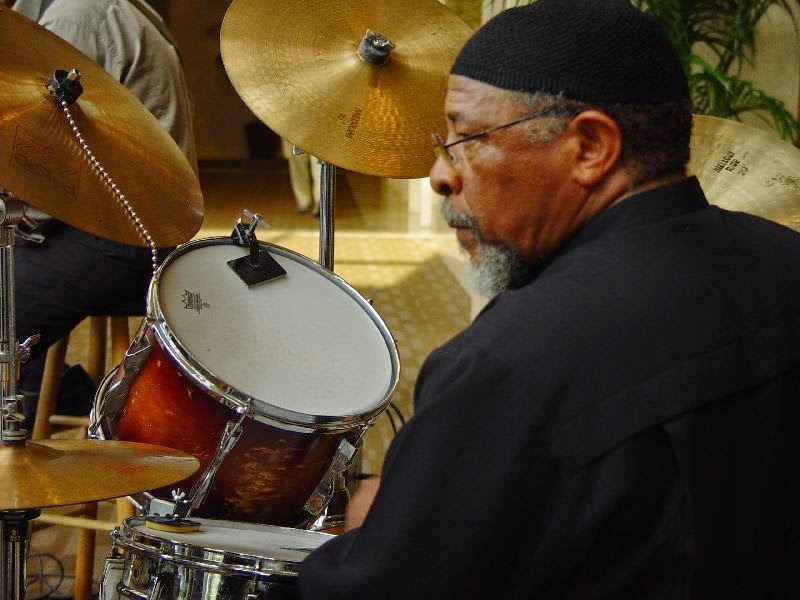
During a career that caught fire in the 1960s and continues to this day, drummer Carl Burnett has worked with a Who's Who of jazz artists: from Eddie Harris and Sarah Vaughn to Marvin Gaye and O.C. Smith, from Art Pepper and Freddie Hubbard to Horace Silver and Kenny Burrell. These days, Burnett frequently performs and records with bassist and longtime friend Stanley Gilbert; the two met back in the 1960s, when both were members of Cal Tjader's Quintet.


Which led both Burnett and Gilbert, in turn, to a brief association with Guaraldi.

I caught up with Burnett thanks to my colleague Duncan Reid, who authored our shared publisher's recent biography of Tjader. Just as I continue to gather anecdotes and information about Guaraldi's life and career, Duncan does the same, with respect to Tjader; Duncan tracked down and interviewed Burnett, and then kindly shared the drummer's contact information. Burnett's path crossed Guaraldi's only fleetingly, but significantly, and the drummer cheerfully welcomed the chance to reflect on his memories of Dr. Funk.

Burnett made his first appearance with Tjader's band on March 14, 1966, during a gig at El Matador. The drummer remained with Tjader for a little over two years, departing in the summer of 1968.

"El Matador was our home base, with Cal," Burnett recalled. "We'd go on the road and be gone for awhile; when we returned, we'd rest for a week, maybe two. Then we'd be back at El Matador, and folks would say, Hey, Cal's back, and the place would be packed every night."

As he related during an interview for Kathy Sloane's Keystone Korner: Portrait of a Jazz Club, Burnett had a room at a place called the Happy House, where numerous jazz musicians both resided and hung out.

"I was still living in Los Angeles," Burnett elaborated, "but Happy House was home when I was in San Francisco. We had a big piano in the living room, and every Sunday we'd have jam sessions, and everybody would play. It was a wonderful place to call home."

Burnett recalled having caught Guaraldi and Bola Sete during their heyday ("a really enjoyable musical situation"), but he didn't actually meet the famously mustachioed pianist until a few years later.

Sunday, April 6, 2014

A visit with the Doc

Guaraldi continues to elicit interest from jazz critics and historians, which of course is marvelous. Late last year, I was contacted by Richard "Doc" Stull, a jazz fan, writer and radio host whose CV reveals that he also dabbles as a musician and entertainer. You can learn more about him at his quite engaging web site.

Anyway, Doc wanted to chat about Guaraldi, and my book; we eventually enjoyed a lengthy phone conversation on February 4. Doc was well prepared, and his questions touched on everything from Guaraldi's childhood to his legacy, with stops along that way that covered bossa nova, the Grace Cathedral Jazz Mass and (of course!) the Peanuts gang.


I was particularly pleased to spend several minutes discussing Guaraldi's recording and performance association with Bola Sete, pictured here. For roughly two years, from March 1964 through February 1966, the Guaraldi/Sete Quartet was the hot ticket in the greater San Francisco area. Their debut run at Berkeley's Trois Couleur was extended repeatedly; they performed together at the 1964 Monterey Jazz Festival; and they wrapped lines around the building during numerous bookings at El Matador.

"The joy in Guaraldi's jazz is a priceless and timeless gift to music lovers," Doc wrote at one point, during our many e-mails. I couldn't have expressed that sentiment better, and Doc's appreciation for Dr. Funk is evident throughout the lengthy podcast that resulted from our chat. It went up April 3 on the New Books in Jazz website, where you'll also find Doc's generous review of my book. The interview runs 73 minutes; you can either play it via the site's pop-up player, or download it for later listening at your leisure.

Thanks again, Doc. It was great fun.

Friday, September 6, 2013

More power!


Bassist Kelly Bryan became a member of Guaraldi's trio in the fall of 1967, during what was to become a transitional point in the jazz pianist's career.

Kelly Bryan in 1968: You gotta love the threads.
(Sadly, no, he doesn't have any photos of his various
gigs as a member of Guaraldi's trio. More's the pity!)
The reason: Vince’s fondness for experimenting with all sorts of sounds, and his seduction by good ol rock n roll.

In hindsight, we probably can’t blame him; jazz clubs had all but vanished by this point, replaced in the San Francisco area — as everywhere else — by folk and rock venues. Guaraldi undoubtedly regarded his first-gen electric keyboards as a means of remaining relevant. Perhaps to the dismay of his long-time fans, though, he experimented with these new toys on the fly, during his club appearances, rather than developing at least some technique in the privacy of his home studio.

The results often weren't pretty, but hey: It was the 1960s, and some listeners probably expected things to get way, way out during an extended jam.

Bryan was present at Ground Zero, during one such gig, and he remembers it well.

Kelly was one of my more enjoyable interviews: amiable, helpful and always willing to be prodded by a few more questions, as I attempted to clarify various details. Our chats also helped motivate his own literary desires, and he has been penning his own memories of this quite engaging period in his life. (Frankly, Kelly, if what's to come reads as well as what you've already kindly shared, you must consider some sort of formal publishing arrangement.)

Anyway, Kelly cheerfully agreed to go into a bit more detail about his early days with Guaraldi, along with some general thoughts about the early days of electric instrumentation.

The rest of this entry, then, belongs to Kelly.

**********

In late January and early February of 1968, I played for a week with Vince Guaraldi and John Rae at the Bear Valley Ski Resort, in northern California. Vince had taken an interest in skiing and would spend all day on the slopes. He must have done well, because he always made it back to the lodge in time for dinner and the gig ... and all in one piece. I went skiing a couple of times and took lessons from a pretty blond ski instructor. By coincidence, she lived in Berkeley, too, so I got her number and dated her for a while when we were both at home again.

It might have been after the Bear Valley job that Vince said, "Well, Kel, now we've played every kind of gig there is ... except a hanging.”

Sunday, May 13, 2012

Guaraldi's career: Nailing down every event

The third disc of Stan Getz's four-CD set, The Bossa Nova Years, is playing as these words are typed: a languid, lovely reminder of the film Black Orpheus; the subsequent explosion of sensual, Latin-hued music in the U.S. pop world of the early 1960s; and the impact both had on Guaraldi's career. I'd love to have been in the adjacent seat, the first time he saw that film in a San Francisco movie theater. Ralph Gleason got the pianist to reflect on that seminal moment in the charming 1963 film, Anatomy of a Hit, but of course hindsight isn't the same as being present in the moment.


Guaraldi's life was filled with such moments, many of them taking place during otherwise ordinary gigs at greater Bay Area jazz clubs such as the Blackhawk, the hungry i, Outside at the Inside, the Trident and El Matador. One of my many "getting ready" exercises, while preparing the outline and itinerary that prefaced my plunge into the actual writing of my book, was an attempt to identify where he performed, and when, for as much of his life as possible. This began as a useful chronology; it quickly blossomed into an obsession. If I knew where he was for the first few weeks of, say, November 1968, I had to clock his movements for the rest of that month (which I was unable to do, alas).


I got lucky at times. Guaraldi's mother saved many things, such as the three-page itinerary of his 1956 winter and spring tour with Woody Herman's Third Herd; it wasn't complete, but ads in newspapers across the country helped fill many of the holes. Herman was a very popular draw; most of his band's performances were publicized.


The San Francisco Chronicle's entertainment section also was a blessing, as it listed who was appearing at every greater Bay Area club during the upcoming week. I had to be careful, though; I discovered that those bookings sometimes changed after the paper had gone to press, and that -- at other times -- careless reporters occasionally made mistakes. At times, a listing would claim one thing, but the given club's display ad -- on the same page! -- contained entirely different information. 


That phase of the research would have been much easier if the Chronicle -- and its companion paper, the San Francisco Examiner -- had entered the 21st century and made its archives available online. Alas, it seems the Chronicle and Examiner are destined to be the last big-city U.S. papers to make that transition (and they still haven't). The only option? The painful study, day by day, of the four or five pages of entertainment news via a microfilm reader. (My eyes are still crossed.)


The effort was worthwhile, though, because a portrait of Guaraldi's career began to take shape, which helped immensely during the subsequent construction of the book's narrative. But this was only the Bay Area: just part of the picture. Guaraldi toured a lot during the first 15 years of his career, whether on his own or as a member of units fronted by Woody Herman or Cal Tjader. I'd get occasional hits with respect to specific stops in larger markets, thanks to papers such as the Chicago Tribune, the Boston Globe, the Los Angeles Times and the New York Times (all of which do have online archives). Daily Variety, Variety and Billboard also were great help, and here's something I was delighted to discover: Google Books has made every single issue of Billboard available online, at no charge. What a Godsend!


The resulting timeline blossomed to a size and scope that outgrew the eventual destination for its data. Much of the information wound up between the covers of my book, but I didn't want the reader -- particularly the casual reader -- to drown in minutia. Ergo, much got left behind. But I also didn't want the information -- and the effort required to compile it -- to go to waste. Enter the Vince Guaraldi Timeline, a companion web page designed to complement Vince Guaraldi at the Piano. This web chronology contains everything I learned about Guaraldi's movements, along with who played at his side, when known. It's a "living" document; new information continues to surface all the time. 


Which leads to the obvious request: If you remember seeing Guaraldi perform at a particular venue, on a particular date, please get in touch. If you're one of Guaraldi's former sidemen, and you recall being with him at a particular gig -- note all the timeline entires with "sidemen unspecified" -- please get in touch. If you know of a gig I left out, absolutely get in touch. If you saved a poster from one of the many "group gigs" Guaraldi joined during his latter-career appearances at Bay Area rock and folk clubs, please get in touch. If you took pictures -- even ill-focused snapshots -- please get in touch. If you saved a souvenir program, or a newspaper ad such as the one at the top of this post, please get in touch. 


Despite the wealth of information in this document, many, many gaps remain ... all waiting to be filled.


Think of it as your contribution to history!