Showing posts with label Billboard. Show all posts

Thursday, January 30, 2025

Chart action: The 2024 holiday season

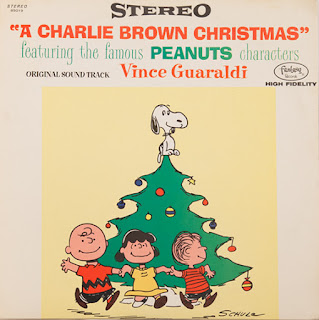
After 2023 produced only a single vinyl edition of A Charlie Brown Christmas, we wondered if the "multiple variants" fad had concluded.

Answer: definitely not.

2024 gave us four variants, as detailed in this earlier post.

And those multiple variants clearly had an impact on sales and chart position. 

The album returned to the Billboard 200 on November 16, entering at #170. The subsequent results: #108 (11/23), #58 (11/30), #29 (12/7), #17 (12/14), #18 (12/21), #12 (12/28) and peaked at #11 (1/4) ... one notch higher than the previous year. It then dropped precipitously to #138 (1/11) and vanished the following week.

It did significantly better in the Jazz Albums chart, debuting at #13 on August 31 (!). The subsequent ride was quite a roller coaster: #15 (9/7), #13 (9/14), #20 (9/21), #18 (9/28), #14 (10/5), #9 (10/12), #7 (10/19 and 10/26), #5 (11/2), #4 (11/9), #3 (11/16), #2 (11/23 and 11/30), #3 (12/7, 12/14, 12/21 and 12/28), #4 (1/4 and 1/11), #7 (1/18), #10 (1/25), #15 (2/1), #17 (2/8), #20 (2/15) and #24 (2/22, 3/1 and 3/8), and finally vanished the following week. All told, it remained in this chart for slightly more than half a year!

The Traditional Jazz chart was quite similar, starting at #11, also on August 31. The subsequent results: #13 (9/7), #11 (9/14), no appearance on 9/21 (!), #13 (9/28), #12 (10/5), #7 (10/12), #6 (10/19, 10/26 and 11/2), #3 (11/9 and 11/16), #2 (11/23 and 11/30), #3 (12/7, 12/14, 12/21 and 12/28), #4 (1/4 and 1/11), #5 (1/18), #8 (1/25), #12 (2/1), #13 (2/8) and #15 (2/15). It vanished the following week.

Apparently, people continued to purchase the album well past Christmas!

Since it continues to appear in the latter two charts, I'll continue to update this post, if necessary ... so check back occasionally.

Billboard's seasonal Top Holiday Album chart was somewhat frustrating. As expected, A Charlie Brown Christmas did quite well, starting at #3 on November 2, and remaining in the top 10 for the rest of the season: #2 (11/9), #5 (11/16), #4 (11/23 and 11/30), #6 (12/7), #5 (12/14), #6 (12/21), #5 (12/28), #7 (1/4) and #4 (1/11), after which that chart was closed until later this year. Nobody could dislodge Michael Buble from the top spot, and Vince also couldn't beat Nat King Cole!

The news was better, however, in the Hot 100. "Christmas Time Is Here" re-entered the chart at #48, on December 21 ... then rose to #46 the following week, and then #31 on January 4. The latter is an all-time high!

But wait ... there's more!

Thanks to the Lee Mendelson Film Productions' recent release of the soundtrack to Be My Valentine, Charlie Brown on black vinyl and two variants — as detailed in this earlier post — that album also began to chart!

It debuted on the Jazz Albums chart on 2/1, at #9, then dropped to #13 (2/8), #22 (2/15) and then rebounded to #16 (2/22).

It debuted on the Traditional Jazz Albums chart the same day, at #7, then dropped to #11 (2/8). It vanished on 2/15, but then reappeared at #12 on 2/22.

It also debuted on the Top Albums chart that same day, at #48 ... but vanished the following week.

(In case you're wondering, Billboard always dates its charts on the Saturday following each Tuesday's fresh set of statistics.)

As I said above, keep checking back ... because I suspect we aren't done yet! 

Wednesday, May 15, 2024

The second time around!

Big news, gang.

Huge, actually.

After two lonely years spent in my patented deep-sea isolation chamber, I've emerged victorious with the enhanced and improved second edition of my Guaraldi biography. McFarland, my beloved publisher, graciously agreed to share this magnificent tome with the world at large. It officially becomes available today.

[Um ... too much?]

Okay, I embellished a little.

In point of fact, I was quite honored — back in January 2022 — when McFarland expressed interest in an updated version of the original 2012 book. The target goal of such projects, I was told, was at least 25 percent new material; did I think I could supply that much?

Goodness, yes, I replied. Probably a bit more.

For starters — and this is no surprise, with such a book — within weeks of original publication, I started hearing from additional people with great "Guaraldi encounter" experiences to share, along with sidemen I'd either been unable to track down, or who simply hadn't been on my radar at all. Some of their stories first appeared in earlier posts in this blog; others are seeing print for the first time in the book's new edition.

Then, too, Guaraldi's star has gone supernova during the past decade, with all manner of new album releases, expanded and re-mastered editions of earlier albums, and wholly unexpected and unprecedented Billboard chart-making sales figures. Guaraldi arguably is much more famous today, than he was during his own lifetime ... and he was well celebrated then!

The excitement generated by all this fresh success demanded to be recorded for posterity in an updated edition of his biography.

But there was one stipulation: Neither McFarland nor I wanted the book to get excessively fat, because that would have pushed the cover price beyond what we considered reasonable. It therefore became necessary to trim the existing content by roughly 25 percent, in order to make room for the new material.

That was a fascinating challenge ... because, ideally, I wanted such cuts to be invisible, or nearly so. I felt like a director tasked with whittling a 160-minute first cut down to its best possible self, at 120 minutes ... and then making it even better with 40 additional minutes of fresh footage.

And, yes; that took the better part of 20 months. As the work progressed, I frequently was reminded of the sage wisdom of British journalist, critic and novelist Sir Arthur Quiller-Couch, who advised the frequent necessity to ruthlessly "murder your darlings." Which is to say, a glib turn of phrase — or paragraph or three — that's cute for its own sake, serves no real purpose.

Hard advice. I like my glib turns of phrase.

(And yes; I'm well aware that many attribute that guidance to either William Faulkner or Ernest Hemingway. They're wrong.)

Anyway...

Both McFarland and I are pleased with the ultimate result: a heartfelt book that (in my humble opinion) does an even better job of honoring the late and totally great Vince Guaraldi.

I'm further honored to have a new, second Foreword by good buddy and multiple Grammy Award-winning mastering engineer Michael Graves, and the truly snazzy cover designed by equally good friend and multi-talented Douglas Anderson. Gentlemen, take a bow.

The official McFarland order page can be found here.

Although the book wasn't officially released until today, I'm pretty sure folks have been able to order from other sources for awhile. Such is the crazy world of publishing these days.

Needless to say, I hope you all enjoy it...


Friday, October 13, 2023

End of an era?

Has the Charlie Brown Christmas vinyl craze finally played out?

Concord/Craft confirmed that only one vinyl variant will be released this year: the picture vinyl shown at left, available solely from Barnes & Noble.

However...

Although this LP was scheduled to be released on September 22, it's "temporarily out of stock" at B&N's online store. Nor is it available in any of the 21 B&N outlets within 100 miles of our home. On top of which, I have a report from one fan who advance-ordered it online awhile back, and his order was canceled ... which is odd.

Hopefully, it simply has been delayed.

That aside ... goodness, just the one? 

That's quite a reduction from last year, which saw eight variants, as also was the case in 2021. (A complete history of this marketing program, which photos of the variants, can be found here.) Including this year's release, and assuming my math is accurate — and if it isn't, I'm sure somebody will tell me — über-fans will have accumulated 42 LPs and one green 45 single.

I'd love to know what such an individual did with them all.

Display all the discs on a wall? (If somebody reading this actually did that, please send a photo; I'll happily post it here.)

It seems unsatisfying to simply file them vertically, with only their side ID visible, as with a conventional row of LPs.

There's no question that all the vinyl variants released during the past several years helped push the album into the Billboard 200's Top 10 for the past two years. I wonder, then, if that won't happen this year.

I guess we'll find out...

Friday, January 6, 2023

Chart success: 2022

After the excitement generated by last year's holiday-season sales of Guaraldi's soundtrack to A Charlie Brown Christmas, the question was whether the results would be as spectacular this year.

Not quite ... but still very impressive.

Three Billboard charts held our attention this year:

• The Billboard 200, which tracks album sales across all platforms (the formula being 1,500 on-demand audio and/or video song streams = 10 tracks sales = 1 album sale);

Billboard's Top Album Sales, which preserves the traditional methodology of counting solely pure album sales (which is where all those variant vinyl LPs play an important role); and

Billboard's Hot 100, which tracks the popularity of individual songs.

Last year, A Charlie Brown Christmas rose to #6 on the Billboard 200. So, how did it do this year?

The album entered the chart (once again, a "re-entry") for the week of November 19, at #90. It quickly rose to #43 the following week, and then #17 on December 3. It entered the top 10 — at #10 — the next week, but dropped to #12 on December 17. Then it rallied, and rose to #9 on December 24 ... and then #8 on December 31. Alas, that proved to be its peak, as it dropped back to #10 during the week of January 7.

Ah, but the news was much better in the Top Album Sales chart, where A Charlie Brown Christmas entered at #11 on December 3. It rose to #7 the following week, and then to #5 on December 17 ... which surpassed the previous year's peak position (#6). But Vince wasn't finished; his album hit #2 (!) on December 24, trailing behind only Taylor Swift's Midnight.

We held our breath, and wondered ... could Charlie Brown overtake Ms. Swift the following week?

(Highly unlikely. A Charlie Brown Christmas sold 17,000 units that week, to achieve its #2 status ... while Midnight's sales were in the low six figures.)

Alas, A Charlie Brown Christmas dropped to #3 on December 31, and then to #8 on January 7.

UPDATE: It dropped to #40, for the week ending January 14. (Guaraldi vanished from the other two charts.)

The Hot 100 chart offered a bit of solace. "Linus and Lucy" popped up for one week, at #49 on December 31, giving that tune its second run on this chart, following the previous year's surprise appearance (at #37). It disappeared on January 7, when "Christmas Time Is Here" debuted, at #50. It, too, did better the previous year, with a two-week run (#48, then #41).

Albeit a bit disappointing, we must put this chart action in perspective; we're talking about music that was produced almost seven decades ago, by a jazz artist who's been dead for almost half a century. If that isn't unprecedented, it's certainly astonishing!

Friday, May 20, 2022

Another sales milestone!

Guaraldi’s soundtrack to 1965’s A Charlie Brown Christmas has just been certified quintuple platinum by the Recording Industry Association of America (RIAA).


Back in the day, such a count would have been tabulated by physical album sales: LPs and CDs. The RIAA included streams beginning in February 2016, so this Charlie Brown Christmas milestone is based on more than 4 million copies purchased over various formats, and 1.14 billion streams.


(The formula is 1,500 on-demand audio and/or video song streams = 10 track sales = 1 album sale.)


As always gets mentioned in the same breath, this makes A Charlie Brown Christmas the second-best-selling jazz album of all time, behind Miles Davis’ Kind of Blue, which went quintuple platinum in 2019. And as I always point out — most recently in this post, when A Charlie Brown Christmas went quadruple platinum in December 2016 — these RIAA figures are based mostly on electronically recorded sales made subsequent to 1991, when Neilsen SoundScan began tracking data. Clearly, Guaraldi’s album sold many, many copies during the previous quarter-century … but because Fantasy’s record-keeping was so sloppy during those earlier years, a precise figure has been impossible to determine.


It’s therefore entirely possible that Guaraldi’s album has surpassed Kind of Blue … but we can only speculate. (In fairness, Davis’ album also sold plenty of copies prior to 1991.)


Meanwhile, this is merely the latest in a long line of accolades showered upon Guaraldi’s score. The album first was certified platinum in 1996; was inducted in the Grammy Hall of Fame in 2007; and was added to the Library of Congress’ National Recording Registry in 2012. Just last December, as detailed in this post, the album reached its highest-ever Billboard chart position, 56 years after its original release. Nor can we overlook Billboard citing A Charlie Brown Christmas at the top of its 50-position Greatest of All Time Holiday Albums List (followed, for those who are curious, by Michael Bublé’s Christmas, Mariah Carey’s Merry Christmas, and Mannheim Steamroller’s A Fresh Aire Christmas and Christmas).


Good ol’ Charlie Brown may not have shone during baseball and football place-kicking, but he’s certainly no slouch when it comes to album sales! 

Thursday, April 21, 2022

More great stuff from the magazine archives!


My previous post concerned the exciting discovery of a searchable online archive for Record World, during its time one of the three primary U.S. weekly music industry trade publications.


In my delight over focusing on Record World entries related to Guaraldi, I initially neglected to investigate more about the host site: worldradiohistory.com


Oh. My. Goodness.


Record World is just one of dozens of magazines and journals offered with similarly searchable archives; you’ll find the list here.


Alternatively, clicking on the “Music Magazines” button, along the top row, will open a sub-menu allowing quick access to a given magazine’s entire archive.


The depth and scope of this site are simply jaw-dropping.


It remains a work in progress; some archives aren’t complete, and occasional issues have missing pages. But it’s still astonishing.


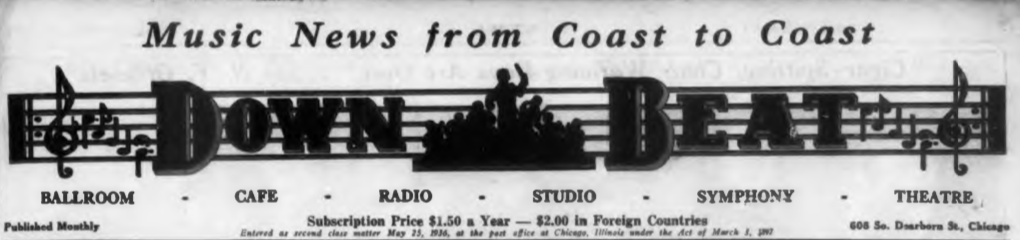
Having thoroughly examined Record World, I subsequently turned my attention to BillboardCash Box and Down Beat (as it was known, in the early days). 


Billboard began publishing in 1894. The entries are spotty until 1936, after which each year is pretty much complete. (Most crucially, it’s much easier — and more reliable — to search here, than in the Google Books Billboard archives, which return only some hits for a given search term.)


Cash Box ran from 1942 to 1996, and its archive is solid.


Down Beat, which debuted in 1934, is the most haphazard. 1934-36, 1938 and 1963 are entirely (or mostly) missing, and the entries are thin in 1971-77, and 1979-83.


All three magazines yielded plenty of fresh information about Guaraldi. I was particularly pleased by bits and bobs in the early 1950s, a period where information about his activities is quite scarce.


That said, the absence of 1963 in the Down Beat archive was vexing, since that was a busy year for him. Additionally, several of the Down Beat entries are weeks — even months — out of date, in terms of the information presented, which also is frustrating.


Some highlights:


• Thanks to Down Beat, I now have this earliest known photo (by far!) of Guaraldi performing with a combo. The quality isn’t terrific, but that’s him at far left. Until now, I was aware of Guaraldi performing with this quartet solely in the spring of 1951, but this photo ran in the November 16, 1951, issue. That’s intriguing, because Guaraldi had joined Cal Tjader’s trio as of mid-September. Was he simultaneously moonlighting with Chuck Travis? Unlikely, as the schedule with Tjader was full. But Guaraldi’s activities were sparse for most of 1951, until he joined Tjader, so it’s entirely possible that the gig with Travis was off and on throughout the summer. (Regardless, this Down Beat photo and caption obviously ran months after Guaraldi had left Travis.)

• This gig was new to me: On March 9, 1955, Down Beat reported that “Jerry Dodgion now leading the house band at the Black Hawk [sic], with Dottie Grae on drums, Dean Riley [sic], bass, and Vince Guaraldi, piano.” (Dodgion was part of the Guaraldi Quartet, with a different bassist and drummer, on Modern Music from San Francisco, recorded in August of the same year.)


• On December 28, 1955, Down Beat reported that “Vince Guaraldi drawing a lot of comment for his piano playing these nights at hungry i.”


• On March 7, 1956, Down Beat gave a thorough review of the Woody Herman band’s performance at New York’s Basin Street. (Guaraldi had joined Herman’s band the previous New Year’s Eve.) The lengthy piece includes this comment: “In the rhythm section, Woody has a find in pianist Vince Guaraldi, a San Franciscan recommended by Ralph Gleason. Guaraldi plays with rare economy of means, much warmth and taste, an excellent beat, and a real feeling for the blues vein in jazz.”


• Billboard gave a very nice review of Guaraldi’s first album, Vince Guaraldi Trio, on September 29, 1956: “Altho sales are unlikely to be spectacular, this is one of the pleasant surprises of the month. Guaraldi is a young San Francisco pianist who has been getting rave notices with the Woody Herman band. Evidence here says he’s a tasteful, authoritative and facile modernist, and that he swings. Further, he has a sense of humor. Guitarist Eddie Duran and bassist Dean Reilly are worthy colleagues. Try their version of John Lewis’ ‘Django’ for a real delight.”


• On May 2, 1957, Down Beat reviewed Introducing Gus Mancuso; Guaraldi performed on three of that album’s tracks. The review includes this comment: “Guaraldi is a particularly stimulating soloist (and isn’t it time for another LP by him?)” And, indeed, Guaraldi next album, A Flower Is a Lovesome Thing, arrived a few months later.


• On February 19, 1959, Down Beat reported that “Pianist Vince Guaraldi, scheduled to leave the Cal Tjader Quartet this month, is planning a musical partnership with drummer Johnny Markham and bassist John Mosher.” Guaraldi actually split with Tjader on January 18 or 19, and his next known booking followed immediately: at Lenny’s, in Oakland, every Tuesday evening, as part of tenor saxman Harold Wylie’s Quartet, alongside Markham and bassist Jerry Goode. I’ve no evidence that Guaraldi ever headed a trio with Markham and Mosher.


• Billboard noted the rising interest in Guaraldi’s Black Orpheus album on December 15, 1962: “Vince Guaraldi on San Francisco’s Fantasy label is grabbing solid sales action. Jazz Impressions of Black Orpheus has gone over 7,000 in album sales within six weeks, and is spreading to other areas. The single ‘Cast Your Fate to the Winds' [sic], a segment of the album, started in Sacramento, spread to all of Northern California with 10,000 discs out, and is now moving strongly in Southern California.”

• Fantasy ran a cute ad in Cash Box, on February 2, 1963; check it out at right. (Note Fantasy's address: As I’ve said elsewhere, it’s Treat Avenue, not Street!)


• On June 8, 1963, Cash Box tagged the Guaraldi Quintet single “Zelao”/“Jitterbug Waltz” — from the album In Person — as a Best Bet: “Vince Guaraldi, who scored last time out with ‘Cast Your Fate to the Winds’ [sic], could duplicate that success with this top-flight bossa nova follow-up stanza. The tune is a contagious, easy-going lyrical ballad with a danceable, rapidly-changing beat.”


• On September 18, 1965, Billboard noted that Guaraldi’s single, “Theme to Grace” — taken from the Grace Cathedral Jazz Mass LP — was “predicted to reach the Hot 100 Chart.” (Alas, it didn’t happen.)


• On August 6, 1966, Cash Box tagged Shelby Flint’s vocal cover of “Cast Your Fate to the Wind” — on a single backed by “The Lilly” — as a Best Bet: “Shelby Flint could make lots of playlists with this sweet, lyrical reading of this oft cut ditty. The lark does a smooth, lilting job on the tender lyric. Watch closely.” (Indeed, her single made Billboard’s Top 100 chart for six weeks, peaking at No. 61.)

• Finally, this was an eye-opener: Guaraldi’s first album for Warners, Oh Good Grief, made Billboard’s Best Selling Jazz LPs chart for two consecutive weeks, on June 29 and July 6, 1968. He’s at the bottom of the chart both times … but that’s still charting! 

Tuesday, April 12, 2022

Tidbits from Record World

I recently discovered a searchable online archive devoted to Record World, which — during its reign, from 1946 to 1982 — was one of the three primary U.S. weekly music industry trade publications, alongside Billboard and Cash Box. Record World actually debuted under the name Music Vendor, then switched in 1964, and continued under that new name until its final issue (April 10, 1982).

The archive is an obvious labor of love, with (thus far) most of its content running from spring 1964 to end of publication. Guaraldi likely wouldn’t have been more than an occasional blip until 1960 or ’61, but I’m sure he’d have been mentioned a lot in 1962 and ’63; I hope those issues will be added to the archive at some future time.


Meanwhile, a search on Vince turned up a couple dozen results, a few of which are worth noting here.


Talk about luck: The sole 1962 issue in the archive — June 23 — includes early mention of Jazz Impressions of Black Orpheus, as a coveted “Album Pick.” The brief write-up certainly is encouraging:

Pianist Guaraldi has a cleverly swinging, inventively saleable jazz product here. There is Brazilian music blending Latin African rhythms which were featured in tunes presented in this 1959 Cannes Film Festival winning pic. Proper exploitation could make it a chart album; it has the musical ingredients.


Mind you, this was a month before San Francisco’s Melody Sales issued a press release extolling the album, and another couple months before the impact of Sacramento radio station KROY’s success with “Cast Your Fate to the Wind” began to have a national impact. That makes Music Vendor quite prescient.


Moving ahead…


Now as Record World, the 9/25/65 issue’s “Money Music” column includes this brief item: “Much good music play in S.F. on ‘Theme to Grace’ — Vince Guaraldi, Fantasy — plus other areas.” Two months later, on November 27, the same column amplified the message: “ ‘Theme for [sic] Grace,’ Vince Guaraldi, Fantasy, selling well in Chicago and Detroit off good music play (plus California).”


These are the only industry mentions I’ve ever seen, regarding this particular Guaraldi tune’s chart and business activity. Pretty cool!


Elsewhere in that same issue, Record World says very nice things about Guaraldi’s just-released soundtrack to A Charlie Brown Christmas:


Guaraldi plays the jazz score of the new cartoon coming by for Christmas consumption. Most of the album is Guaraldi improvisations on familiar seasonal standards and carols — all getting fresh treatment from the piano player. The movie should give buyers a big push toward counters.


(Given publication lead time, this proves review copies were sent out at least two weeks prior to December 4, which has long been assumed the album’s public release date.)


Moving forward to December 3, 1966, reviewer Del Shields waxed enthusiastic about Live at El Matador:

Eastern jazz fans have not had a chance to hear Bola Sete. Out on the West Coast, Bola is the “in thing,” and this album could be one of the big sleepers of the year. Guaraldi, whose “Cast Your Fate to the Wind” was a monster chart item a few seasons ago, lends sympathetic support to this Brazilian guitarist, and the result is pure pleasure. Again, the excitement of the crowd helps so much to project the feeling of “you are there” on quite a session. “Black Orpheus Suite” is particularly outstanding.


The 10/7/67 issue includes an intriguing little item, buried within an article which discusses the recent sale of Fantasy and Galaxy Records to Saul Zaentz. In a paragraph highlighting future activity, Zaentz mentions an “eight-LP release for October and November, featuring new albums by,” among others, Guaraldi. That never happened, and there’s no indication that Guaraldi had a new album ready to be released on such short notice. (Guaraldi’s final Fantasy album was the aforementioned Live at El Matador, released a year earlier.) And it’s odd that Zaentz would issue such a statement, given that Guaraldi was in the midst of suing to be released from his Fantasy contract, which was indeed dissolved just a few months later, on December 27.


Guaraldi didn’t waste any time. Record World’s 4/13/68 issue features a short article headlined “WB-7A Signs Guaraldi,” which reads, in part:


Vince Guaraldi, composer of “Cast Your Fate to the Wind” and the musical scores of the Charlie Brown television specials, has been signed to an exclusive contract as an artist by Warner Bros.-Seven Arts Records Inc., announces Joe Smith, Vice President and general manager.


Guaraldi, one of the more recent contributors responsible for interpretive jazz in church halls and theater, will produce his own sessions at Warners.


It’s nice to see an early article that acknowledges the impact of Guaraldi’s Grace Cathedral Mass.


Moving ahead again, the 1/17/70 issue includes one of the very few reviews I’ve seen of Alma-Ville, the final album Guaraldi released during his lifetime:

That subtle, fluid melodic mind of Vince Guaraldi’s is at it again. Vince has come up with some exquisite melodies on this album, and plays them better than anybody else can, or probably ever will. He also does a striking guitar solo. Watch every cut.


(Goodness; you can’t ask for better than that!)


The final Guaraldi entry is somewhat bittersweet, as it comes more than a year after his passing in early 1976. The 12/24/77 issue features a round-up of “good Christmas records” by columnists David McGee and Barry Taylor. Along with paragraphs devoted to Elvis’ Christmas Album, Phil Spector’s Christmas Album, Merry Christmas: The Supremes and several others, we get this endorsement of A Charlie Brown Christmas:


Nothing like it anywhere. Vince Guaraldi fused classical, pop and jazz in writing the mellowest of scores for the Emmy Award-winning television show. Light and lyrical, with boundless good humor, it is enough to make you believe in Santa Claus and man’s inherent goodness.


We now take for granted that Guaraldi’s score for that cherished Peanuts special has become a must-play item every December … but it’s nice to see that Record World, way back in 1977, already was trumpeting its merits as a holiday chestnut. 

Monday, January 3, 2022

Chart success!

Guaraldi's score for A Charlie Brown Christmas has been popular ever since it debuted back in 1965, so it's no surprise that sales increase every year, as we approach the holiday season. What is surprising is that the album's popularity — as measured by sales, and recorded by Billboard magazine's various charts — has been increasing dramatically during the past several years.

The album didn't achieve any Billboard ranking until 1987, when (finally!) it debuted on the Top Holiday Albums chart. Two decades later — for the week ending January 27, 2007 — it peaked at No. 2 on that chart.

Its performance on the Billboard 200 (album) chart is more noteworthy, as this chart clocks all genres. A Charlie Brown Christmas always has posted respectable numbers during the final month of each year, but it finally reached the Top 10 — at #10 — just a year ago, on January 2, 2021.

Ah, but its performance this past holiday season has been spectacular.

The album entered the Billboard 200 chart on the week ending November 13, at #159. It rose to #63 the following week, then #51, and then #21. It hit #10 on December 11. Then it rose to #9 the following week, and #8 on Christmas Day.

Then — wait for it — the album hit #6 (!) on January 1, 2022. That's amazing.

(I suspect all those variants LPs, which have become an annual tradition, had a great deal to do with that ranking.)

UPDATE: With the holidays behind us, I guessed it would drop much lower the following week ... but that didn't happen. A Charlie Brown Christmas still placed a very respectable #8 for the week concluding January 8.

But this isn't even the best news.

Billboard's Hot 100 tracks the popularity of individual songs; way back in the day, that was measured by the sales of 45 singles. These days, as explained by Billboard, "The week's most popular songs across all genres [are] ranked by radio airplay audience impressions, as measured by Nielsen Music; sales data, as compiled by Nielsen Music; and streaming activity data provided by online music sources."

Guaraldi's only song to hit the Hot 100 was "Cast Your Fate to the Wind," which entered that chart — at #94 — on December 8, 1962. During a 19-week run that finally concluded on April 6, 1963, it peaked at #22 on February 23.

That song remained a Hot 100 Guaraldi one-shot ... until now.

The just-released Hot 100 chart — also dated January 1, 2022 — reveals two new debuts: "Linus and Lucy," at #37; and "Christmas Time Is Here," at #48.

UPDATE: "Christmas Time Is Here" rose to #41 for the week dated January 8, although (alas) "Linus and Lucy" vanished from the chart.

More than half a century after they were released.

This truly has been a magical Guaraldi Christmas!

[Note: The chart links above always default to the most recent week; you can dial back to any previous week by clicking on the blue circle calendar icon, directly below the chart title.]

Thursday, December 31, 2020

Chart success ... after 55 years!

Well, here's something worth singing about.

For the first time ever, Guaraldi's soundtrack album for A Charlie Brown Christmas has hit the Top 10 of Billboard's "Hot 200" album chart. This reflects sales and streaming data compiled for the week that concluded on Christmas Eve, December 24.

Granted, it's perched in the No. 10 spot ... but that's still Top 10!

And, mind you, this isn't merely the Top Holiday Albums chart, where it has tracked regularly since 1987. No, we're talking about the overall album chart, where the top spots currently belong to (respectively), Taylor Swift, Paul McCartney and Eminem.

This is huge.

Read the full report here, and you'll find the relevant chart here.

What a lovely, lovely way to conclude the year!

Wednesday, June 24, 2015

Fantasy (almost?) on the block ... the first time

Google Books’ massive wealth of material includes the complete archives of Billboard magazine, free for anybody to peruse. It’s easy to spend several hours (days?) tripping down musical memory lane, and of course these archives also are an invaluable resource; I used them extensively while researching information for my Guaraldi bio.

Until just the other day, though, I hadn’t considered investigating a search on Fantasy Records. Most of the results were too tangential for my purposes, but I did learn a few helpful details. The first was a squib from March 12, 1955, headlined Zaentz Heads Fantasy Sales. In entirety, the little piece informed readers that “Saul Zaentz has been named national sales manager for Fantasy Records. He formerly held sales and promotion posts with Clef and Norgran. Zaentz’s Fantasy duties will also include deejay relations.”

A little more than a month later, on April 23, that week’s Jazz Best Sellers — a listing always subdivided by label — gave Fantasy’s street address: 654 Natoma Street, in San Francisco. Although I already knew that Fantasy was on Natoma Street in the mid-1950s, I’d never had the actual number. (Yes, I do obsess over such details.)

The most interesting tidbit, however, unfolded during slightly more than four months, starting on New Year’s Eve in 1966 ... when Fantasy Records supposedly was purchased by a rival label (!).

Now, it’s well known that Max and Soul (Sol) Weiss sold Fantasy on September 1, 1967, to a consortium of distributors headed by Zaentz. But I had no idea that an entirely different offer had been floated nine months earlier.

On top of which, this earlier potential deal apparently blew up quite spectacularly.

It started when Billboard reported, on December 31, 1966, that — according to “reliable sources” — Audio Fidelity Records had bought Fantasy. “Contracts have been signed,” the article went on, “and Audio Fidelity is expected to take title in a few days. The label will be moved to New York, and Orrin Keppnews, former Riverside Records executive recently hired by AF, is expected to be Fantasy a&r vice president. The move is AF’s second major acquisition since Herman Gimbel took over the reins of the company. The first was the expansion into the country field with Little Darlin’ Records.”

As Mr. Spock had just begun to say, every Thursday evening that TV season, Fascinating...

At that point in time, Audio Fidelity’s major claim to fame was having released the United States’ first mass-produced stereophonic long-playing record, in November 1957. Under original owner Sidney Frey, the label signed a respectable collection of jazz musicians, including Lionel Hampton, Louis Armstrong, Elmo Hope and Lalo Schifrin. In 1962, Frey became one of the first U.S. record company owners to aggressively pursue bossa nova and Brazilian jazz, releasing LPs by João Gilberto, Luiz Bonfá, Oscar Castro-Neves and several others.

Frey sold the company in 1965 to Gimbel, who expanded inventory and artists; even so, he never became a major player during the rapidly expanding rock era. Ironically, most of the Audio Fidelity LPs found in home libraries in the 1970s weren’t music at all; the label did quite well by its extremely popular line of sound-effects albums. Audio Fidelity was folded into Milestone Records in 1985, and eventually went bankrupt in 1997.

But back to our story...

Despite the apparent haste with which Audio Fidelity’s deal with Fantasy was expected to take place, nothing happened for several months. Then, on March 25, 1967, Billboard unveiled fresh information beneath the headline A Disagreement Stops Buying of Fantasy by AF.

“The acquisition has failed to materialize,” the article began. “Herman Gimbel, AF president, had flown to San Francisco last week to close the deal. Gimbel returned without the acquisition, charging that Fantasy failed to deliver assets provided for in the agreement. These assets, according to Gimbel, include ‘full use of a quantity of masters — including all of the Dave Brubeck material, which is unquestionably the heart of the Fantasy catalog.’ Gimbel added that record club and tape cartridge deals had been negotiated for the expected new Fantasy operation.”

The next step was inevitable: Gimbel sued.

On May 13, 1967, Billboard broke this news under the headline AF Charges Fantasy Welched on Contract. “Audio Fidelity has sought recourse through the courts,” the article began. “The deal allegedly was set by both parties, when, according to AF President Herman Gimbel, Fantasy backed out.

“According to the complaint, the defendants entered into a written contract with Gimbel for the sale of their music and sound recording business. Sale price was allegedly $235,000, with another $200,000 for royalties to be paid over a five-year period. Gimbel said he made a $5,000 down payment last November.

“Gimbel charges that on March 9 he met with the defendants in San Francisco, to sign the final contract, but that the defendants refused to deliver the business and assets.”

The rest of the article specifies various sidebar details, including advance orders that Gimbel already had taken for the expected Fantasy library, which “would have yielded him a net profit of at least $70,000” (and which sounds rather like counting one’s chickens before they’ve hatched).

“Gimbel seeks an accounting of the Fantasy operation for 1967,” the article concludes, “along with court costs, and, if the court rules that the contract cannot be performed, damages of $95,974.32 and such additional damages as may be established by the evidence.”

I’d love to know how they came up with that 32 cents...

All kidding aside, I was struck by what seems to have been Fantasy’s rather modest value. Just a quarter-million for the whole shebang, plus not quite that much in royalties? Seriously? I know everything cost less back in 1967, but that still seems low.

Maybe it was, and maybe that’s why Soul and Max backed out. Alas, we’ll never know. That was the last Billboard reported of the matter, which suggests things were settled out of court.

Zaentz and his fellow investors were more successful a few months later, paying $325,000 for the label and all its assets ... which, on the surface, seems a worse deal than Soul and Max were offered by Audio Fidelity. As history quickly demonstrated, Zaentz made one helluva deal. Thanks to the incredible popularity of Creedence Clearwater Revival, he was able to pay off the five-year note in 18 months. As quoted in Billboard on May 3, 1969, Zaentz now insisted that he “wouldn’t take $6 million for Fantasy.”

Zaentz’s subsequent adventures with Creedence and John Fogerty, of course, became an entirely different story, and the stuff of both rock and precedent-establishing courtroom legend. If you’re curious, check it out here.

In hindsight, it’s interesting to note that the Audio Fidelity imbroglio was taking place at the same time that Guaraldi had filed his own lawsuit against Fantasy, seeking release from his oppressive contract. That suit wasn’t resolved until December 27, 1967, shortly after Zaentz took over the label. (I remain convinced that Zaentz, far smarter about such things than the Weiss brothers, recognized and quickly dealt with what almost certainly would have been an embarrassing courtroom loss for Fantasy).


As journalist Linda Ellerbee is so fond of saying, And so it goes...

Tuesday, September 25, 2012

The fickle fingers of 'Fate'

"Cast Your Fate to the Wind" isn't Guaraldi's most famous composition at this late date — that honor probably belongs to "Linus and Lucy," with "Christmas Time Is Here" coming up rapidly — but it was his first hit, and certainly the only one to win him a Grammy Award.


The song's generally accepted copyright dates back to 1961, when it was registered with the Friendship Music Corporation, a collaborative endeavor between Guaraldi and good friend Frank Werber, who at the time was well-regarded for having turned the Kingston Trio into touring and recording stars. But Guaraldi had been noodling around with "Fate" for several years before that; one former Daly City neighbor recalls hearing him working on it in the late 1950s, when she was a little girl whose mother pointed to Guaraldi as an example of the way somebody should faithfully practice the piano.

"I'll tell you when I wrote it," Guaraldi later recalled, during an interview with his longtime friend and advocate Ralph Gleason. "I think it was in '58, just about when I left Cal. In fact, I brought it to Cal, but I never played it until after I left Woody, when I was at Outside at the Inside, in Palo Alto."

Outside at the Inside — initially known as Caffe Court — opened August 7, 1959. Guaraldi backed singer Valerie Knight during the first week of business, and then he joined Herman's band for a week in Las Vegas. Next up was a long stint down in Southern California, with the Lighthouse All-Stars, after which Guaraldi returned north and began a yearlong residency at Outside at the Inside in the spring of 1960. So if Guaraldi remembered the details accurately during that chat with Gleason, we can assume this is when the pianist publicly unveiled "Cast Your Fate to the Wind."

Why, then, wasn't the song copyrighted sooner?

Ah, but it was ... and therein lies a tale.

Sunday, May 13, 2012

Guaraldi's career: Nailing down every event

The third disc of Stan Getz's four-CD set, The Bossa Nova Years, is playing as these words are typed: a languid, lovely reminder of the film Black Orpheus; the subsequent explosion of sensual, Latin-hued music in the U.S. pop world of the early 1960s; and the impact both had on Guaraldi's career. I'd love to have been in the adjacent seat, the first time he saw that film in a San Francisco movie theater. Ralph Gleason got the pianist to reflect on that seminal moment in the charming 1963 film, Anatomy of a Hit, but of course hindsight isn't the same as being present in the moment.


Guaraldi's life was filled with such moments, many of them taking place during otherwise ordinary gigs at greater Bay Area jazz clubs such as the Blackhawk, the hungry i, Outside at the Inside, the Trident and El Matador. One of my many "getting ready" exercises, while preparing the outline and itinerary that prefaced my plunge into the actual writing of my book, was an attempt to identify where he performed, and when, for as much of his life as possible. This began as a useful chronology; it quickly blossomed into an obsession. If I knew where he was for the first few weeks of, say, November 1968, I had to clock his movements for the rest of that month (which I was unable to do, alas).


I got lucky at times. Guaraldi's mother saved many things, such as the three-page itinerary of his 1956 winter and spring tour with Woody Herman's Third Herd; it wasn't complete, but ads in newspapers across the country helped fill many of the holes. Herman was a very popular draw; most of his band's performances were publicized.


The San Francisco Chronicle's entertainment section also was a blessing, as it listed who was appearing at every greater Bay Area club during the upcoming week. I had to be careful, though; I discovered that those bookings sometimes changed after the paper had gone to press, and that -- at other times -- careless reporters occasionally made mistakes. At times, a listing would claim one thing, but the given club's display ad -- on the same page! -- contained entirely different information. 


That phase of the research would have been much easier if the Chronicle -- and its companion paper, the San Francisco Examiner -- had entered the 21st century and made its archives available online. Alas, it seems the Chronicle and Examiner are destined to be the last big-city U.S. papers to make that transition (and they still haven't). The only option? The painful study, day by day, of the four or five pages of entertainment news via a microfilm reader. (My eyes are still crossed.)


The effort was worthwhile, though, because a portrait of Guaraldi's career began to take shape, which helped immensely during the subsequent construction of the book's narrative. But this was only the Bay Area: just part of the picture. Guaraldi toured a lot during the first 15 years of his career, whether on his own or as a member of units fronted by Woody Herman or Cal Tjader. I'd get occasional hits with respect to specific stops in larger markets, thanks to papers such as the Chicago Tribune, the Boston Globe, the Los Angeles Times and the New York Times (all of which do have online archives). Daily Variety, Variety and Billboard also were great help, and here's something I was delighted to discover: Google Books has made every single issue of Billboard available online, at no charge. What a Godsend!


The resulting timeline blossomed to a size and scope that outgrew the eventual destination for its data. Much of the information wound up between the covers of my book, but I didn't want the reader -- particularly the casual reader -- to drown in minutia. Ergo, much got left behind. But I also didn't want the information -- and the effort required to compile it -- to go to waste. Enter the Vince Guaraldi Timeline, a companion web page designed to complement Vince Guaraldi at the Piano. This web chronology contains everything I learned about Guaraldi's movements, along with who played at his side, when known. It's a "living" document; new information continues to surface all the time. 


Which leads to the obvious request: If you remember seeing Guaraldi perform at a particular venue, on a particular date, please get in touch. If you're one of Guaraldi's former sidemen, and you recall being with him at a particular gig -- note all the timeline entires with "sidemen unspecified" -- please get in touch. If you know of a gig I left out, absolutely get in touch. If you saved a poster from one of the many "group gigs" Guaraldi joined during his latter-career appearances at Bay Area rock and folk clubs, please get in touch. If you took pictures -- even ill-focused snapshots -- please get in touch. If you saved a souvenir program, or a newspaper ad such as the one at the top of this post, please get in touch. 


Despite the wealth of information in this document, many, many gaps remain ... all waiting to be filled.


Think of it as your contribution to history!