Showing posts with label Shelby Flint. Show all posts

Thursday, April 21, 2022

More great stuff from the magazine archives!


My previous post concerned the exciting discovery of a searchable online archive for Record World, during its time one of the three primary U.S. weekly music industry trade publications.


In my delight over focusing on Record World entries related to Guaraldi, I initially neglected to investigate more about the host site: worldradiohistory.com


Oh. My. Goodness.


Record World is just one of dozens of magazines and journals offered with similarly searchable archives; you’ll find the list here.


Alternatively, clicking on the “Music Magazines” button, along the top row, will open a sub-menu allowing quick access to a given magazine’s entire archive.


The depth and scope of this site are simply jaw-dropping.


It remains a work in progress; some archives aren’t complete, and occasional issues have missing pages. But it’s still astonishing.


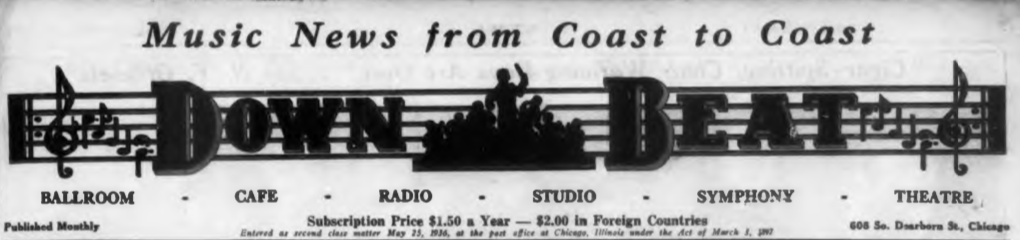
Having thoroughly examined Record World, I subsequently turned my attention to BillboardCash Box and Down Beat (as it was known, in the early days). 


Billboard began publishing in 1894. The entries are spotty until 1936, after which each year is pretty much complete. (Most crucially, it’s much easier — and more reliable — to search here, than in the Google Books Billboard archives, which return only some hits for a given search term.)


Cash Box ran from 1942 to 1996, and its archive is solid.


Down Beat, which debuted in 1934, is the most haphazard. 1934-36, 1938 and 1963 are entirely (or mostly) missing, and the entries are thin in 1971-77, and 1979-83.


All three magazines yielded plenty of fresh information about Guaraldi. I was particularly pleased by bits and bobs in the early 1950s, a period where information about his activities is quite scarce.


That said, the absence of 1963 in the Down Beat archive was vexing, since that was a busy year for him. Additionally, several of the Down Beat entries are weeks — even months — out of date, in terms of the information presented, which also is frustrating.


Some highlights:


• Thanks to Down Beat, I now have this earliest known photo (by far!) of Guaraldi performing with a combo. The quality isn’t terrific, but that’s him at far left. Until now, I was aware of Guaraldi performing with this quartet solely in the spring of 1951, but this photo ran in the November 16, 1951, issue. That’s intriguing, because Guaraldi had joined Cal Tjader’s trio as of mid-September. Was he simultaneously moonlighting with Chuck Travis? Unlikely, as the schedule with Tjader was full. But Guaraldi’s activities were sparse for most of 1951, until he joined Tjader, so it’s entirely possible that the gig with Travis was off and on throughout the summer. (Regardless, this Down Beat photo and caption obviously ran months after Guaraldi had left Travis.)

• This gig was new to me: On March 9, 1955, Down Beat reported that “Jerry Dodgion now leading the house band at the Black Hawk [sic], with Dottie Grae on drums, Dean Riley [sic], bass, and Vince Guaraldi, piano.” (Dodgion was part of the Guaraldi Quartet, with a different bassist and drummer, on Modern Music from San Francisco, recorded in August of the same year.)


• On December 28, 1955, Down Beat reported that “Vince Guaraldi drawing a lot of comment for his piano playing these nights at hungry i.”


• On March 7, 1956, Down Beat gave a thorough review of the Woody Herman band’s performance at New York’s Basin Street. (Guaraldi had joined Herman’s band the previous New Year’s Eve.) The lengthy piece includes this comment: “In the rhythm section, Woody has a find in pianist Vince Guaraldi, a San Franciscan recommended by Ralph Gleason. Guaraldi plays with rare economy of means, much warmth and taste, an excellent beat, and a real feeling for the blues vein in jazz.”


• Billboard gave a very nice review of Guaraldi’s first album, Vince Guaraldi Trio, on September 29, 1956: “Altho sales are unlikely to be spectacular, this is one of the pleasant surprises of the month. Guaraldi is a young San Francisco pianist who has been getting rave notices with the Woody Herman band. Evidence here says he’s a tasteful, authoritative and facile modernist, and that he swings. Further, he has a sense of humor. Guitarist Eddie Duran and bassist Dean Reilly are worthy colleagues. Try their version of John Lewis’ ‘Django’ for a real delight.”


• On May 2, 1957, Down Beat reviewed Introducing Gus Mancuso; Guaraldi performed on three of that album’s tracks. The review includes this comment: “Guaraldi is a particularly stimulating soloist (and isn’t it time for another LP by him?)” And, indeed, Guaraldi next album, A Flower Is a Lovesome Thing, arrived a few months later.


• On February 19, 1959, Down Beat reported that “Pianist Vince Guaraldi, scheduled to leave the Cal Tjader Quartet this month, is planning a musical partnership with drummer Johnny Markham and bassist John Mosher.” Guaraldi actually split with Tjader on January 18 or 19, and his next known booking followed immediately: at Lenny’s, in Oakland, every Tuesday evening, as part of tenor saxman Harold Wylie’s Quartet, alongside Markham and bassist Jerry Goode. I’ve no evidence that Guaraldi ever headed a trio with Markham and Mosher.


• Billboard noted the rising interest in Guaraldi’s Black Orpheus album on December 15, 1962: “Vince Guaraldi on San Francisco’s Fantasy label is grabbing solid sales action. Jazz Impressions of Black Orpheus has gone over 7,000 in album sales within six weeks, and is spreading to other areas. The single ‘Cast Your Fate to the Winds' [sic], a segment of the album, started in Sacramento, spread to all of Northern California with 10,000 discs out, and is now moving strongly in Southern California.”

• Fantasy ran a cute ad in Cash Box, on February 2, 1963; check it out at right. (Note Fantasy's address: As I’ve said elsewhere, it’s Treat Avenue, not Street!)


• On June 8, 1963, Cash Box tagged the Guaraldi Quintet single “Zelao”/“Jitterbug Waltz” — from the album In Person — as a Best Bet: “Vince Guaraldi, who scored last time out with ‘Cast Your Fate to the Winds’ [sic], could duplicate that success with this top-flight bossa nova follow-up stanza. The tune is a contagious, easy-going lyrical ballad with a danceable, rapidly-changing beat.”


• On September 18, 1965, Billboard noted that Guaraldi’s single, “Theme to Grace” — taken from the Grace Cathedral Jazz Mass LP — was “predicted to reach the Hot 100 Chart.” (Alas, it didn’t happen.)


• On August 6, 1966, Cash Box tagged Shelby Flint’s vocal cover of “Cast Your Fate to the Wind” — on a single backed by “The Lilly” — as a Best Bet: “Shelby Flint could make lots of playlists with this sweet, lyrical reading of this oft cut ditty. The lark does a smooth, lilting job on the tender lyric. Watch closely.” (Indeed, her single made Billboard’s Top 100 chart for six weeks, peaking at No. 61.)

• Finally, this was an eye-opener: Guaraldi’s first album for Warners, Oh Good Grief, made Billboard’s Best Selling Jazz LPs chart for two consecutive weeks, on June 29 and July 6, 1968. He’s at the bottom of the chart both times … but that’s still charting! 

Friday, September 22, 2017

Vince Guaraldi Day (locally)

The opening line of a brief announcement published in Wednesday's Napa Valley Register couldn't help catching my eye:

Mill Valley Mayor Jessica Sloan has proclaimed Sunday, Sept. 24, as "Vince Guaraldi Day."

Seriously?

Indeed yes. And the official proclamation is pretty fancy:


It seems an oddly random choice of day. Guaraldi was born on July 17, and died on February 6. Near as I can determine, nothing of consequence ever happened to him on a September 24 (although Shelby Flint's vocal cover of "Cast Your Fate to the Wind" did peak at No. 11 on Billboard's Top 40 Easy Listening Chart, on September 24, 1966).

So, I had to wonder ... what will take place, on Vince Guaraldi Day?

A speech by Mayor Sloan? A parade? A screening of the recent Toby Gleason/Andy Thomas documentary, The Anatomy of Vince Guaraldi? All-day screenings of the many Peanuts TV specials he scored, including A Charlie Brown Christmas and A Boy Named Charlie Brown, for which he "may be most known"?

Apparently not.

Near as I can tell, the only event scheduled is a Guaraldi-themed concert by the Larry Vuckovich Quintet, taking place at 3 p.m. at Mill Valley's Throckmorton Theatre. (Ticket information is available here.)

Which makes it seem as though Mayor Sloan's proclamation mostly is a well-timed boost for Larry's concert. I guess it's great to have friends in high places!

And I look forward to ever-more-ambitious programs, when Mill Valley celebrates each Vince Guaraldi Day, in years to come...

Thursday, May 17, 2012

Carel Werber speaks (although not to me)

Casual Guaraldi fans may have raised an eyebrow at the implications in the previous post, which discussed Shelby Flint's charting version of "Cast Your Fate to the Wind" ... and, thanks to the informative comment added by Chris Lee, the additional information about the very brief chart appearance male vocalist Steve Alaimo enjoyed with the same song.

But wait, I hear you cry. Isn't "Cast Your Fate to the Wind" an instrumental composition?

Indeed yes, as recorded by Guaraldi in 1962, and later covered — as the decades passed — by other jazz artists ranging from Quincy Jones and George Benson to Dave Brubeck and Guaraldi's protégé, Larry Vuckovich.

But as a purchase of the song's sheet music reveals, "Cast Your Fate to the Wind" also has lyrics that are credited to Carel (sometimes spelled Carol) Werber. And those lyrics allowed cover versions by vocalists such as Flint, Alaimo and other famous folks including Johnny Rivers and Mel Torme.

Fair enough. But why, then, didn't I mention the lyrics — or Carel — in my book?

Very simple: I never was able to get a line on her, regardless of how her first name was spelled. She's vexingly MIA on the Web, never mentioned at all in any of Ralph Gleason's San Francisco Chronicle jazz columns — or in any other vintage interviews with, or articles about, Guaraldi — and journalistic caution precluded commentary without at least some first-person input.

Imagine the mixed feelings that emerged, then, when my buddy Doug in D.C. sent a link to an interview Carel Rowe (her maiden name) granted KRTS 93.5 FM a few months back, on February 13. Host Ross Burns invited Rowe on his program, "Talk at Ten," to reminisce about her time with the Kingston Trio and the group's manager, Frank Werber, who married Carel after a whirlwind courtship in the summer of 1961. My feelings were mixed because it was great to hear a first-person account of her activities back in the day, but frustrating because it would have been far better to have that information before my book went to press. But that's the way it often goes (as I've lamented elsewhere in this blog).

Although booked to chat about the Kingston Trio, Carel spent far more time discussing how she met and married Werber, and how she subsequently met Guaraldi, and how she came to write the lyrics for "Cast Your Fate to the Wind." Indeed, Kingston Trio fans let their displeasure be known in the blogosphere, particularly since Carel (to put it as kindly as possible) damned the famed trio with very faint praise. But that really isn't our concern here.

The scoop, then, as recounted on Burns' radio show:

Carel began her college career while living at home and commuting to the University of Arizona, Tucson, where she became a cheerleader. The folk scene was a big deal in Tucson in the early 1960s, just as it was everywhere else, and she spent a lot of after-class hours hanging out with various musicians. One of these troubadours was Travis Edmonson, a rising folksinger soon to achieve fame as a member of the Gateway Singers, and also with his own duo, Bud (Dashiell) and Travis. Carel dated Edmonson and viewed the budding relationship as serious: serious enough that, when he left Arizona for San Francisco as the 1961 summer break started, she followed.

Tuesday, May 15, 2012

Shelby Flint's 'Fate'

Research is an endless task akin to cleaning a house: No matter how meticulous the approach, no matter how much time and effort are put into the work, there's always another overlooked corner waiting to be scoured. At some point, though, one must call it a day and get on with life.


So it was, toward the end of the roughly three years I spent actively gathering data, conducting interviews, preparing outlines and then actually writing what became my book, Vince Guaraldi at the Piano. The writing too frequently was interrupted by a fresh quest prompted by a nugget of information in a newspaper article, or a casual aside in the transcription of an interview with one of Guaraldi's former sidemen. I love investigative research; it suits both my scrupulous nature and romantic notions of being a private detective. Writing is hard; sifting data is fun. No surprise, then, that I frequently postponed the former in order to indulge in more of the latter.


Too frequently, as it turned out. And each new bit of discovered information made the manuscript longer by a sentence, a paragraph or a page. A writer who yields too often to such impulses will a) wind up with a manuscript that's much too long; or b) never finish the book at all. Or both.


I finally had to stop, submit the final, polished edit to my publisher, and walk away ... knowing, with certainty, that the moment the contents of the book became set in stone (well, on paper), I'd think of something else that should have been included.


I therefore wasn't surprised, a few weeks ago — which was a few weeks after the book was released — when I woke one morning, having recalled something that hadn't properly registered when I first came across it. Something I read, something somebody said ... I didn't know which. A simple statement to the effect that the song "Cast Your Fate to the Wind" had "charted" three times, referring to landings on the Billboard pop chart. And that statement, freshly remembered, brought me up short.


Three times?


Only two leaped to mind: the 19 weeks that Guaraldi's own version of his song had spent on the charts, in late 1962 and 1963; and the 13 weeks of chart action enjoyed in 1965 by the cover version delivered by the British group Sounds Orchestral. I could not recall having come across a third artist or band that also had a hit single with the song.


So I went looking.


Mercifully, the hunt was short. California-born singer Shelby Flint enjoyed an eight-week run with "Cast Your Fate to the Wind" in 1966, from August 13 through October 4: six weeks on the Top 100 chart, and a slightly overlapping seven weeks on the Top 40 Easy Listening chart. It was Flint's second and final Top 100 single, after 1961's "Angel on My Shoulder." She enjoyed a modest but noteworthy pop career in the 1960s, releasing a handful of albums, one of them prompted by her success with Guaraldi's hit song. She was praised by jazz critic Leonard Feather, and cited as a role model by Joni Mitchell. Flint went on to work in film and television; she eventually gravitated more toward jazz, and her 1992 album Providence remains a high point of her later career. Like Guaraldi, she also enjoyed a Peanuts connection, albeit a brief one; she sang Lila's theme — "Do You Remember Me?" — in the second big-screen Peanuts film, 1972's Snoopy Come Home.


Obviously, she should have been mentioned in my book; neglecting her chart action with "Cast Your Fate to the Wind" was an unfortunate oversight.


An oversight which, happily, can be set right here.