Showing posts with label Dean Reilly. Show all posts

Thursday, April 21, 2022

More great stuff from the magazine archives!


My previous post concerned the exciting discovery of a searchable online archive for Record World, during its time one of the three primary U.S. weekly music industry trade publications.


In my delight over focusing on Record World entries related to Guaraldi, I initially neglected to investigate more about the host site: worldradiohistory.com


Oh. My. Goodness.


Record World is just one of dozens of magazines and journals offered with similarly searchable archives; you’ll find the list here.


Alternatively, clicking on the “Music Magazines” button, along the top row, will open a sub-menu allowing quick access to a given magazine’s entire archive.


The depth and scope of this site are simply jaw-dropping.


It remains a work in progress; some archives aren’t complete, and occasional issues have missing pages. But it’s still astonishing.


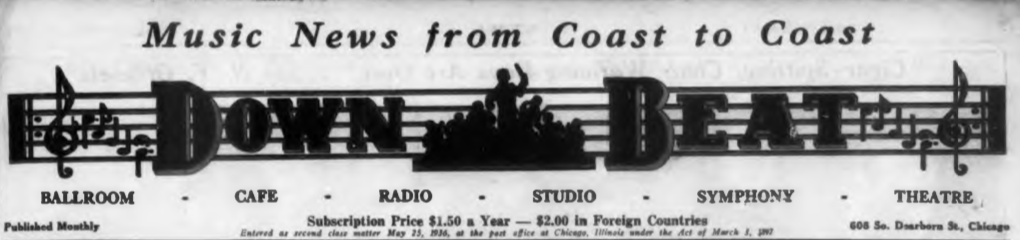
Having thoroughly examined Record World, I subsequently turned my attention to Billboard, Cash Box and Down Beat (as it was known, in the early days). 


Billboard began publishing in 1894. The entries are spotty until 1936, after which each year is pretty much complete. (Most crucially, it’s much easier — and more reliable — to search here, than in the Google Books Billboard archives, which return only some hits for a given search term.)


Cash Box ran from 1942 to 1996, and its archive is solid.


Down Beat, which debuted in 1934, is the most haphazard. 1934-36, 1938 and 1963 are entirely (or mostly) missing, and the entries are thin in 1971-77, and 1979-83.


All three magazines yielded plenty of fresh information about Guaraldi. I was particularly pleased by bits and bobs in the early 1950s, a period where information about his activities is quite scarce.


That said, the absence of 1963 in the Down Beat archive was vexing, since that was a busy year for him. Additionally, several of the Down Beat entries are weeks — even months — out of date, in terms of the information presented, which also is frustrating.


Some highlights:


• Thanks to Down Beat, I now have this earliest known photo (by far!) of Guaraldi performing with a combo. The quality isn’t terrific, but that’s him at far left. Until now, I was aware of Guaraldi performing with this quartet solely in the spring of 1951, but this photo ran in the November 16, 1951, issue. That’s intriguing, because Guaraldi had joined Cal Tjader’s trio as of mid-September. Was he simultaneously moonlighting with Chuck Travis? Unlikely, as the schedule with Tjader was full. But Guaraldi’s activities were sparse for most of 1951, until he joined Tjader, so it’s entirely possible that the gig with Travis was off and on throughout the summer. (Regardless, this Down Beat photo and caption obviously ran months after Guaraldi had left Travis.)

• This gig was new to me: On March 9, 1955, Down Beat reported that “Jerry Dodgion now leading the house band at the Black Hawk [sic], with Dottie Grae on drums, Dean Riley [sic], bass, and Vince Guaraldi, piano.” (Dodgion was part of the Guaraldi Quartet, with a different bassist and drummer, on Modern Music from San Francisco, recorded in August of the same year.)


• On December 28, 1955, Down Beat reported that “Vince Guaraldi drawing a lot of comment for his piano playing these nights at hungry i.”


• On March 7, 1956, Down Beat gave a thorough review of the Woody Herman band’s performance at New York’s Basin Street. (Guaraldi had joined Herman’s band the previous New Year’s Eve.) The lengthy piece includes this comment: “In the rhythm section, Woody has a find in pianist Vince Guaraldi, a San Franciscan recommended by Ralph Gleason. Guaraldi plays with rare economy of means, much warmth and taste, an excellent beat, and a real feeling for the blues vein in jazz.”


• Billboard gave a very nice review of Guaraldi’s first album, Vince Guaraldi Trio, on September 29, 1956: “Altho sales are unlikely to be spectacular, this is one of the pleasant surprises of the month. Guaraldi is a young San Francisco pianist who has been getting rave notices with the Woody Herman band. Evidence here says he’s a tasteful, authoritative and facile modernist, and that he swings. Further, he has a sense of humor. Guitarist Eddie Duran and bassist Dean Reilly are worthy colleagues. Try their version of John Lewis’ ‘Django’ for a real delight.”


• On May 2, 1957, Down Beat reviewed Introducing Gus Mancuso; Guaraldi performed on three of that album’s tracks. The review includes this comment: “Guaraldi is a particularly stimulating soloist (and isn’t it time for another LP by him?)” And, indeed, Guaraldi next album, A Flower Is a Lovesome Thing, arrived a few months later.


• On February 19, 1959, Down Beat reported that “Pianist Vince Guaraldi, scheduled to leave the Cal Tjader Quartet this month, is planning a musical partnership with drummer Johnny Markham and bassist John Mosher.” Guaraldi actually split with Tjader on January 18 or 19, and his next known booking followed immediately: at Lenny’s, in Oakland, every Tuesday evening, as part of tenor saxman Harold Wylie’s Quartet, alongside Markham and bassist Jerry Goode. I’ve no evidence that Guaraldi ever headed a trio with Markham and Mosher.


• Billboard noted the rising interest in Guaraldi’s Black Orpheus album on December 15, 1962: “Vince Guaraldi on San Francisco’s Fantasy label is grabbing solid sales action. Jazz Impressions of Black Orpheus has gone over 7,000 in album sales within six weeks, and is spreading to other areas. The single ‘Cast Your Fate to the Winds' [sic], a segment of the album, started in Sacramento, spread to all of Northern California with 10,000 discs out, and is now moving strongly in Southern California.”

• Fantasy ran a cute ad in Cash Box, on February 2, 1963; check it out at right. (Note Fantasy's address: As I’ve said elsewhere, it’s Treat Avenue, not Street!)


• On June 8, 1963, Cash Box tagged the Guaraldi Quintet single “Zelao”/“Jitterbug Waltz” — from the album In Person — as a Best Bet: “Vince Guaraldi, who scored last time out with ‘Cast Your Fate to the Winds’ [sic], could duplicate that success with this top-flight bossa nova follow-up stanza. The tune is a contagious, easy-going lyrical ballad with a danceable, rapidly-changing beat.”


• On September 18, 1965, Billboard noted that Guaraldi’s single, “Theme to Grace” — taken from the Grace Cathedral Jazz Mass LP — was “predicted to reach the Hot 100 Chart.” (Alas, it didn’t happen.)


• On August 6, 1966, Cash Box tagged Shelby Flint’s vocal cover of “Cast Your Fate to the Wind” — on a single backed by “The Lilly” — as a Best Bet: “Shelby Flint could make lots of playlists with this sweet, lyrical reading of this oft cut ditty. The lark does a smooth, lilting job on the tender lyric. Watch closely.” (Indeed, her single made Billboard’s Top 100 chart for six weeks, peaking at No. 61.)

• Finally, this was an eye-opener: Guaraldi’s first album for Warners, Oh Good Grief, made Billboard’s Best Selling Jazz LPs chart for two consecutive weeks, on June 29 and July 6, 1968. He’s at the bottom of the chart both times … but that’s still charting! 

Saturday, September 25, 2021

Colin Bailey: Gentleman drummer

Colin Bailey, Monty Budwig and Vince Guaraldi, performing at The Trident — their
favored "home" for a few years — likely during the autumn of 1961.

“I learned so much from Vince: how to be a better jazz player. He made me play good. He inspired me. When I first started playing with him, I was in over my head; I was quite inexperienced with jazz, at that level. To play with him — that caliber of player, every night — was incredible. I got used to it. Vince improved my playing, just by playing with him and Monty [Budwig].”


Sigh.


It has been a rough summer.


We lost Jerry Granelli on July 20, and I just learned that Colin Bailey left us this past Monday, September 20. He’d been hospitalized with a case of pneumonia, after having recovered from Covid-19. At age 87, the poor guy never had a chance. 


He was the final link to Guaraldi’s first two classic trios. Monty Budwig died comparatively early, on March 9, 1992: well over a decade before I even considered writing a Guaraldi bio. Eddie Duran was next, on November 22, 2019; Dean Reilly went earlier this year, on March 9.


Colin was one of my most gracious interview subjects, and I loved chatting with him. He and Chuck Gompertz were the most candid, enthusiastic and helpful; I’m hard-pressed to determine which of the two I spent more time with, in person and on the phone … but I’m pretty sure it was Colin.


I first met him — after a few phone chats — on April 23, 2010, at his apartment in Martinez. It was a lunchtime visit; I stopped at a sandwich shop en route, and picked up a couple of subs. (I was armed with his preference.) I remember wondering, as I parked at the apartment complex, how a drummer could possibly rehearse at home, without driving half a dozen neighbors out of their minds. The answer was an eye-opener: He’d had a special sound-proofed “cubby” installed in one corner of his living room, with clear walls on two sides. It was just large enough for his kit, and his chair. (Such accommodations may be common among drummers, but it certainly was new to me.) We had lunch, chatted for several hours, and then he happily obliged when (of course!) I asked him to strut his stuff … which he did, for a breathtaking 20 minutes.


It was a marvelous afternoon, well worth battling Bay Area traffic during the drive home.


Colin was born in Swindon, England, and began playing drums at age 4; by 18, he was working with English name bands. He moved to Australia in the late 1950s, and became a staff drummer at Sydney’s TV Channel 9, which allowed him to work with visiting jazz luminaries such as Dizzy Gillespie and Sarah Vaughan. Colin subsequently joined pianist Bryce Rohde’s Australian Jazz Quartet, which soon was hired to tour the United States as the opening act for the Kingston Trio.


“My wife and I got green cards, and sold everything we had. We came over not knowing what would happen; we didn’t have a lot of money. We arrived in the States in 1961, and played San Francisco on the final weekend of the tour; it was a Friday night, May 26. Vince and Monty came by and heard me, and Vince said he liked the way I played, and invited me to sit in during their Monday night gig at the Jazz Workshop.


“The next week, I was at a drum shop, just hanging out, and the owner said ‘Hey, there’s a phone call for you.’ It was Vince, saying that he’d like to have me in his trio.


“I couldn’t believe my luck; I’d only been in the States for seven weeks, and here Vince was offering me a steady gig. Talk about being in the right place at the right time!”


Colin joined Vince’s trio in July 1961, replacing Benny Barth. Colin remained with Guaraldi until January 27, 1963, when he left to join Victor Feldman’s band in Hollywood. Even so, he and Monty continued to worked with Vince occasionally, during the rest of the 1960s.


I can’t begin to do justice to Colin’s subsequent career in this space, but his web site has an excellent biography.


Colin was present for — and recorded — Guaraldi’s two most significant songs: “Cast Your Fate to the Wind” and “Linus and Lucy.”


Colin vividly remembered the sharp learning curve “Fate” forced upon him.


“It took a lot, getting to know the logistics of that song, from a drummer’s point of view. I had to learn how to get that cymbal bells Latin sound, and I had to do it with the ring at the end of the brush, because there wasn’t enough time to change brushes to sticks. I also had to use the floor toms — on which I usually keep the sticks or brushes, when I’m not using them — because I had a solo. To this day, I don’t remember how I managed to do that. It was one of the hardest logistical things I’ve ever had to deal with.”


Dean Reilly, Colin and Eddie Duran.
Colin and I stayed in touch, which wasn’t true of everybody I interviewed. A few months after my book was published, I had the opportunity to assemble a “dream team” for a private concert on June 30, 2012. I gathered Colin, Dean and Eddie — along with “youngster” Jim Martinez, on piano — for a fabulous 90-minute performance in front of an audience of 100 or so. Talk about a night to remember!

Colin and I lost touch when he and his wife moved south to Port Hueneme, in Ventura County, three years later.


The first appendix in my Guaraldi bio is a series of personal comments about him, from the many sidemen who played with him over the years. I concluded the several dozen warm observations with a brief, wistful remark from Colin, which seemed the perfect coda for the book. And it’s the perfect way to end this post.


“I wish [Vince] were still here, so we could play again.”


I wish all of them were still here.

Friday, March 19, 2021

Dean Reilly: Gentleman bassist

Damn, we just lost another one: the final member of Guaraldi's original trio.

Dean left us a week ago Tuesday, March 9, at the youthful age of 94: the same age as Eddie Duran, who we lost back in November 2019. And, like Eddie, Dean kept performing almost to the very end. Unlike Eddie, who had only a guitar to keep track of, Dean was famous for lugging his massive double bass from car to stage (and back again, at the end of a gig).

They met in the early 1950s, because Dean "stalked" Eddie.

"I saw a guy with a guitar case going into an apartment across the street," Dean told me, during one of our many chats in 2010, "and I waited for him, and introduced myself. And it went from there."

Eddie, in turn, introduced Dean to Vince; the friendship blossomed to include all three. Their casual "garage band" sessions turned serious with an offer from Enrico Banducci in 1954.

"I was jamming with Eddie," Dean explained, "and somehow Vince got word that we could have a job at the hungry i, so we got together for that purpose."

The gig was all-consuming: six nights a week — Mondays were dark — and somewhat unscheduled, because of the club's intriguing layout and arrangements. "Name" acts — the Mort Sahls and Kingston Trios — were booked into the main showroom. It was separate and enclosed, with ticketed, theater-style seating and waiters who circulated and took drink orders. Guaraldi's trio played in the amusingly named "Other Room," actually the rear postion of an extended foyer/lounge area.

"We lived close by, but we drove separately," Dean continued, describing a typical evening. "It was a lot easier to park in those days. We'd start playing at 9 p.m. and continue until 1 a.m. The Other Room was where people lined up to go into the showroom. There were some bar stools, but people mostly stood in line, waiting for the show to begin; we played for their enjoyment, and to put them at ease.

"We were the frosting on the cake. We were on our own; we played what we felt like playing, when we felt like playing it. It was unbelievable, to be so loose. We'd call tunes among ourselves: standards, blues. We didn't have arrangements at first; the arrangements — key changes, that kind of thing — grew out of tunes we'd repeat over time."

This first "classic" Guaraldi Trio co-starred on Vince's first two Fantasy albums: The Vince Guaraldi Trio and A  Flower Is a Lovesome Thing. There was no drummer; as with the Nat King Cole Trio, the set-up was piano, guitar and bass. Dean easily "covered" for the absent drummer.

As you'll read in this lovely San Francisco Chronicle obit, Dean went on to perform alongside just about everybody you could think of.

As mentioned in my post on Eddie, linked above, my fondest personal memory of Dean came early in the summer of 2012. The Gods smiled upon me; I was able to hire him, Eddie, drummer Colin Bailey and pianist Jim Martinez for a performance at that year’s Beaglefest (an annual convention for fans of Charles M. Schulz and Peanuts). It was a fabulous reunion and blending of Guaraldi's two early trios: an evening of magic.

Godspeed, Dean. Heaven's massive jazz band just got a lot more swing.

Saturday, November 30, 2019

Eddie Duran: Guitar maestro

My fondest personal memory of jazz guitarist Eddie Duran came early in the summer of 2012. The Gods smiled upon me; I was able to hire him, drummer Colin Bailey, bassist Dean Reilly and pianist Jim Martinez for a performance at that year’s Beaglefest (an annual convention for fans of Charles M. Schulz and Peanuts).

Eddie Duran, "in the moment" during a private concert
June 30, 2012. (The arm at upper left belongs to
drummer Colin Bailey.)
It was a reunion of Vince Guaraldi’s former sidemen, from his “classic” early trios: Eddie and Dean, at Vince’s side for a lengthy gig at San Francisco’s hungry i nightclub, and while recording his first two Fantasy Records albums; and Colin, who with bassist Monty Budwig put Vince on the map with the release of 1962’s Jazz Impressions of Black Orpheus and its breakout single, “Cast Your Fate to the Wind.” Jim, the (comparatively) young pianist who stood in for Vince that evening, likely couldn’t believe his good fortune. The appreciative audience definitely couldn’t believe it, as this quartet — never before having performed together, or even rehearsed — breezily powered through a couple hours of Guaraldi jazz classics. (Including, of course, plenty of Peanuts melodies.)

The three Guaraldi veterans were the epitome of graciousness. They joined us earlier in the evening for a banquet dinner, sitting at different tables in order to interact with as many attendees as possible. Once they started playing, a few hours later, they were wholly in the groove. As one would expect, distinct personalities emerged; Colin and Dean, all smiles, were quick with an occasional quip between — and sometimes even during — numbers. But Eddie was all business. his gaze was wholly absorbed by his guitar, particularly during his positively magical solos.

Several years earlier, he’d been one of my favorite interview subjects, while assembling the wealth of material for my Guaraldi biography. Eddie had a terrific memory for detail, and he vividly painted “word picture” descriptions of the hungry i environment, and the hilariously Spartan, spit-and-bailing-wire simplicity of the Fantasy recording sessions, circa mid-1950s. “[The first album] was recorded in the garage of a building south of Market. They didn’t do any extensive preparation for sound-proofing; it was just a bare garage … although they did spread some carpets on the floor.”

Eddie spun wonderful anecdotes about club gigs with Vince, several of which were much too coarse to have made it into my book. (I rapidly came to the conclusion that jazz musicians tell the best stories … and also the filthiest!) Eddie enjoyed a remarkably prolific career, with and beyond Vince, as this San Francisco Chronicle article recounts briefly. (Additional details, although still woefully incomplete, can be found at Wikipedia.)

Eddie was lucky enough to make a successful career out of doing what he loved, and he maintained a performance schedule right up to the very end. We lost him November 22, 94 years young. I like to think this was merely a change of venue, and that — somewhere, somehow — he has been reunited with Vince, and they’re both enjoying the most amazing jam sessions with all manner of other jazz cats.

Thursday, July 11, 2019

Loss of Faith

Sad news from San Francisco.

Faith Winthrop played a major role in Guaraldi's early career, working at his side for much of 1955 at the famed hungry i nightclub. She continued to perform during a long and successful career, and her memory was remarkably vivid when she graciously provided a lengthy interview during my book's research phase.

The San Francisco Chronicle honored her with a generous obituary, reprinted here in full:

***********

Faith Winthrop, jazz singer who founded Glide community choir, dies at 87

by Aidin Vaziri
July 10, 2019


Faith Winthrop, the jazz vocalist who founded Glide Memorial Church’s community gospel choir and mentored Bay Area luminaries such as Ledisi, Lavay Smith and Paula West, died on July 1 in San Francisco. She was 87.

Her death was confirmed by Erika Lenkert, her daughter, who said the cause was complications from what was expected to be a simple surgery.

Winthrop moved in the mid-1950s from her native Massachusetts to San Francisco, where the classically trained singer established herself on the city’s vibrant club scene. She worked as the house singer at the hungry i in North Beach, where she warmed up audiences for up-and-coming stars like Woody Allen, Barbra Streisand and Mort Sahl. Her backing band included pianist Vince Guaraldi, guitarist Eddie Duran and bassist Dean Reilly.

Known for her silky voice and dramatic vocal interpretations of the standards, Winthrop was dubbed “San Francisco’s grand dame of song” by Philip Elwood, the music critic for the Examiner. She performed at venerable jazz institutions like the London House and Mister Kelly’s in Chicago, and the Blue Angel and Village Vanguard in New York. She made her television debut on the Today Show, before deciding to settle down in San Francisco to start a family with Hans Lenkert, with whom she had a brief relationship.

Winthrop worked as a faculty member in the music department at Mills College in Oakland, the Jazz School in Berkeley and the San Francisco Conservatory of Music. She also taught private lessons out of her homes in the Haight and Cole Valley, tutoring everyone from pop singers like Al Jarreau and Romeo Void’s Debora Iyall to screen stars like Divine and Keanu Reeves.

In 1966, Winthrop became the founding director of the Glide Ensemble, the community choir at the Rev. Cecil Williams’ Glide Memorial Church in the Tenderloin.

In the 1970s, Winthrop joined the Sometime Sondheim Singers performance group. Erika Lenkert, an author and former writer for The Chronicle, recalled sitting under the piano at their Cannery performance space and singing along to her songs.

“My mother was a very spiritual person who lived in gratitude and wonder,” Lenkert said. “She had an incredible ability to help people find and embrace themselves just as they are. She passed away the same way she lived life: surrounded by loved ones, music and song.”

Faith Winthrop was born in Boston on Nov. 18, 1931, to Russian immigrants Sarah Kaplan and Maurice Winthrop.

In the early 1950s, she moved to the West Coast, where she lived in a cottage in Malibu, owned by Mickey Rooney, and scored a record deal. She eventually made her way to San Francisco, living for a brief spell on a houseboat in Sausalito.

Winthrop released a pair of albums featuring standards and original material, 1993’s A Leap of Faith and 2007’s Havin’ Myself a Time!

Winthrop often recounted the tale of meeting Billie Holiday at George Wein’s Storyville Club in Boston in her early years as a performer.

“I was singing ‘Lover Man’ while they adjusted the mikes and lights, and in walked Billie holding her two Chihuahuas,” Winthrop said. “I saw her, stumbled through the song, and she came up and said, ‘Sing the song, girl, sing it!’ and I nearly collapsed, but I did finish it.”

In 2016, Winthrop moved to a retirement community in Mill Valley, where she taught voice lessons to fellow residents and her 13-year-old granddaughter, Viva Wertz.

Until her death, Winthrop performed twice monthly at Fior d’Italia restaurant in the city.

Lenkert is planning a celebration of life event for September. Details will follow and will be posted on her Facebook page.

Winthrop is survived by her daughter, Erika Lenkert, and granddaughter, Viva Wertz.

Monday, November 19, 2012

A Jolly Guaraldi Holiday


As the first decade of the 21st century drew to a close, several bands and performance entities throughout the country began to offer what has grown into something of a holiday habit: concerts of music from Guaraldi's score for A Charlie Brown Christmas. California's Pasadena Jazz Institute was one of the first, with 2008's presentation of It's a Charlie Brown Christmas: The Music of Vince Guaraldi; the concert featured the David Arnay Jazz Trio. Starting in 2009, a New York theater company — Road Less Traveled Productions — adapted the entire TV special for the stage, with Guaraldi's music performed by the Julie Arlotta Jazz Trio.

Much more visibly, jazz pianist and Concord recording artist David Benoit has been touring his own ambitious Charlie Brown Christmas show for several years; the 2011 tour kicked off in late November at the Hyatt Regency Lake Tahoe in Incline Village, Nevada, and later touched down at venues in California, New York, Vermont, Pennsylvania, Wisconsin, New Mexico, Washington, Georgia and Washington, D.C. We caught last year's performance in Livermore, California, and I can report that it's a great show. It's also tremendously sweet, since Benoit and his team work with a children's choir that is local to each venue.

Benoit is part of the Dave Koz and Friends Christmas show this year, and therefore won't be touring his own production, but keep an eye out for 2013.

Meanwhile, we do have numerous other options for this year. One ambitious tour is being mounted by jazz pianist Jim Martinez, with whom I've shared a stage twice this past year. He has a great feel for Guaraldi's touch, and also is an engaging performer with plenty of anecdotes to sprinkle throughout a concert. He often appears with vocalist Laura Didier, who delivers a truly soulful reading of "Christmas Time Is Here." Jim's Music from A Charlie Brown Christmas show kicks off November 24 at Southgate, Michigan; additional appearances have been scheduled for venues in North Carolina and California. Check his web site for details.

The biggest gig on his tour is the one belonging to the illustration at the top of this article — December 19, in Berkeley, California — when Jim will be joined by former Guaraldi sidemen Eddie Duran and Dean Reilly. And if you decide to attend, you might bump into me, as well.

The Eric Byrd Trio also has made a cottage industry of Guaraldi's Christmas music, going so far as to cover most of the album in a 2009 release. Byrd's combo has taken its Charlie Brown Christmas Show on the road for several years now, mostly in Maryland. 2012 gigs begin in Salisbury, MD (December 5), and conclude with three shows in Westminster, MD, on December 14-15. One additional bonus performance will take place December 21, at the Westminster Presbyterian Church in Washington, D.C. Check his website for details.

The Ornaments, a jazz trio based in Nashville, Tennessee, released their cover of Guaraldi's album in late 2011; they delivered a mini-tour that year, and they're doing the same thing this year. They have six dates booked between December 18 and 22, most at The Family Wash, a family-style restaurant in East Nashville. Check their Facebook page for details.

The Cartoon Christmas Trio doesn't concentrate solely on music from A Charlie Brown Christmas; they also pepper their performances with tunes from other animated holiday shows, such as Frosty the Snowman and How the Grinch Stole Christmas. I love their album, and they have a busy touring schedule this year, throughout Pennsylvania. Check their website for details.

Other groups also are getting into the act, and I'll cite them below, and add to this list as new information becomes available (so do check back on occasion). Be advised, though, that these are listings, not endorsements. Not having heard any of these other acts, I'm not in a position to judge (as opposed to Jim Martinez and David Benoit, about whom my enthusiasm knows no bounds).

• Charlie Brown Jazz Christmas, with the John Milham Jazz Trio; Friday, November 30, during Canton's Light Festival at the Canton First Baptist Church Family Life Center, in Canton, Mississippi. Details.

• Charlie Brown Jazz Christmas; Saturday, December 1, at the Mississippi Children's Museum in Jackson, Mississippi. Details. [same combo — the John Milham Jazz Trio — as the November 30 show]

• It's a Jazzy Christmas: A Celebration of Vince Guaraldi's Holiday Jazz Music, with the Peanut Gallery Jazz Trio; Sunday, December 2, at the Massry Center for the Arts in Albany, New York. Details.

• Charlie Brown Jazz Christmas; Friday, December 7, at the Laurel Little Theater in Laurel, Mississippi. Details. [same combo — the John Milham Jazz Trio — as the November 30 and December 1 shows]

• Charlie Brown Jazz Christmas; Saturday, December 8, at Murphy High School's Delaney Auditorium, in Mobile, Alabama. Details. [the John Milham Jazz Trio again]

• Charlie Brown Jazz Christmas; Sunday, December 9, at Faulkner State Campus' Giddens Auditorium, in Fairhope, Alabama. Details. [the John Milham Jazz Trio again]

• A Charlie Brown Christmas, with the Heather Pierson Quartet; Sunday, December 9, at the Medallion Opera House in Gorham, New Hampshire. Details.

• A Charlie Brown Christmas, with the Michelle Schumann Trio; Sunday, December 9, at the Austin Chamber Music Center in Austin, Texas. Details.

• A Charlie Brown Christmas, with the Jose Gonzales Trio; Tuesday, December 11, at the Rainier Chapter House in Seattle, Washington. Details.

• A Charlie Brown Christmas, with the Heather Pierson Quartet; Thursday, December 13, at Pitman's Freight Room in Laconia, New Hampshire. Details.


• A Charlie Brown Christmas, with the Heather Pierson Quartet; Friday, December 14, at the Leura Hill Eastman Performing Arts Center in Fryeburg, Maine. Details.


• A Charlie Brown Christmas, with the Heather Pierson Quartet; Saturday, December 15, at The Lily Pad in Cambridge, Massachusetts. Details.

• Jeffrey Butzer & T.T. Mahony Perform Vince Guaraldi's A Charlie Brown Christmas; Saturday, December 15, at The Earl, Atlanta, Georgia. Details.

• A Charlie Brown Christmas Extravaganza, with an unidentified band performing while the TV special is shown on a wall; Saturday, December 15, at Back to the Grind, 3575 University Avenue, Riverside, California. Details.

• A Charlie Brown Christmas in Norway (!), with the Heather Pierson Quartet; Sunday, December 16, at the First Universalist Church of Norway, in Maine. Details.

• Jeffrey Butzer & T.T. Mahony Perform Vince Guaraldi's A Charlie Brown Christmas; Sunday, December 16, at the Bottletree Cafe in Birmingham, Alabama. Details.

• Sunday Serenades: A Charlie Brown Christmas with jazz saxophonist Karl Stabnau; Sunday, December 16, at the Brighton Memorial Library in Rochester, New York. Details.

• Jeffrey Butzer & T.T. Mahony Perform Vince Guaraldi's A Charlie Brown Christmas; Friday, December 21, at the Bottletree Cafe in Birmingham, Alabama. Details.

• A Charlie Brown Christmas and Other Seasonal Music, with the MASK Quartet; Saturday, December 22, at Parlor 88 East, Springfield, Missouri. Details.

• Ring in the Holidays (some Guaraldi content), with the Eric Mintel Quartet; Saturday, December 22, at the Sellersville Theater, Sellersville, Pennsylvania. Details.

That's it for the moment ... but stay tuned!


Tuesday, September 11, 2012

Still spreading the word

I love libraries; I faithfully biked to our local library every Friday afternoon after school, pretty much from the time I was old enough to make such a trip (about four miles) on my own. This continued through high school, at which point I then transitioned to the majestic main library at UC Davis, where I completed my undergraduate work. I subsequently learned that it's by no means the largest library in the University of California system, but it sure impressed me at the time: four floors of books, plus a basement, in a structure so immense that one could get lost in the crazy-quilt section between the second and third floors, in the oldest part of the building. (Indeed, one freshman rite-of-passage involved getting "accidentally" locked in the library overnight, a feat easily accomplished in that section.)

More recently, I lost myself for untold hours, days, weeks and months in the UC Davis library's microfilm section, poring over old newspapers, while researching Vince Guaraldi at the Piano. (Sadly, they've a long way to go before that entire newspaper archive gets digitized.)

I'm therefore delighted to be presenting my Guaraldi dog-and-pony show in a library this week: the first time I've been able to "give back" to one of the venerable lending institutions where I've derived such pleasure over the years. I'll be reading an excerpt and then giving a brief overview of Guaraldi's life, accompanied by photos, audio and video clips: a program very similar to the one I gave at the Charles M. Schulz Museum, back in late June. This one will take place in a few days, at 7 p.m. Thursday, September 13, at the St. Helena Public Library. That's part of the wine country, as folks in Northern California know: very close to Charles Krug, one of my favorite wineries.

This gig was set up by one of my partners in crime — and publishing — Don Fraser, a longtime Peanuts licensee who retired from active duty in that realm, but has remained quite active among those of us devoted to highlighting Charles M. Schulz's fame at every opportunity. Don and I co-edited Security Blankets: How Peanuts Touched Our Lives a few years ago, a project that (alas!) delivered far more delight in prep and production, than in eventual sales. (Ah, well; they can't all be winners!) Don and his wife live in St. Helena, so it came as little surprise when he contacted me one day and confessed to having rather aggressively pitched me as a worthy candidate for his local library's speaker program. Apparently, they weren't able to refuse.

My presentation will be free, so if you've no other plans Thursday evening — and the commute wouldn't be too onerous — please drop by.

*****

KCSM Jazz Radio, not too much farther away in San Mateo, aired its Guaraldi special — Vince Guaraldi: The Story of Dr. Funk — last Friday between 7 and 9 a.m. (PST); the show, divided into distinct parts, was one of the featured specials presented during the station's pledge drive. On-air host Alisa Clancy interviewed quite a few folks for the show, including Colin Bailey, Eddie Duran, Dean Reilly and Lee Mendelson; she also spent a delightful 90 minutes with me earlier in the summer. She did an accomplished job in production, blending music, commentary and interview material, and I'd like to think it was the highlight of that day's pledge activities. Alisa and colleague Chris Phillips also maintained a lively patter during the pledge breaks themselves, and I was delighted to hear that copies of my book were among the thank-you gifts for pledges at or above a certain level. (Frankly, Alisa enthused about my book so much that I blushed.)

Why do I mention all this, since the show aired last week? Well, The Story of Dr. Funk was such a hit that KCSM will repeat it this weekend: from 10 a.m. to 2 p.m. Sunday, September 16. So, if you missed it the first time, you've got a second chance. The station streams its content from its Web site, which you'll find linked above, so you can listen from anywhere in the world. Best of all, Alisa admits that last Friday's version was truncated a bit, since the morning activities also included a birthday tribute to Sonny Rollins; she promises that her complete edit of Dr. Funk will air this Sunday.

Heck, I thoroughly enjoyed the "short" version; I can't wait to hear the rest!

Monday, May 14, 2012

The Johnny Mathis Connection

During the Guaraldi trio's lengthy 1955 run as the house band at San Francisco's hungry i -- as discussed in Chapter 3 of my book -- the combo was approached one day by Helen Noga, who with her husband John owned two other jazz clubs in the city: the Blackhawk and the Downbeat.


Helen Noga wanted a favor, as Guaraldi bassist Dean Reilly recounts, in my book. She had discovered a young, talented singer, and wanted Guaraldi's trio to back him for an audition tape. The trio members agreed -- guitarist Eddie Duran being the third member -- and spent an afternoon at the Blackhawk, laying down the tracks.


"The tapes were sent to Columbia Records," Reilly concludes, "and it wasn't long before most everyone knew the name of that 19-year-old singer: Johnny Mathis."


Drummer Al Torre, who worked alongside Guaraldi later that decade, when both were members of Cal Tjader's Quintet, just sent me a note, having reached that part of the book. I'll let him take over:


******


I'm about halfway through your book, and am really impressed with the work you have done. You've definitely captured Vince Guaraldi's personality, and I'm learning a lot of things about him that I didn't know.

On page 41, you describe Helen Noga introducing Vince and company to Johnny Mathis and they, in turn, producing an audition tape of Mathis' songs for Helen to take to New York. At that time, I was a member of the Virgil Gonsalves sextet: Clyde Pound, piano; Ed Coleman, bass; Mike Downs, trumpet; Danny Patiris, tenor sax; Gonsalves, baritone sax; and me on drums. We were playing the Blackhawk, and Mathis used to sit in with us. Helen asked us to do a demo tape for him, so Clyde, Ed and I spent an afternoon at the Blackhawk, recording Johnny's material. 


Knowing Helen and her aggressiveness, it's understandable that she would have had two different bands record for Johnny. This is the first that I've heard of Vince's involvement. At one point, while on the Cal Tjader band, we crossed paths with Mathis, but neither Vince nor I ever mentioned those tapes.

After Cal Tjader disbanded the group in the spring of 1958, I got a call from Mathis' manager to go on the road with them. I declined, because of my recent marriage and the fact that I was enrolled in college, working on my second career in engineering, before joining IBM in December 1958. Looking back and seeing the state of the jazz scene today, I made the right decision.

I love your book, and will try to get everyone I know to purchase a copy.


******


Needless to say, an endorsement from Al means the world to me ... and I got a new anecdote to add to this blog, in the bargain!