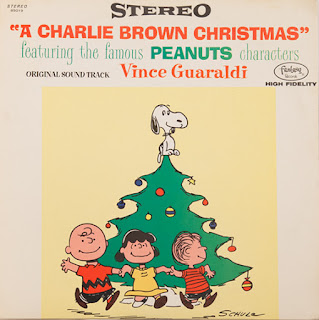
Commentary, discussions and random thoughts about San Francisco-born jazz pianist Vince Guaraldi, beloved by many — including those who recognize his music, but not his name — and affectionately known as Dr. Funk
Friday, January 6, 2023
Chart success: 2022
Monday, January 3, 2022
Chart success!
Monday, February 15, 2021
What's in a word? (Or two?) (Or three?)
You’d think, after slightly more than three decades, that somebody would have noticed and discussed this by now.
But no; it appears to be a recent discovery, brought to my attention by David, a good friend and fellow Guaraldi fan.
Readers of this blog — and probably a good percentage of people throughout the world — undoubtedly know the lyrics of “Christmas Time Is Here” by heart. Goodness, we’ve watched A Charlie Brown Christmas countless times, and played the soundtrack album even more than that.
So we all remember that the show opens with the Peanuts gang ice skating and crooning the tune (actually “ghosted” by young members of the St. Paul’s church choir, from San Rafael, California: a group that included David). It’s a joyous scene, and — following the “Sleigh bells in the air” bridge — this is what we next hear:
Christmas time is here …
Fam-lies drawing near …
A quarter-century passed, before the song was covered by another artist: Patti Austin, on the 1989 compilation album, Happy Anniversary, Charlie Brown!
Following the “Sleigh bells” bridge, this is what she sings:
Christmas time is here …
We’ll be drawing near …
Take a moment. Let it sink in.
Perform an Internet search on the lyricss to “Christmas Time Is Here,” and most results — but not all — show “We’ll be drawing near.” That’s likely due to the way the song is printed — complete with sheet music — on pages 93-95 in Lee Mendelson’s 2000 book, A Charlie Brown Christmas: The Making of a Tradition. Because why would anybody assume that Mendelson’s book might be incorrect? After all, he penned the lyrics, back in the day.
“We couldn’t find anybody to write the lyrics,” Mendelson recalled, in a 2008 interview for TV Time Machine. “I called all my Hollywood friends who were songwriters. But nobody took the assignment, so I sat down, and in about 10 minutes wrote the words to ‘Christmas Time Is Here’ on an envelope.
“I sure wish I still had that envelope!”
Well, we may not have the envelope, but we have something almost as good: the song’s copyright deposit, filed with the U.S. Library of Congress on February 7, 1966. You can see the relevant bit at the top of the second page, shown at left:
Fam-lys. Growing (!)
So … what happened?
Did Lee change his mind, at some point between 1965 and 2000? Did he mis-remember? Did he hear and prefer Patti Austin’s slight modification?
(I sure wish I’d learned about this sooner, because he’s no longer around to ask. More’s the pity.)
Thursday, November 19, 2020
Vinyl madness
Wednesday, January 3, 2018
The magic — and music — of carriage returns
Tuesday, November 18, 2014
A little of this, a little of that
To cases, then:
The first bit of news warrants a fist-bump for my good friend and radio colleague, Bill Buchanan, who has solved The Mystery Of The Ages: the identity of the "mystery track" on the second disc of the 2011 CD release, An Afternoon with the Vince Guaraldi Quartet. Contrary to what the liner notes claim, it most definitely is not "Autumn Leaves" ... even though Sound Hound and various other web sources now insist as much, having propagated the error (an issue I covered at length in this previous post). Bill and I discussed this situation at length, when I brought the song to his attention earlier this year; unknown to me, he kept chewing at it ... convinced that he recognized the melody from somewhere. Well, he was right; he did recognize it, and the penny finally dropped a few weeks ago.
The song is "Sunny Goodge Street," which made a splash in October 1965 on Fairytale, the second album from British singer Donovan. The tune took a few years to become a pop hit, and then was covered by the likes of Judy Collins and Tom Northcott. The arrangement performed by Donovan is the closest to Guaraldi's take, which you can hear by comparing Vince's version with Donovan's, thanks to this YouTube clip.
So, mystery solved. I'm forever indebted to Bill, and of course will take this opportunity to give his Davisville radio show another plug. Indeed, Bill and I just yesterday recorded our annual discussion of upcoming holiday movies: a show that should go live in about another week. Do give us a listen.
Wednesday, July 31, 2013
A cool July afternoon
Wednesday, December 26, 2012
Will the preferred soundtrack please stand up?
Folks love to discuss his music as well, and particularly his score for 1965's debut Peanuts TV special, A Charlie Brown Christmas.
The most common question these days actually is a request: Numerous fans want to know how to distinguish the "original" 2006 Concord/Fantasy CD from the later "corrected" version. If you're not familiar with the controversy that erupted when this re-mastered album debuted, the exhaustive details can be found here. The pertinent modifications on the initial 2006 release concerned four tracks, and this is how Fantasy described them:
Track 1: "O Tannenbaum" -- the original LP version cut off the introduction to the song, which has been reinstated on this new CD;
Track 4: "Linus And Lucy" -- the original LP version was an edit of two different takes, whereas in the remix for the new CD we ran one of the takes in its entirety;
Track 5: "Christmas Time Is Here" (instrumental) -- the original LP version fades out at the end of the song, almost losing the last chord, which can be heard quite clearly on this new CD;
Track 7: "Skating" -- the original LP version fades during the bass solo at the very end, whereas this remastered CD allows the song to run to its conclusion, which adds about 10 seconds to the track.
Unfortunately, longtime listeners were very unhappy with these changes, insisting that they wanted the listening experience to be just as it was on the 1965 LP (although apparently it was all right to clean up extraneous studio noise). One must not tamper with perfection, folks insisted, and the situation was worsened by the fact that an entirely different take accidentally had been selected for Track 9, "Christmas Is Coming."
The other side of the debate was occupied by jazz fans who hunger for just the sort of alternate takes that this 2006 album provided. (Four bonus tracks offered yet more variety.) I belonged in their company, and I honestly couldn't understand the fuss; it wasn't as if all the LPs and 1988 CDs had vanished — or ever would — leaving people with no choice but the 2006 album. People who preferred the original listening experience still could find it, and quite easily.
But Concord/Fantasy bowed to public pressure and agreed to switch things back on all future pressings of the 2006 CD. Additionally, patrons unhappy with their "defective" 2006 originals were encouraged to send 'em back for this "corrected" version; the offer was valid through March 1, 2007 (so don't expect anything at this late date).
Well, you can imagine what happened next.
2) The Madacy disk comes in plastic clamshell packaging, as opposed to Fantasy's paper tri-fold with the clear "cel" window; and
All these years later, whether on VHS, DVD, Blu-ray or anything else, the show never has been completely intact. As a result, the Coca-Cola sponsorship has assumed the aura of legend, with an equal number of people arguing that Coke never did have a visible presence in A Charlie Brown Christmas ... despite the premature — and quite obvious — fade to black and muting of the soundtrack immediately after the show's title appeared on screen.
Friday, October 26, 2012
Lee Mendelson, lyricist
And, on a few occasions, he turned into a songwriter.
The most famous example, and the tale oft-told by Mendelson himself, refers to A Charlie Brown Christmas and the song it made famous: "Christmas Time Is Here."
To quote a brief passage from my book:
As late summer [1965] segued to early autumn, the Peanuts Christmas special was coming together; a rough cut, set to Guaraldi's music, opened on Charlie Brown and his friends skating on a frozen pond, as snowflakes gently flurried about them. But although Mendelson liked the music employed behind the action — Guaraldi's "Christmas Time Is Here" — he felt the scene lacked something.
"The opening song was an instrumental," Mendelson recalled. "I felt we should get some lyrics, and some voices. We couldn't find anybody to write the lyrics, and I called all my Hollywood friends who were songwriters. But nobody took the assignment, so I sat down, and in about 10 minutes wrote the words to 'Christmas Time Is Here' on an envelope.
"I sure wish I still had that envelope!"
Ask folks to cite Peanuts songs that include lyrics, and you'll get a very short list: "Christmas Time Is Here," "Joe Cool" and "Little Birdie." Guaraldi himself wrote the words for the latter two. But Peanuts fans with very good memories can add another song: the title theme to You're in Love Charlie Brown, the fourth Peanuts special, which debuted June 12, 1967. The show's title theme, a lyrical, slightly woeful waltz, reflects Charlie Brown's hopeless yearning for the never-seen Little Red-Haired Girl.
Mendelson, no doubt encouraged by the success he'd had with "Christmas Time Is Here," penned some brief lyrics for this title theme, which are heard as the show's credits appear:
Poor little Charlie Brown,
Don't let love bring you down.
You'll have your day,
She'll come your way;
She'll take away your frown.
Poor little Charlie Brown.
At least ... I thought they were brief.
Well, in fairness, that's all we ever heard. That's all anybody ever knew about.
But that's not all Mendelson wrote.
Guaraldi's tune continues far longer than those six lines; it therefore stands to reason that Mendelson might have written lyrics for the entire composition, although I doubt anybody ever made that assumption. Thanks to some digging at the U.S. Library of Congress, and a related search of the U.S. Copyright Office, the full story — or, rather, the full song — has come to light.
(Truly, I love this sort of discovery!)
Herewith, then, Lee Mendelson's full lyrics to "You're in Love, Charlie Brown," accompanied by one of the actual manuscript pages that was filed with the Copyright Office. Note the twin bylines: "V. Guaraldi + L. Mendelson." Note also the hilarious doodle of — I'm guessing — Charlie Brown's head!
One last little oddity: Various DVDs of this Peanuts special include the six brief lines as indicated above. The English audio soundtrack included with the Warners 1960s collection DVD, however (and rather strangely!), features a different sixth line: You're in love, Charlie Brown ... which you'll note is the final line of the second stanza. It's therefore possible that at least the entire second stanza was recorded during production, but then left unused.
Catholic San Francisco runs an occasional feature titled "Cemetery Corner," which marks the 125th anniversary of Holy Cross Catholic Cemetery in Colma, California. The entry in a recent issue (October 19, 2012) is a nice little tribute to Guaraldi, and includes an excellent photo of his grave marker (sharpest photo I've seen of it, in fact). Check it out here.
Wednesday, August 8, 2012
The Very Best of Vince Guaraldi ... and a bit more
Anyway, I received a nice little note from Vinny Marino today, a fellow who obtained an advance review copy of the CD from Concord. He wanted to know if I were aware of the fact that Todd Rundgren, ah, "borrowed" portions of "Treat Street" for his instrumental, "Breathless," which appeared on the famed rocker's Something/Anything album. Picture my eyebrows shooting up; no, I replied, this was news to me. I immediately hied me hence to YouTube, where I knew it would be easy to find Rundgren's tune. Gave it a quick listen, and shurenuff, distinctive quotes from Guaraldi's "Treat Street" can be heard, starting at about 3:03. Give it a listen, and verify with thine own ears.
That's what I love about life; you learn something new every day.
Aside from Curiosity's successful landing in Mars' massive Gale Crater, last week also brought some pleasant news of a more personal sort: Jeff Dayton-Johnson's lengthy, thoughtful and quite complimentary review of my book, which debuted July 31 at the indispensable allaboutjazz web site. Jeff raises a few concerns, notably my fixation on backstory and occasional brain-stuffing wealth of sidebar details, and what he terms a "thinness of musical analysis." To the first charge, I plead guilty; having so many wonderful facts at my fingertips, I was loathe to abandon any of them (and, in fairness, Jeff cuts me some slack on that count, in the interest of scholarship). To the second charge, I sidestep and offer two excuses: In the first place, I wasn't sure my various roles, in this book, included that of critical lobotomist. In the second place, I've always been wary — given my background as an English major — of the "fatuous analysis" syndrome, wherein some stuffy teacher professes to understand precisely what this poet intended here, and that essayist intended there. When it comes to art — music, in this case — I'm inclined to believe that such observations are best left to the individual listener.
Ironically, some efforts at musical commentary were present in the first draft, but then were cut for space because I was some 75,000 words over what had been contracted. (I only trimmed some 25,000; McFarland let me keep the other 50,000.) For what it's worth, and because nothing ever goes to waste, some of that commentary wound up in my online Guaraldi discography.
But I absolutely accept Jeff's points; he defends them well, and obviously knows whereof he speaks, with respect to so many other aspects of jazz in general, and Guaraldi's career in particular. I'm very grateful for the review, and I'm equally sure that it'll be the most scholarly commentary I'm likely to receive.
Meanwhile, I'm working out the details of an upcoming appearance — 7 p.m. Thursday, September 13 — at the St. Helena Public Library, in Northern California, when I'll next preach The Gospel According to Vince. Always a happy occasion.
Tuesday, July 17, 2012
Many happy returns
For an artist, I suppose nothing would be worse than failing to achieve fame in one's lifetime ... and then achieving it after death. Guaraldi was luckier than some; he made the most of the 15 minutes of fame that was his due reward after paying his own dues. He got his hit song, as good friend and former San Francisco Chronicle music columnist Ralph Gleason observed, while narrating his 1963 documentary Anatomy of a Hit, which traced the rise of "Cast Your Fate to the Wind." And Guaraldi knew precisely what to do with that fame; through a combination of talent, bravado and the luck that God grants us every so often, he parlayed that Grammy Award-winning song into immortality in both the religious and secular realms, with his ground-breaking Grace Cathedral Mass and the lively melodies that characterized his scores for the Peanuts animated TV specials.
Although Guaraldi's life was cut short, that day in early 1976, he had made excellent use of his time in this mortal realm. He knew — while performing as house musician at Butterfield's, during the final years of his life — that people came to hear him play, because they loved his stuff. Fans knew that he would entertain and captivate them, as he had for the previous two decades and change.
Even so, I lament the fact — in addition to his loss, at so young an age — that he isn't around today, here and now, to register and take pride, to be thrilled, by the degree to which his music lives on. The name "Guaraldi" may not slide easily off the mainstream tongue, but mainstream ears know his music; one need only cue up any arrangement of "Linus and Lucy" or, during the holiday season, "Christmas Time Is Here." During the past decade in particular, Guaraldi's star has risen anew, and his work is being discovered by fresh generations, and re-discovered by fans who remember him from the day. So yes, it could be true that Guaraldi's fame — and the degree to which we celebrate him today — are larger than when he actually walked this Earth, and so we can further mourn that he isn't here, to witness that.
Even so, I like to think that somewhere, somehow, he knows anyway. Pausing, as he performs in some celestial combo comprising the greatest jazz cats who ever lived, to twirl that impossible mustache, flash that pixie grin and then settle back to the serious work, his undersized hands a blur on the keyboard.
I was delighted, on this day of Guaraldi's birth, to give a radio interview with Alan Rock at WUCF, 89.9 FM, in Orlando, Florida. Alan kept me on the air for an entire hour, alternating lively conversation with half a dozen tracks from various Guaraldi recordings. It felt right to be celebrating Guaraldi's work in such a fashion, on this day.
A few hours later — also by way of celebrating Guaraldi's birthday — WJSU in Jackson, Mississippi, aired a nicely edited piece from an interview I had with Larissa Hale a few weeks earlier. This piece has been posted at WJSU; scroll down to the "Take 5" button, and look for my name.
Actually, I've had a busy 48 hours. Aside from the WUCF interview, conducted by phone, I spent 90 minutes yesterday at KCSM Jazz 91, in San Mateo, California, chatting with DJ and longtime jazz fan — and Guaraldi follower — Alisa Clancy. The WUCF interview may be posted on that station's web site soon; I'll share that information as soon as I find out. The KCSM piece will be included in a much larger "all-Guaraldi morning" on Friday, September 7, as part of KCSM's pledge drive. Alisa has interviewed, and plans to interview, a broad range of folks: Eddie Duran, Dean Reilly, Colin Bailey, Larry Vuckovich and Lee Mendelson, possibly others. You definitely won't want to miss that tribute.
I also learned that my book got a nice shout-out from jazz writer and historian Doug Ramsey, on his Rifftides blog. And the second portion of my three-part interview on WGLT is available now at their web site.
Looking forward, I've been added to the St. Helena (California) Public Library calendar; I'll be giving a reading and audio/visual presentation at 7 p.m. Thursday, September 13. This will be very much like the program I delivered to a full house at the Charles M. Schulz Museum theater, on June 29, in Santa Rosa, California. Keep an eye on the St. Helena Public Library web site calendar, for updates.
So believe me, Vince, I've been workin' hard to spread the word ever further.
Happy returns, indeed. Listening to Guaraldi's music can brighten any day, and make it that much happier.