Transcribing the Guaraldi
Mass is trickier than one might think. According to all accounts, Vince never
played the music the same way twice, which is confirmed by the few existing
recordings of the Mass. So I’ve worked toward a consensus, to ascertain “the
mind of Vince,” knowing in advance that I probably will adapt the music in the
moment of performance, just like any other jazz musician.Commentary, discussions and random thoughts about San Francisco-born jazz pianist Vince Guaraldi, beloved by many — including those who recognize his music, but not his name — and affectionately known as Dr. Funk
Saturday, June 6, 2015
Mass appeal: Chapter 2
Transcribing the Guaraldi
Mass is trickier than one might think. According to all accounts, Vince never
played the music the same way twice, which is confirmed by the few existing
recordings of the Mass. So I’ve worked toward a consensus, to ascertain “the
mind of Vince,” knowing in advance that I probably will adapt the music in the
moment of performance, just like any other jazz musician.Friday, March 20, 2015
Mass appeal: Chapter 1
The hoopla surrounding that first Peanuts TV special, however, threatens to overshadow another Guaraldi milestone also celebrating its golden anniversary this year: the Jazz Mass that he wrote and debuted at San Francisco's Grace Cathedral, on May 21, 1965.
Although Guaraldi's score for A Charlie Brown Christmas (and subsequent Peanuts TV specials) had a massive impact on the American public's music taste — unquestionably turning more people onto jazz than any other single artist — his Grace Cathedral Mass is more significant historically, for a variety of reasons.
As I explain in my Guaraldi bio, in part:
The entire concept was completely radical. No American church had ever employed jazz in such a setting [during an actual worship service]. The Rev. Charles Gompertz [who "hired" Guaraldi for this assignment] knew of only one earlier precedent. Geoffrey Beaumont, a London priest, had composed a Jazz Mass in 1956: a work scored for a cantor and a jazz quartet. Beaumont and his composition made the news in 1957, but the vicar's performance of this work always took place after his regular services at St. George's, in Camberwell.
Guaraldi's Mass was an impressive success, and not just in San Francisco.
The subsequent publicity wasn't merely a localized wave; it was a tsunami that swept across the entire country. The Grace Cathedral Mass was granted a page-length article in Time magazine; the single accompanying photo showed Guaraldi and his trio members, Tom Beeson and Lee Charlton, above a caption that read "Praising the Lord with blues and bossa nova."
The Grace Cathedral staff couldn't move quickly enough, in an attempt to replicate the event. No less a jazz icon than Duke Ellington was hired to perform in the cathedral later that same summer, on Sept. 16.
But Guaraldi got there first. He even beat Ellington.
That's huge.
Wednesday, April 30, 2025
From album to manuscript page
I’ve played piano since childhood, although I never rose beyond the level necessary to perform for local community theater productions. Even so, I’ve continued to dabble, and of course have purchased every Guaraldi songbook or sheet music single that came to my attention.
I started young. In the late '60s and early ’70s, Pointer Publications, a division of what then was Hal Leonard/Pointer Publications, put out a series of easy piano books — the Peanuts Keyboard Fun series — which were adapted from the early TV specials. The books typically contained 32 pages, and the two center pages featured full-color illustrations from the show in question. The musical contents tended to cross over from book to book; in other words, if you had two books, they’d have some of the same songs, and some unique to each book.
The books were $2.95 each, and included the following volumes:
• A Charlie Brown Christmas
• Charlie Brown's All Stars
• It’s the Great Pumpkin, Charlie Brown
• You’re in Love, Charlie Brown
• He’s Your Dog, Charlie Brown
• It Was a Short Summer, Charlie Brown
My library has grown substantially since then, and recent years have been a true Renaissance. As a sidebar to all the recent Peanuts soundtrack albums released by Lee Mendelson Film Productions, Sean and Jason Mendelson also worked with Hal Leonard LLC, a music publishing and distribution company that dates back to 1947, to publish many cues and songs never before released in sheet music format, as I covered in an earlier post.
I recently realized, as a result of my ongoing collaborations with Sean and Jason, that I had an “in” to answer a question that has long intrigued me:
How does a song get transcribed? What’s the process?
Sean put me in touch with Ben Culli, Hal Leonard’s Vice President of Editorial and Production, who turned me over to keyboard publications editor Mark Carlstein. He and I had a delightful chat a few weeks ago, and all my questions were answered.
The first one was obvious: Are transcribers musicians themselves?
“Yes,” Mark replied, “that’s absolutely imperative.”
So ... when starting work on a new tune, Mark — a pianist himself — handles the initial steps.
“The first thing is to get a good recording that’s indicative of the song. If I’m looking at Bill Evans, he might have recorded a given tune half a dozen times, and I’d want one that best represents him playing that music.”
Next: “catalogue” the tune.
“Every song has a road map. In the same way you’d follow a route, to get from A to B, a given song will last a certain number of bars, in a certain time signature, and in a certain key signature. Some sections may repeat, or not; typically in jazz, you don’t have exact repeated sections, as often is the case in pop music.
“I then send the representative tune to one of our transcribers, along with my road map; they listen to it, and write down everything they hear. All the parts are important. If words are part of the song, those words also must be transcribed. All of the melody’s rhythms must be notated precisely.
“What you look at, when you sit down to play something from a songbook, is a finished document that the transcriber built from the ground up.”
In the case of a Guaraldi trio composition, the transcriber pays attention to both the keyboard work, and the bass, to pick up the latter’s supplementary notes.
“The trio musicians will be playing the same harmonies and chords, but not necessarily the same notes. (We always ignore the drums, because that’s a non-tonal portion of the recording.)”
Vocalists, often backed by larger ensembles, are trickier.
“Take a Taylor Swift recording. It’ll have a bass line, a guitar player, a piano player, perhaps another keyboard player, perhaps a secondary guitar player, the vocals and the words. All of that must be distilled into something that can be played — say, in the case of a pianist — by one person with two hands. As a result, a lot of compromises are involved, and it’s necessary to focus on the essence of the song.
“How much of what the bass player does should be included? Some of it can’t be played by a pianist, and it’ll never be in the same octave, because what the bassist plays sounds too low on a piano keyboard; the two hands must be kept closer together.
“You also can’t play a busy guitar part at the same time you’re playing the melody and bass line.
“Everything can’t be included, and that’s the biggest challenge for our transcribers who handle vocals, because we always include the melody in the right hand, and everything else must be inserted around that. Our transcribers therefore start first and foremost with the melody, because it’s imperative that it be presented in a way that can be played by that one person with two hands.”
Are vocal pieces easier than instrumentals?
“Yes, because you’re looking primarily at the melody and bass line; far fewer parts must be coordinated into a single playable score.
“Alternatively, right now I’m working with one of our best transcribers on a jazz piano Omnibook, which includes classic recordings by Herbie Hancock, Oscar Peterson and everybody else you’d immediately recognize. But few of the pieces are solo piano; most involve at least bass and drums, and perhaps one or two horns. In such cases, you can’t include every single thing that every instrument plays, but all of the piano stuff is transcribed precisely — everything exactly as was played by that particular artist, on that particular recording — and the other instruments go onto other staves. One pianist can’t possibly play everything, but an Omnibook like this serves as a reference of sorts.”
What determines the necessary skill level required to play the result?
“That gets into arrangements. ‘Exact transcription’ means note for note, and the result can be quite complex and extremely difficult to play, because we’re talking about musicians who have extraordinary skills. If you’ve tried to play anything by Oscar Peterson, you know right away; it’s next to impossible. But something like the Omnibook isn’t what Hal Leonard does most. The bulk of what Hal Leonard does, is to take songs that people know, and to present them in different ways: different grade and skill levels.
“Looking at just piano, we have at least a dozen different skill series, and of course we also have stuff for clarinet, violin and all sorts of other instruments. So, one person might do the initial transcription, and then several other people will handle the various arrangements.”
Why are some transcriptions in a key that differs from the original performance?
“We try to present things with no more than four sharps, or four flats. When we transcribe and arrange what we call ‘sheet music’ for the consumer, 1) the melody must be in the piano, so it can be played; and 2) it can only be reasonably difficult, at worst.
“We’re super-conscious of keeping things at an average consumer’s ability level, so that almost anybody can pick up that sheet music and make use of it, and enjoy it. Part of that involves avoiding complicated key signatures.
“A lot of jazz and pop musicians like keys that have five and six flats, because it works well under their hands, like certain sharp keys work better for guitar players.
“But the rest of us,” Mark added, with a chuckle, “don’t like seven sharps or seven flats.”
Indeed, some books are deliberately signature-simple.
“One of our most popular series is My First Fake Book, and every song is in the key of C major. We make it easy for the consumer, and of course you can transpose a song into any key you want.”
During my childhood, almost everybody I knew had a piano in their home, as also was the case in ours. These days, though, one sees very few pianos in homes. Has that affected sales of songbooks and sheet music singles?
“No, because all sorts of electronic keyboards are available these days; they’re less expensive and portable. The nature of the product has changed, because so much is available online; a lot of people download sheet music, as opposed to walking into a store and pulling something off a rack.”
Mark laughed at my next comment: One of my ongoing pet peeves has been the annoyance of square-bound songbooks. I’ve long felt that every songbook should be spiral-bound ... but I guessed (accurately) that must be too expensive.
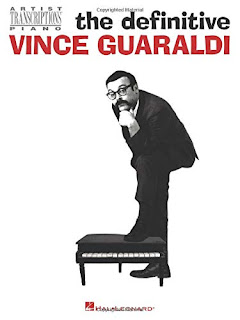
“As far as I’m concerned, having the book stay open, while on the music rack, is the most important thing. So for Hal Leonard’s jazz piano solos series, at 96 pages, we switched the binding to what we call ‘lay-flat binding,’ so you can open the book anywhere, and it stays open and doesn’t split the spine.
“As it happens, the Guaraldi volume in that series is one of my favorites.”
That book is pictured at left; check it out here. Click on "closer look," below the photo, to see sample pages from "A Day in the Life of a Fool (Manha de Carnival)," "Great Pumpkin Waltz" and "Skating."
In the case of the Guaraldi cues and themes recently released in The Peanuts Piano Collection, Ben then explained that one final step was involved: “Sean reviewed the transcriptions prior to release, and offered a few very small suggestions and tweaks.”
And there you have it.
Many thanks to Mark and Ben, for fully satisfying my curiosity.
Friday, August 28, 2015
Mass appeal: Chapter 5
Friday, February 18, 2022
Bits & bobs
Tuesday, May 15, 2012
Shelby Flint's 'Fate'
So it was, toward the end of the roughly three years I spent actively gathering data, conducting interviews, preparing outlines and then actually writing what became my book, Vince Guaraldi at the Piano. The writing too frequently was interrupted by a fresh quest prompted by a nugget of information in a newspaper article, or a casual aside in the transcription of an interview with one of Guaraldi's former sidemen. I love investigative research; it suits both my scrupulous nature and romantic notions of being a private detective. Writing is hard; sifting data is fun. No surprise, then, that I frequently postponed the former in order to indulge in more of the latter.
Too frequently, as it turned out. And each new bit of discovered information made the manuscript longer by a sentence, a paragraph or a page. A writer who yields too often to such impulses will a) wind up with a manuscript that's much too long; or b) never finish the book at all. Or both.
I finally had to stop, submit the final, polished edit to my publisher, and walk away ... knowing, with certainty, that the moment the contents of the book became set in stone (well, on paper), I'd think of something else that should have been included.
I therefore wasn't surprised, a few weeks ago — which was a few weeks after the book was released — when I woke one morning, having recalled something that hadn't properly registered when I first came across it. Something I read, something somebody said ... I didn't know which. A simple statement to the effect that the song "Cast Your Fate to the Wind" had "charted" three times, referring to landings on the Billboard pop chart. And that statement, freshly remembered, brought me up short.
Three times?
Only two leaped to mind: the 19 weeks that Guaraldi's own version of his song had spent on the charts, in late 1962 and 1963; and the 13 weeks of chart action enjoyed in 1965 by the cover version delivered by the British group Sounds Orchestral. I could not recall having come across a third artist or band that also had a hit single with the song.
So I went looking.
Mercifully, the hunt was short. California-born singer Shelby Flint enjoyed an eight-week run with "Cast Your Fate to the Wind" in 1966, from August 13 through October 4: six weeks on the Top 100 chart, and a slightly overlapping seven weeks on the Top 40 Easy Listening chart. It was Flint's second and final Top 100 single, after 1961's "Angel on My Shoulder." She enjoyed a modest but noteworthy pop career in the 1960s, releasing a handful of albums, one of them prompted by her success with Guaraldi's hit song. She was praised by jazz critic Leonard Feather, and cited as a role model by Joni Mitchell. Flint went on to work in film and television; she eventually gravitated more toward jazz, and her 1992 album Providence remains a high point of her later career. Like Guaraldi, she also enjoyed a Peanuts connection, albeit a brief one; she sang Lila's theme — "Do You Remember Me?" — in the second big-screen Peanuts film, 1972's Snoopy Come Home.
Obviously, she should have been mentioned in my book; neglecting her chart action with "Cast Your Fate to the Wind" was an unfortunate oversight.
An oversight which, happily, can be set right here.
Saturday, August 8, 2015
Mass appeal: Chapter 4
Monday, February 19, 2018
Concerto-izing, Episode 2
Thursday, May 21, 2015
Golden memories of Grace
Nor was Guaraldi a mere performer; he also wrote the jazz portions of the Mass, weaving fresh themes around the chanted "Plain Song" setting of the Eucharist's Missa Marialis. This wasn't merely typical jazz improvisation; all involved with this ground-breaking project took the precaution of adapting the Fourth Communion Service setting as a means of blunting criticism from conservatives who worried about bringing "saloon music" — the Devil's music — from the cocktail lounge into the church.
Such fears notwithstanding — and more than a few nasty, even threatening letters were received, prior to May 21, 1965 — Guaraldi's completed Jazz Mass was a resounding success in every possible way.
Which goes to show that God clearly is a jazz fan.
Guaraldi's involvement with the Mass had begun roughly 18 months earlier, when he was approached by a young Reverend named Charles Gompertz. The latter had been charged by his "boss" — the Right Reverend James A. Pike, Bishop of the Episcopal Diocese of California — to come up with a musical event that would suitably honor the then-under-construction Grace Cathedral during its inaugural "Year of Grace" celebrations. This was a very big deal, as Grace was soon to become the first major Anglican cathedral consecrated in the United States.
Gompertz had been drawn to Guaraldi the same way television director/producer Lee Mendelson had decided to select the jazz pianist for what eventually became the wildly successful Peanuts animated franchise: after hearing "Cast Your Fate to the Wind" on the radio. Gompertz and Guaraldi met at the Trident, the former outlining the project and all of its necessary parameters. None of this gave Guaraldi the slightest pause, who quite famously commented — as Gompertz vividly recalls, to this day — "Bach, Brahms and Beethoven all wrote masses ... so why not me?"
The next year and a half was to be quite busy, with Guaraldi rehearsing at least once each week with Barret (Barry) Mineah and his choir at St. Paul's Church in nearby San Rafael. When the big day finally came, the cathedral was filled to overflowing, people known to have driven from as far away as San Luis Obispo. The sermon was delivered by the quite radical Malcolm Boyd, the "coffeehouse priest" who — among his many other Civil Rights activities — had been one of 28 Episcopal priests present during 1961's Freedom Ride from New Orleans.
When it was all over — when Pike, Gompertz, Guaraldi and numerous other clergy members joined an impromptu reception in the vesting area — they began to realize, in Gompertz's words, that they had "done something bigger than all of us."
Indeed.
The resulting media explosion was huge, even by today's standards; Grace, Gompertz and Guaraldi remained in the news throughout the subsequent summer. The companion Fantasy LP was preceded by a 45 single, which undoubtedly raised eyebrows from casual listeners who never expected to hear "Adore Devote (Humbly I Adore Thee" or Guaraldi's "Theme to Grace" on pop and jazz radio stations. The Grace Cathedral staff, at best reluctant during the ramp-up to May 21, couldn't move quickly enough to take advantage of this unexpected success; Duke Ellington was hired to perform in the cathedral on Sept. 16.
Within just a few years, churches became quite popular settings for jazz celebrations, and of course we don't think twice about such things today.
This Golden Jubilee anniversary of Guaraldi's Jazz Mass hasn't gone unnoticed; I'm already reporting on the work being done by Bill Carter, pastor of the First Presbyterian Church of Clarks Summit, Pennsylvania. He and his jazz combo and church choir will deliver an anniversary presentation of Guaraldi's Mass on September 6, as faithful readers of this blog already know.
What you don't know is that another endeavor has just been announced, here on the West Coast.
Northern California-based jazz pianist Jim Martinez is no stranger to Guaraldi's music; by total coincidence, he has a new album of Guaraldi covers and Guaraldi-esque originals coming out in just a few weeks (which I'll discuss at greater length in a future post, when the CD is available for purchase). Meanwhile, Martinez has just gone public with his own plan for a Guaraldi Jazz Mass tribute event.
This will be a concert, not a formal Mass. Thus far, Jim anticipates an opening jazz set by his combo, followed by a short intermission and then a lengthy second half featuring his home-base Fair Oaks Presbyterian Church Choir, with the combo, in a program of themes from Guaraldi's Jazz Mass. The performance also will include some Gospel choir songs and major anthem pieces.
Best of all, as you'll see from the announcement here, this event will take place at no less than Grace Cathedral itself.
How's that for big news?
Jim and Bill Carter are collaborating on the heavy lifting: the necessary transcription of Guaraldi's music from the Jazz Mass, none of which ever was written down. They're doing it the hard way, by listening to the Fantasy LP and a few other snippets of unreleased recordings. (The original Grace Cathedral Mass ran much, much longer than what we hear on the Fantasy LP; the full majesty of Guaraldi's "Holy Communion Blues" is known to have lasted more than half an hour ... because a lot of people received Communion that evening. Sadly, that full recording is believed lost.)
Additional details will follow, so watch this spot.
It's gonna be a busy summer!