Tuesday, January 15, 2013

Blast from the Past

Along with all the lively chats I had with Guaraldi's colleagues and former sidemen, while working on my book — definitely the high point of the research process — additional excitement came from the discovery of fresh examples of the pianist's recorded output. Such albums came in two flavors: Either they were new to me — such as Woody's Herman's Anglo-American Herd, a way-obscure British LP on the Jazz Groove label, and the only known recording of the 1959 UK tour that included Guaraldi — or they were just plain new, as with Concord's The Best of Cal Tjader: Live at the Monterey Jazz Festival 1958-1980, which came out in 2008, when I was up to my eyeballs in notes, transcripts, photocopies of old newspapers, and all sorts of other ephemera. The latter finally allowed me to hear the exciting late-night set by Tjader's combo at the debut Monterey Jazz Fest, which did much to raise Guaraldi's profile as a ferocious pianist.

I know of other recordings that haven't yet seen the light of day; somewhere, the Fantasy/Concord vaults must contain the entire Brew Moore/Tjader septet performance that was recorded live at UC Berkeley on August 28, 1955. Thus far, only two isolated tracks have been released on two different Brew Moore albums ... talk about frustrating!


Meanwhile, Santa Claus brought Guaraldi fans a lovely present on December 11: The Cal Tjader Quintet: Live at Club Macumba, which presents two mostly up-tempo sets recorded at that San Francisco club in late 1956. The album has been released on the Acrobat Jazz label, and is readily available at Amazon and the usual outlets. The precise dates are unknown; Tjader's quintet was booked September 3-16 and then again October 2-28, so it's possible one set was recorded during the September run, while the second came in October. Or some other combination therein.

The original tapes are part of what is known as the Ackerman Collection, an archive of jazz recordings made during the 1950s and '60s, and assembled by broadcaster Ken Ackerman, beloved as the voice of the "Music Till Dawn" show on KCBS. As sometimes happens with such things, the collection was stored away and then mostly forgotten, until being "rescued" by San Francisco Traditional Jazz Federation members William Carter and Dave Radlauer. They, in turn, donated everything to Stanford University's Archive of Recorded Sound in November 2007. Cataloguing and restoration have allowed bits to be released commercially; this double-CD set is one such example. You can read more about the collection here; I note, with interest, that the listings include a KNBC radio broadcast of a set by the house band at the popular San Francisco restaurant Sabella's. That unit was fronted by Joe Marcellino, one of Guaraldi's two musical uncles.

So, all right already, you're thinking; how's the music?

Tuesday, January 1, 2013

A song by any other name...

The name always bothered me.

Guaraldi had an occasional tendency to recycle his own compositions, sometimes under new titles ... much to the hair-pulling frustration of discographers. "Ginza Samba," which popped up on 1958's The Cal Tjader/Stan Getz Sextet, is pretty much the same as plain ol' "Ginza," which debuted on 1956's Modern Music from San Francisco (Guaraldi's first album as a combo leader). "Air Music," a bouncy little track originally recorded for TV's A Charlie Brown Christmas — but not included on the soundtrack album — also is known as "Surfin' Snoopy," reflecting the tune's later use behind Snoopy's imaginative effort to hang paws on the end of his surfboard ... in a wading pool.


And then there's "Casaba," alternately known as "Jambo's."

"Casaba" opens 1964's Vince Guaraldi, Bola Sete & Friends, the first of the jazz pianist's three collaborative albums with the Brazilian guitarist. The eight-minute tune, which reflects Guaraldi's sense of compositional whimsy, boasts sparkling interplay between his single-note runs and Sete's graceful guitar work. The tune resurfaced on 1970's Alma-Ville, the third of Guaraldi's albums for Warner Bros., and the last LP he recorded during his lifetime. This time, however, it was retitled — rather oddly — as "Jambo's." Percussionist Rubens Bassini highlights this latter-day version of the tune, which evokes the same bossa nova atmosphere that Sete had given it six years earlier.

But that name ... who or what was Jambo's?

Jimbo's would have made much more sense, given all the happy hours Guaraldi spent at the after-hours San Francisco club that took its name — Jimbo's Bop City — from John "Jimbo" Edwards, the cool cat who ran the place from 1950 to '65. I learned quite a lot about that venue while researching my book, with most of the information coming from filmmaker Carol P. Chamberland's excellent 1998 documentary, The Legend of Bop City, and an extensive article she wrote for the fall 1996 issue of California History.

Surely Guaraldi would have honored Edwards with a song, and surely the so-called "Jambo's" must have been that song. But how to prove as much?

This sounded like a job for the U.S. Library of Congress, and its musical composition copyright deposits. And, indeed, it was.


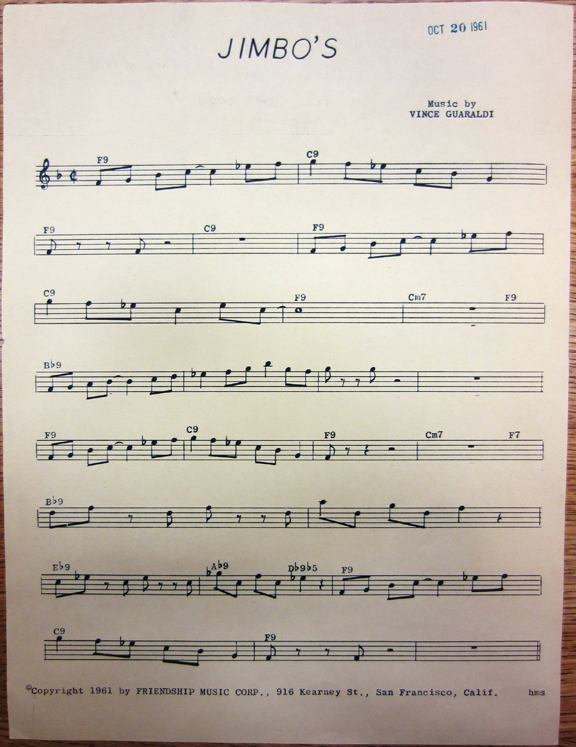
Click here to see a larger image.
On October 20, 1961, Guaraldi filed a copyright claim for an original composition titled "Jimbo's." The copyright deposit — the page of music filed to identify the song — displays a melody line that can be recognized instantly as "Casaba"/"Jambo's."

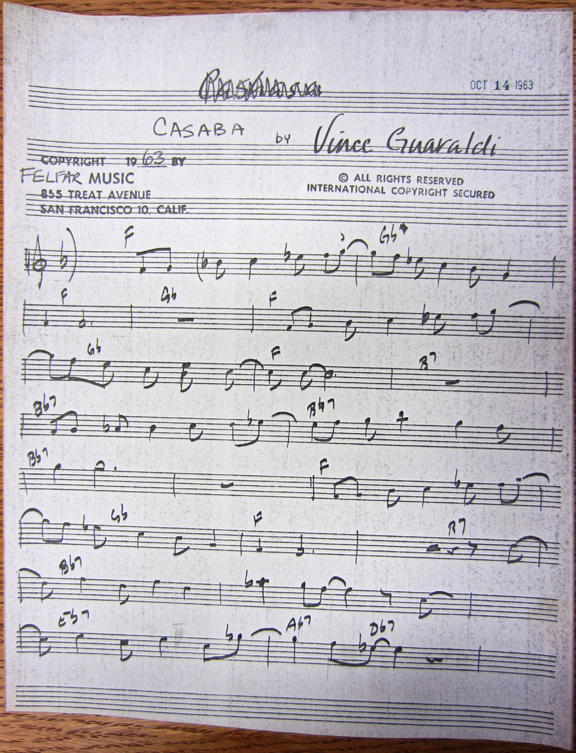
Two years later, almost to the day — on October 14, 1963 — Guaraldi filed a copyright claim for "Casaba." That page of music displays an identical melody line, allowing for minor variations on how long individual notes were to be held. "Casaba," then, was the title used when Guaraldi and Sete debuted the recorded version of the tune on their first collaborative LP.

Why, we wonder at this late remove, the change of heart, title-wise? And for that matter, why file a second copyright? What had changed, aside from the title?

The song's owner, that's what.

Prior to this most recent bit of research, I was under the impression that Guaraldi had issued only two songs — "Cast Your Fate to the Wind" and "Alma-Ville" — under the Friendship Music banner, the partnership he had formed with Trident club manager Frank Werber. An exhaustive examination of the Library of Congress' Guaraldi copyright registrations, however, reveals that Friendship also represented "Jimbo's" ... but not for long. By the time Guaraldi and Sete recorded their album, the song belonged to Felfar Music, one of the many shell entities that Fantasy Records' Sol and Max Weiss employed to conceal their control of the pianist's work. We'll never know why Guaraldi chose to re-title the song at that point, but he did.


Click here to see a larger image.
And he didn't immediately arrive at that new choice, either. The sheet music deposit for "Casaba" shows this to be a replacement title, written beneath a crossed-out "Cashasa." Cashasa — also spelled cachaca — is one of Brazil's most popular distilled spirits (390 million gallons consumed annually!), fermented from sugar cane juice and ripened to somewhere between 70 and 100 proof. The connection is obvious: Bola Sete, Brazil, bossa nova, cachaca. 

A casaba is a melon that hails from Turkey. Not much of a link there.

Why "Casaba," then, instead of "Cashasa"? Hey, we'll never know that answer, either.

Which brings us back to the title employed when Guaraldi re-recorded the tune on his final Warner Bros. album.

There is no Library of Congress copyright registration for "Jambo's," which suggests this might have been ... a typographical error on somebody's part. Guaraldi himself? The person responsible for the album liner notes and disc song titles? If the latter, you'd certainly think Guaraldi would have caught such a mistake, particularly since it seemed his intention, in 1970, to finally acknowledge Jimbo Edwards and his club.

My good research buddy Doug — who has assisted greatly with these copyright investigations — points to Guaraldi's occasionally tendency toward wordplay (as with "Coffee and Doe Nuts"), and suggests that perhaps the jazz pianist made a droll portmanteau word out of Jimbo's and jam (as in jazz jam), and arrived at "Jambo's." That's a much more romantic option than an unfortunate spelling mistake, but — as with Casaba and Cashasa — the truth remains lost to time.

But this much is certain: As originally composed and registered as "Jimbo's" in 1961, Guaraldi clearly intended this tune to honor John Edwards and Jimbo's Bop City ... which I long suspected and now can safely accept as fact.

************

Speaking of the album Alma-Ville...

I'm issuing a call to the Internet Group Mind: Let's see if anybody out there can help answer a few questions about this album.

1) Any thoughts of the significance of the title? (Both the LP title, and of course the song of the same name, which debuted back on 1962's Jazz Impressions of Black Orpheus.)

2) Who is the kid in the photo?

3) Where was the picture taken ... and what are those things behind and beneath him?

Enquiring minds want to know...

Wednesday, December 26, 2012

Will the preferred soundtrack please stand up?

I field a lot of questions regarding Guaraldi, more so now, in the wake of my book's arrival in the spring of 2012. I enjoy the correspondence, particularly when somebody points me in the direction of some previously unknown detail about the jazz pianist's life, or confirms an anecdote or concert date that I suspected was genuine, but hadn't yet verified.

Folks love to discuss his music as well, and particularly his score for 1965's debut Peanuts TV special, A Charlie Brown Christmas.


The most common question these days actually is a request: Numerous fans want to know how to distinguish the "original" 2006 Concord/Fantasy CD from the later "corrected" version. If you're not familiar with the controversy that erupted when this re-mastered album debuted, the exhaustive details can be found here. The pertinent modifications on the initial 2006 release concerned four tracks, and this is how Fantasy described them:


Track 1: "O Tannenbaum" -- the original LP version cut off the introduction to the song, which has been reinstated on this new CD;

Track 4: "Linus And Lucy" -- the original LP version was an edit of two different takes, whereas in the remix for the new CD we ran one of the takes in its entirety; 


Track 5: "Christmas Time Is Here" (instrumental) -- the original LP version fades out at the end of the song, almost losing the last chord, which can be heard quite clearly on this new CD;


Track 7: "Skating" -- the original LP version fades during the bass solo at the very end, whereas this remastered CD allows the song to run to its conclusion, which adds about 10 seconds to the track.


Unfortunately, longtime listeners were very unhappy with these changes, insisting that they wanted the listening experience to be just as it was on the 1965 LP (although apparently it was all right to clean up extraneous studio noise). One must not tamper with perfection, folks insisted, and the situation was worsened by the fact that an entirely different take accidentally had been selected for Track 9, "Christmas Is Coming."

The other side of the debate was occupied by jazz fans who hunger for just the sort of alternate takes that this 2006 album provided. (Four bonus tracks offered yet more variety.) I belonged in their company, and I honestly couldn't understand the fuss; it wasn't as if all the LPs and 1988 CDs had vanished — or ever would — leaving people with no choice but the 2006 album. People who preferred the original listening experience still could find it, and quite easily.

But Concord/Fantasy bowed to public pressure and agreed to switch things back on all future pressings of the 2006 CD. Additionally, patrons unhappy with their "defective" 2006 originals were encouraged to send 'em back for this "corrected" version; the offer was valid through March 1, 2007 (so don't expect anything at this late date).

Well, you can imagine what happened next.


Intrigued by the controversy, some folks wanted the original 2006 disc; others wanted its replacement. Some wanted both. The problem: There was no way to tell 'em apart from the outside. One had to play a disc in order to identify it. (Queue up "Linus and Lucy" and listen for drums — or the lack thereof — in the opening measures.) That's not too helpful, unless one had access to a store that carried used CDs and equipment on which to test-play them.

Flash-forward to the present day, and there's still no way to tell 'em apart. The exterior packaging is virtually identical; heck, even the discs themselves are identical. No distinguishing codes along the edges; no indication of "second printing" or words to that effect. And so I'm asked this question a lot, and until now I've not been able to share any useful information.

Thanks to the diligent help of an equally obsessed friend, however, I now can offer a partial ray of sunshine.

There's still no way to distinguish individually sealed versions of 2006 Mark 1 and Mark 2. But the 2007 holiday season debuted an attractively designed tin that contained three CDs: 1998's Charlie Brown's Holiday Hits; the 2005 compilation album, 40 Years: A Charlie Brown Christmas; and the 2006 re-mastered version of A Charlie Brown Christmas ... and the latter is the second, "corrected" version. Best of all, it can be identified by three distinguishing features:

1) The package was distributed and marketed by Madacy Entertainment, of Quebec, Canada, and each disc's exterior artwork also includes this information on the back cover;

2) The Madacy disk comes in plastic clamshell packaging, as opposed to Fantasy's paper tri-fold with the clear "cel" window; and

3) For some odd reason, the word "stereo" was left off the cover of this set's version of the 2006 Charlie Brown Christmas. And that's easy to spot.

So: Although I still can't help anybody wishing a guaranteed copy of 2006 Mark 1, folks wanting Mark 2 are encouraged to seek this tin set ... which has the added bonus of a heavily discounted price.

That's half the battle, anyway...

*************

Speaking of minor controversies, it has long been known that while Coca-Cola sponsored the initial 1965 broadcast of A Charlie Brown Christmas, the soft drink titan's involvement was stripped away in later years, when CBS sold commercial spots to all sorts of advertisers. The TV special's opening scene, with Charlie Brown and the rest of the Peanuts gang skating to the gentle refrain of "Christmas Time Is Here," was similarly truncated when the show was released on video; the cute plug for Coke, as Snoopy slammed Linus and his blanket into a convenient sign, was removed. A second acknowledgment, at the special's conclusion ("Merry Christmas from the people who bottle Coca-Cola"), also was excised.

All these years later, whether on VHS, DVD, Blu-ray or anything else, the show never has been completely intact. As a result, the Coca-Cola sponsorship has assumed the aura of legend, with an equal number of people arguing that Coke never did have a visible presence in A Charlie Brown Christmas ... despite the premature — and quite obvious — fade to black and muting of the soundtrack immediately after the show's title appeared on screen.

I've long known that the Paley Center for Media, with branches in Los Angeles and New York, has a copy in its archives; visitors can visit and view the show, but the Paley Center absolutely does not make copies. I assume that their copy is the original, wholly intact version ... but as I've not yet been able to make the trip and see for myself, I cannot state this with certainty.

Happily, I no longer need to. A helpful soul has posted definitive proof on YouTube: both the key seconds immediately following the show's title and the holiday greeting, complete with Coca-Cola logo, at the end.

But every answer comes with a price: While this footage resurrects the long-discarded proof of Coca-Cola's participation, sharp-eared Guaraldi fans will realize that the background song — "Christmas Time Is Here" — in the opening scene concludes with a refrain quite different from the version used for the 1965 album!

So where in Fantasy's vault is that take hiding?

It simply never ends...

Wednesday, December 12, 2012

The sincerest form of flattery


While writing the final chapter of my book on Guaraldi, when it came time to briefly mention the unusual phenomenon of contemporary musicians who’ve chosen to cover the entire Charlie Brown Christmas score, I paused long enough to wonder whether this has happened very often.

Granted, jazz is a genre that encourages such behavior; consider the number of folks who’ve put their own stamp on, say, Miles Davis’ “All Blues.” But covering an entire album? Surely, that must be unusual.

And, indeed, it is ... but, by a curious coincidence, one of my other favorite jazz albums — also a TV score — has garnered the same attention: Henry Mancini’s iconic soundtrack for Peter Gunn. The series ran for three seasons, from September 1958 through September 1961, and Mancini actually produced two albums: The Music from Peter Gunn (1958) and More Music from Peter Gunn (1959).

To say that Mancini’s swingin’ themes made a splash would be an understatement. The first album reached No. 1 on Billboard’s Pop LP Chart, and suddenly everybody wanted a piece of the action. All sorts of folks covered the groovin' title theme, with Ray Anthony's version spending 17 weeks on the Billboard Hot 100 chart between January 5 and April 27, 1959; it peaked at No. 8 the week of March 2.

Ted Nash, Maxwell Davis and Pete Candoli had released the first cover album, titled simply Peter Gunn, the year before; Nash, Pete and Conte Candoli, calling themselves the Soundstage All Stars, followed with More Peter Gunn in 1959. Drummer Shelly Manne & His Men also released two albums in 1959: Play Peter Gunn and Son of Gunn. The Joe Wilder Quartet joined the fun in 1959, with Jazz from Peter Gunn; Ray Ellis and his Orchestra followed in 1960, with The Best of Peter Gunn.

(And if I’ve missed any others, please let me know.)

It’s very simple, really: When listeners really, truly love a particular score, they can’t get enough of it. Leonard Bernstein’s music for West Side Story is another good example; I couldn’t begin to tabulate all the jazz cover versions that album generated.

We therefore shouldn’t be surprised that Guaraldi’s beloved Christmas album has received the same treatment, and increasingly more often during the past few years.

But are they any good?

In most cases, yes, and well worth your time and money. And since this is the holiday season, it seems an appropriate time to discuss them all.

But let’s make it a bit more fun, and score the contestants according to my own whimsical parameters. Points therefore will be awarded for...

1) Covering all four of Guaraldi’s original tunes: “Christmas Time Is Here,” “Christmas Is Coming,” “Skating” and “Linus and Lucy” (5 points each, for a total of 20);

2) Covering all five of the traditional Christmas songs that Guaraldi arranged and included on the album: “O Tannenbaum,” “What Child Is This, (aka Greensleeves)” “My Little Drum (aka The Little Drummer Boy),” “The Christmas Song” and “Hark, the Herald Angels Sing” (5 points each, for a total of 25);

3) Plus covering Beethoven’s “Für Elise” (25 point bonus);

4) And presenting them in the same album sequence (50 point bonus).

Fresh jazz covers of additional Christmas songs are nice, but count neither toward nor against the total score.

Finally, 10 points will be subtracted for unimaginatively calling the album A Charlie Brown Christmas, because that’s confusing. At the very least, the artist(s) in question should give their work some sort of original title.

Please note, though: The final tally applies solely to how faithful the cover elements are, and in no way reflects the musicality present. Jim Martinez’s album may score low in the “perfect cover” department, but it’s one of my favorites on this list.

Onward!

Monday, November 19, 2012

A Jolly Guaraldi Holiday


As the first decade of the 21st century drew to a close, several bands and performance entities throughout the country began to offer what has grown into something of a holiday habit: concerts of music from Guaraldi's score for A Charlie Brown Christmas. California's Pasadena Jazz Institute was one of the first, with 2008's presentation of It's a Charlie Brown Christmas: The Music of Vince Guaraldi; the concert featured the David Arnay Jazz Trio. Starting in 2009, a New York theater company — Road Less Traveled Productions — adapted the entire TV special for the stage, with Guaraldi's music performed by the Julie Arlotta Jazz Trio.

Much more visibly, jazz pianist and Concord recording artist David Benoit has been touring his own ambitious Charlie Brown Christmas show for several years; the 2011 tour kicked off in late November at the Hyatt Regency Lake Tahoe in Incline Village, Nevada, and later touched down at venues in California, New York, Vermont, Pennsylvania, Wisconsin, New Mexico, Washington, Georgia and Washington, D.C. We caught last year's performance in Livermore, California, and I can report that it's a great show. It's also tremendously sweet, since Benoit and his team work with a children's choir that is local to each venue.

Benoit is part of the Dave Koz and Friends Christmas show this year, and therefore won't be touring his own production, but keep an eye out for 2013.

Meanwhile, we do have numerous other options for this year. One ambitious tour is being mounted by jazz pianist Jim Martinez, with whom I've shared a stage twice this past year. He has a great feel for Guaraldi's touch, and also is an engaging performer with plenty of anecdotes to sprinkle throughout a concert. He often appears with vocalist Laura Didier, who delivers a truly soulful reading of "Christmas Time Is Here." Jim's Music from A Charlie Brown Christmas show kicks off November 24 at Southgate, Michigan; additional appearances have been scheduled for venues in North Carolina and California. Check his web site for details.

The biggest gig on his tour is the one belonging to the illustration at the top of this article — December 19, in Berkeley, California — when Jim will be joined by former Guaraldi sidemen Eddie Duran and Dean Reilly. And if you decide to attend, you might bump into me, as well.

The Eric Byrd Trio also has made a cottage industry of Guaraldi's Christmas music, going so far as to cover most of the album in a 2009 release. Byrd's combo has taken its Charlie Brown Christmas Show on the road for several years now, mostly in Maryland. 2012 gigs begin in Salisbury, MD (December 5), and conclude with three shows in Westminster, MD, on December 14-15. One additional bonus performance will take place December 21, at the Westminster Presbyterian Church in Washington, D.C. Check his website for details.

The Ornaments, a jazz trio based in Nashville, Tennessee, released their cover of Guaraldi's album in late 2011; they delivered a mini-tour that year, and they're doing the same thing this year. They have six dates booked between December 18 and 22, most at The Family Wash, a family-style restaurant in East Nashville. Check their Facebook page for details.

The Cartoon Christmas Trio doesn't concentrate solely on music from A Charlie Brown Christmas; they also pepper their performances with tunes from other animated holiday shows, such as Frosty the Snowman and How the Grinch Stole Christmas. I love their album, and they have a busy touring schedule this year, throughout Pennsylvania. Check their website for details.

Other groups also are getting into the act, and I'll cite them below, and add to this list as new information becomes available (so do check back on occasion). Be advised, though, that these are listings, not endorsements. Not having heard any of these other acts, I'm not in a position to judge (as opposed to Jim Martinez and David Benoit, about whom my enthusiasm knows no bounds).

• Charlie Brown Jazz Christmas, with the John Milham Jazz Trio; Friday, November 30, during Canton's Light Festival at the Canton First Baptist Church Family Life Center, in Canton, Mississippi. Details.

• Charlie Brown Jazz Christmas; Saturday, December 1, at the Mississippi Children's Museum in Jackson, Mississippi. Details. [same combo — the John Milham Jazz Trio — as the November 30 show]

It's a Jazzy Christmas: A Celebration of Vince Guaraldi's Holiday Jazz Music, with the Peanut Gallery Jazz Trio; Sunday, December 2, at the Massry Center for the Arts in Albany, New York. Details.

Charlie Brown Jazz Christmas; Friday, December 7, at the Laurel Little Theater in Laurel, Mississippi. Details[same combo — the John Milham Jazz Trio — as the November 30 and December 1 shows]

• Charlie Brown Jazz Christmas; Saturday, December 8, at Murphy High School's Delaney Auditorium, in Mobile, Alabama. Details[the John Milham Jazz Trio again]

• Charlie Brown Jazz Christmas; Sunday, December 9, at Faulkner State Campus' Giddens Auditorium, in Fairhope, Alabama. Details[the John Milham Jazz Trio again]

A Charlie Brown Christmas, with the Heather Pierson Quartet; Sunday, December 9, at the Medallion Opera House in Gorham, New Hampshire. Details.

A Charlie Brown Christmas, with the Michelle Schumann Trio; Sunday, December 9, at the Austin Chamber Music Center in Austin, Texas. Details.

• A Charlie Brown Christmas, with the Jose Gonzales Trio; Tuesday, December 11, at the Rainier Chapter House in Seattle, Washington. Details.

• A Charlie Brown Christmas, with the Heather Pierson Quartet; Thursday, December 13, at Pitman's Freight Room in Laconia, New Hampshire. Details.


• A Charlie Brown Christmas, with the Heather Pierson Quartet; Friday, December 14, at the Leura Hill Eastman Performing Arts Center in Fryeburg, Maine. Details.


• A Charlie Brown Christmas, with the Heather Pierson Quartet; Saturday, December 15, at The Lily Pad in Cambridge, Massachusetts. Details.

• Jeffrey Butzer & T.T. Mahony Perform Vince Guaraldi's A Charlie Brown Christmas; Saturday, December 15, at The Earl, Atlanta, Georgia. Details.

A Charlie Brown Christmas Extravaganza, with an unidentified band performing while the TV special is shown on a wall; Saturday, December 15, at Back to the Grind, 3575 University Avenue, Riverside, California. Details.

• A Charlie Brown Christmas in Norway (!), with the Heather Pierson Quartet; Sunday, December 16, at the First Universalist Church of Norway, in Maine. Details.

• Jeffrey Butzer & T.T. Mahony Perform Vince Guaraldi's A Charlie Brown Christmas; Sunday, December 16, at the Bottletree Cafe in Birmingham, Alabama. Details.

Sunday Serenades: A Charlie Brown Christmas with jazz saxophonist Karl Stabnau; Sunday, December 16, at the Brighton Memorial Library in Rochester, New York. Details.

• Jeffrey Butzer & T.T. Mahony Perform Vince Guaraldi's A Charlie Brown Christmas; Friday, December 21, at the Bottletree Cafe in Birmingham, Alabama. Details.

A Charlie Brown Christmas and Other Seasonal Music, with the MASK Quartet; Saturday, December 22, at Parlor 88 East, Springfield, Missouri. Details.

Ring in the Holidays (some Guaraldi content), with the Eric Mintel Quartet; Saturday, December 22, at the Sellersville Theater, Sellersville, Pennsylvania. Details.

That's it for the moment ... but stay tuned!


Friday, November 9, 2012

The Schulz Museum Guaraldi Extravaganza

I tend to be cautious with my anticipation, having found that modest expectations more often lead to pleasant surprises. This is particularly true of first-time events with plenty of variables, and such was the case with the collaborative show David Benoit and I designed for the Charles M. Schulz Museum last Saturday, November 3.

Questions abounded. Would we get enough people to fill the seats in the Museum's spacious Great Hall? Would we get too many people, leading to frustration and standing-room-only in the upper balcony? Would the acoustics be suitable for a solo pianist? Would David and I "banter" well, during the course of our back-and-forth format? And (always my most paranoid fear) would audience members chuckle in the right places ... and not laugh in the wrong places?

My wife Gayna and I arrived at the Museum shortly before noon, giving us plenty of time to enjoy a light lunch at the adjacent Warm Puppy Café. We then returned to the Museum, where Education Director Jessica Ruskin was overseeing last-minute arrangements (and believe me when I say that Jessica deserves oodles of credit for attending to all possible details). David and his family — wife Kei and daughter June — arrived shortly after 1 p.m. He and I went over a few final tweaks, having nailed down the music set list via e-mail during the previous few weeks. He had a few anecdotes to insert before or after specific songs; I adjusted my narrative accordingly. 

(Actually, he and I filled an enthusiastic half-hour trading stories about our childhoods, after discovering that he and I grew up in the same Southern California region, and that he and his family now live only a few miles from where I spent all my teenage years. Small world, indeed!)

David Benoit and his daughter, June, rehearsed their one shared number while Museum
visitors (unseen, upstairs and to the left) watched with curiosity and delight. These
proceedings also were observed by Museum Education Director Jessica Ruskin,
center left, and a Museum docent.
We then entered the Great Hall, where a tuner had just finished prepping the gorgeous 9-foot grand piano; even David was impressed by the splendor of this ebony beast. He spent about half an hour running through chords and sections from the various songs, then pronounced himself satisfied with the instrument.

Museum visitors had the bonus of being able to watch all this unfold, since the Great Hall is readily visible from various vantage points. And even when the bulk of the hall was roped off, as the rows of chairs were set up, folks in the exhibit areas on both floors were able to see and hear everything we did.

That was pretty much it, for rehearsal ... and it's equally important to note that, aside from the 15 minutes or so I referenced in the paragraph above, David and I never rehearsed how we'd "pass the baton" between ourselves, as the show progressed. I figured spontaneity would be better than getting hung up on specific dialogue.

Tuesday, November 6, 2012

Win a free "Charlie Brown Christmas" CD!

The folks at Fantasy Records have teamed with the jazz gurus at AllAboutJazz.com, to offer folks an opportunity to obtain a copy of the just-released, newly remastered CD version of Vince Guaraldi's A Charlie Brown Christmas.

Entering the contest couldn't be easier. You'll find the AllAboutJazz press release here; you need only click on the blue link ("Click here to enter the contest"), where you'll both register for the CD draw, and become a member of AllAboutJazz.com (which you should have done long ago anyway!). Alternatively, you could become a Guaraldi fan at AllAboutJazz, which will automatically place you in the running.

The contest will continue until December 1, at which point five winners will be selected.

So, what are you waiting for? The only danger is that you'll suddenly spend hours reading all the excellent essays at AllAboutJazz!

Friday, October 26, 2012

Lee Mendelson, lyricist

Director/producer Lee Mendelson deserves oodles of credit for creating what became the Peanuts television empire; he also had the genius to gather a four-man team that included Charles M. Schulz, Bill Melendez and Vince Guaraldi. Everything started with Schulz, of course, who scripted the early 30-minute specials that featured his characters. Melendez and his crew animated Charlie Brown and the gang; Guaraldi and his fellow musicians supplied the swing in everybody's step. Mendelson officially served as director and producer.

And, on a few occasions, he turned into a songwriter.

The most famous example, and the tale oft-told by Mendelson himself, refers to A Charlie Brown Christmas and the song it made famous: "Christmas Time Is Here."

To quote a brief passage from my book:


As late summer [1965] segued to early autumn, the Peanuts Christmas special was coming together; a rough cut, set to Guaraldi's music, opened on Charlie Brown and his friends skating on a frozen pond, as snowflakes gently flurried about them. But although Mendelson liked the music employed behind the action — Guaraldi's "Christmas Time Is Here" — he felt the scene lacked something.

"The opening song was an instrumental," Mendelson recalled. "I felt we should get some lyrics, and some voices. We couldn't find anybody to write the lyrics, and I called all my Hollywood friends who were songwriters. But nobody took the assignment, so I sat down, and in about 10 minutes wrote the words to 'Christmas Time Is Here' on an envelope.

"I sure wish I still had that envelope!"

Ask folks to cite Peanuts songs that include lyrics, and you'll get a very short list: "Christmas Time Is Here," "Joe Cool" and "Little Birdie." Guaraldi himself wrote the words for the latter two. But Peanuts fans with very good memories can add another song: the title theme to You're in Love Charlie Brown, the fourth Peanuts special, which debuted June 12, 1967. The show's title theme, a lyrical, slightly woeful waltz, reflects Charlie Brown's hopeless yearning for the never-seen Little Red-Haired Girl.


Mendelson, no doubt encouraged by the success he'd had with "Christmas Time Is Here," penned some brief lyrics for this title theme, which are heard as the show's credits appear:

Poor little Charlie Brown,
Don't let love bring you down.
You'll have your day,
She'll come your way;
She'll take away your frown.
Poor little Charlie Brown.

At least ... I thought they were brief.

Well, in fairness, that's all we ever heard. That's all anybody ever knew about.

But that's not all Mendelson wrote.

Guaraldi's tune continues far longer than those six lines; it therefore stands to reason that Mendelson might have written lyrics for the entire composition, although I doubt anybody ever made that assumption. Thanks to some digging at the U.S. Library of Congress, and a related search of the U.S. Copyright Office, the full story — or, rather, the full song — has come to light.

(Truly, I love this sort of discovery!)

Herewith, then, Lee Mendelson's full lyrics to "You're in Love, Charlie Brown," accompanied by one of the actual manuscript pages that was filed with the Copyright Office. Note the twin bylines: "V. Guaraldi + L. Mendelson." Note also the hilarious doodle of — I'm guessing — Charlie Brown's head!


Poor little Charlie Brown,
Don't let love bring you down.
You'll have your day,
She'll come your way;
She'll take away your frown.

Poor little Charlie Brown,
Don't let your hopes all drown.
You'll have your day,
She'll come your way;
You're in love, Charlie Brown.

She's a sweet Little Red-Haired Girl,
Who's nice as she can be.
All she needs is a little boy
Who's just as perfect as she.

Poor little Charlie Brown,
Always ends up a clown.
Who would love you?
No one! That's who!
Why don't you just leave town.


Poor little Charlie Brown,
No one could love that frown.
Who would love you?
No one! That's who!
Your face is too darned round.

Ouch! Those two final choruses are killers, aren't they? 

Perhaps that's why we never got to hear them in the show...

One last little oddity: Various DVDs of this Peanuts special include the six brief lines as indicated above. The English audio soundtrack included with the Warners 1960s collection DVD, however (and rather strangely!), features a different sixth line: You're in love, Charlie Brown ... which you'll note is the final line of the second stanza. It's therefore possible that at least the entire second stanza was recorded during production, but then left unused.


**********

Catholic San Francisco runs an occasional feature titled "Cemetery Corner," which marks the 125th anniversary of Holy Cross Catholic Cemetery in Colma, California. The entry in a recent issue (October 19, 2012) is a nice little tribute to Guaraldi, and includes an excellent photo of his grave marker (sharpest photo I've seen of it, in fact). Check it out here.

Tuesday, October 9, 2012

'Christmas' comes early this year

Fantasy's newly remastered edition of A Charlie Brown Christmas arrives in stores today, just in time to take advantage of the holiday shopping season. (Halloween? Thanksgiving? What are they?)


Quoting from Concord's press release:

The 2012 Remastered & Expanded Edition CD will feature the original 1965 recording, newly remastered with 24-bit technology from the original analog stereo master tapes. It also contains three holiday bonus tracks that did not appear on the original LP: “Greensleeves,” “Thanksgiving Theme” and “Great Pumpkin Waltz.” The digi package includes a 20-page booklet featuring memorable Peanuts character images from the beloved A Charlie Brown Christmas television special.

I've seen the booklet, and Rachel Gutek's package design is, indeed, fabulous. I was pleased, once again, to be asked for a new set of liner notes, and my friends at Concord were kind enough to use the entire essay, even though it ran longer than originally requested ... which probably is why the booklet is 20 pages, and not 12 or 16. (Hey, I've never been known for brevity.)

As I observe, in part, in those liner notes:

Analog-to-digital conversion has gotten a lot better since this album debuted on CD in 1988, as a side-by-side listening comparison will reveal. The ubiquitous background hum, so notorious due to the Spartan conditions of Fantasy's recording studio, is less intrusive; this is particularly evident when the young members of San Rafael's St. Paul's Church Choir — standing in for all of Charlie Brown's friends — croon the melody line and then sing "Hark, the Herald Angels Sing." The album's overall dynamics are more crisp, the individual elements and instruments more "alive," better conveying a sense that we're in the same room as the musicians.

You'll notice the most vibrant difference, throughout, on the contributions by bassists Monty Budwig and Fred Marshall. Guaraldi's piano — at once more detailed and warmer than the somewhat brittle sounding original CD reissue — sits better in the mix. This draws greater attention to the equally superlative work by the sidemen; you'll hear marvelous bass riffs that have been all but buried until now.

And here's a bonus: For those who love the sound and look of old-style LPs, Fantasy also will issue a new pressing of this album on green vinyl. This is an affectionate nod to Fantasy's early days, when owners Max and Soul Weiss — having named their company after the popular science-fiction pulp magazine — would produce records in unusual colors: green, red and blue translucent vinyl. The initial pressings of Guaraldi's early Fantasy LPs followed this pattern: usually red vinyl for the monaural version, and blue vinyl for stereo. I don't believe Fantasy ever granted Guaraldi a green LP, back in the day, so Concord deserves credit both for reviving this tradition, and giving it a holiday vibe.

Be advised, however: LP lacquer cutting from an analog master (LP) and digital remastering (CD) are two different things. The contents of this new green vinyl LP do not, as a result, reflect the newly remastered CD discussed above. This LP has been pressed from George Horn's 1988 master (which does include the extra version of "Greensleeves").

No doubt you've purchased this album at least once before, and perhaps two or three times. But really, it isn't possible to have too many copies ... particularly when this new one sounds so grand.


********


As a reminder to Northern California Guaraldi fans, I'll be joining pianist and recording star David Benoit at Santa Rosa's Charles M. Schulz Museum at 4 p.m. Saturday, November 3. David and I will present a musical and descriptive journey through Guaraldi's life and career, stopping at numerous tuneful highlights along the way. This event will be included with the price of museum admission, and it will be followed by a light reception. Check out the museum's web calendar for additional details.